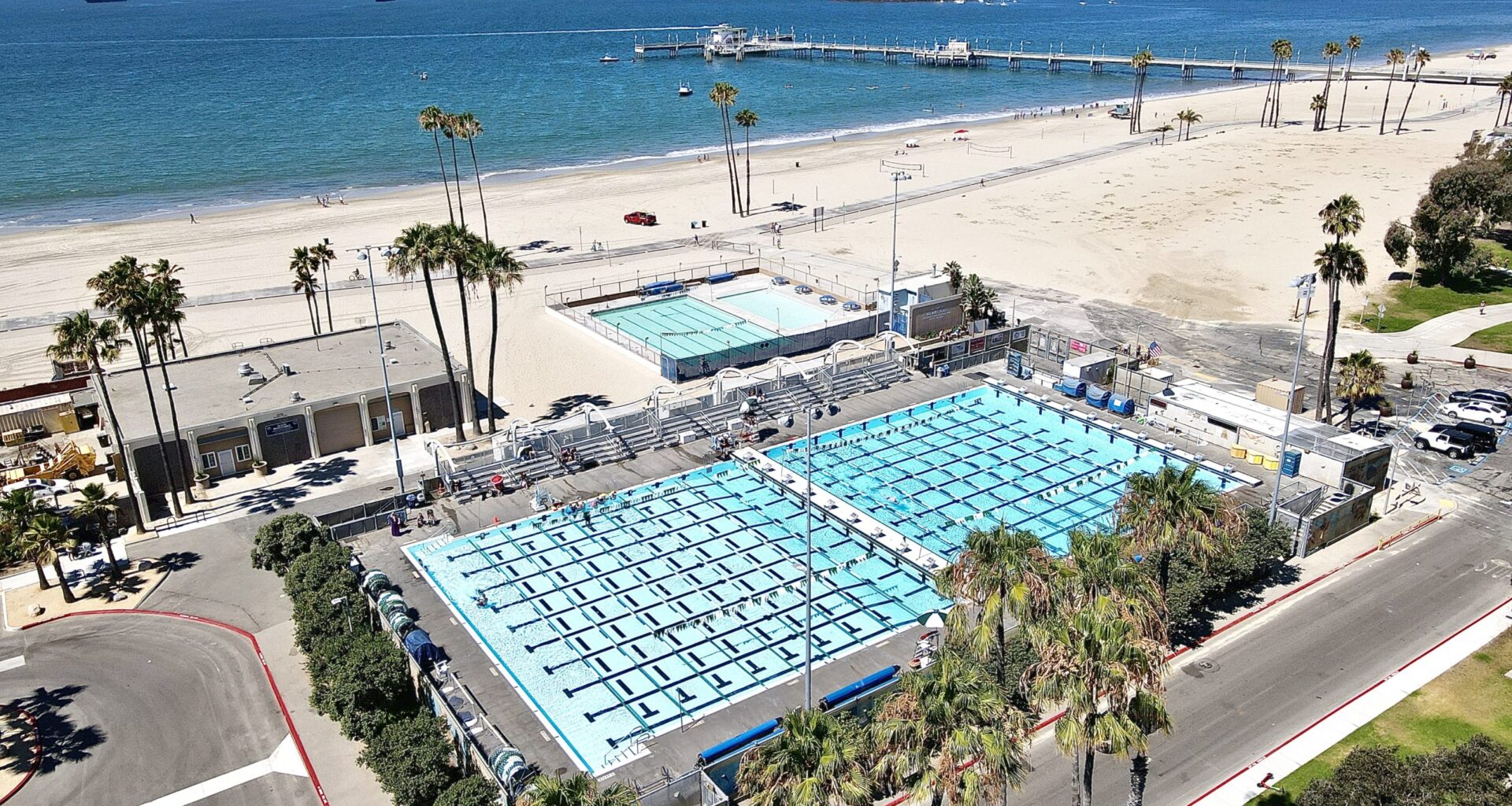
Over a decade and millions spent in preparing and redesigning culminated in a final construction and funding plan for the long-awaited Belmont Beach and Aquatics Center at Tuesday’s Long Beach City Council meeting.
In total, the project is costing the City $105 million, which includes the decade plus of planning meetings, redesigns, fighting a lawsuit and more. While Long Beach has been setting aside funds for the center for years, it will have to borrow $24 million in bonds to be paid back over a period of 30 years.
To pay for this bond, Long Beach will introduce parking meter fees along the coast in 1,800 spots that are currently free, as well as increase parking costs in other areas and increase fees for certain programs at the aquatics center once it’s open.
The City approved a $59 million contract with Bernard Bros. Inc. for the construction of the Belmont Beach and Aquatics Center, as well as $24.5 million in bonds to cover a funding gap for the project.
The City expects to break ground on the aquatics center this summer and have the center completed by spring 2028.
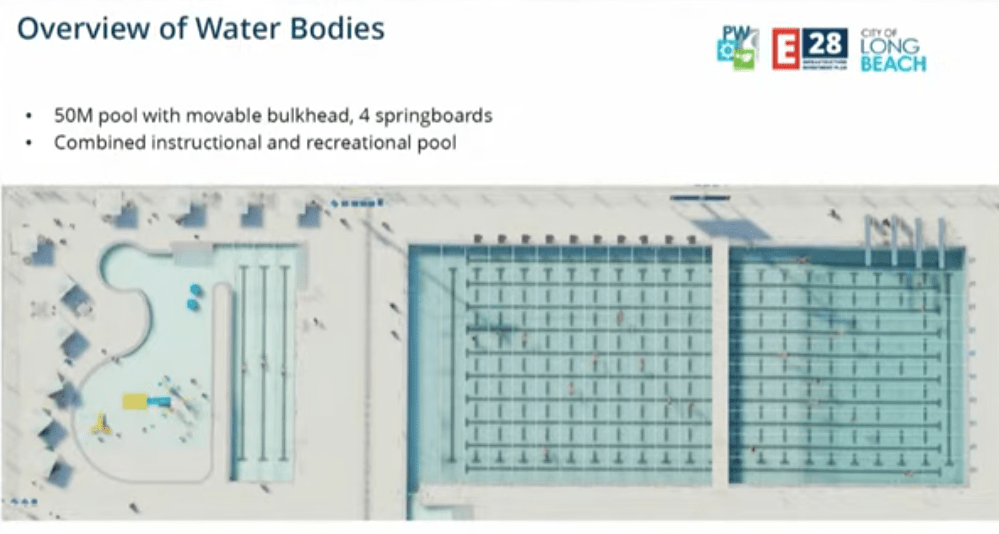 A rendering of an overview of the Belmont Beach Aquatics Center, expected to be built by spring 2028. (Courtesy of the City of Long Beach)
Details of the updated design
The updated design features a 50-meter all-deep outdoor pool with a movable bulkhead dividing the pool in half, four springboards, a shaded seating area with 544 seats, a separate instructional/recreational pool, a splash pad and public art installations. The moveable bulkhead will allow for various practices and competitions to take place for different distance races and diving competitions, as well as professional water polo, said Public Works Director Josh Hickam.
For families, children and seniors, the shallow therapy and learning pool will be more for recreational use, including the splash zone, spray zones and activity tower. This area will also feature a deployable volleyball net and other floatable features, picnic tables and loungers. The recreational area will remain open to the public 95% of the year, according to City documents. There will be separate men’s and women’s locker rooms and upgraded restrooms.
The Belmont Pool project comes equipped with an Equity and Public Access Program with eight components:
After-school learn-to-swim programs: Low-cost swim lessons provided from the months of March to May and September to October, offering 140 swim classes between the City’s three aquatic facilities. Financial scholarships are available for these lessons.
Weekend programs: Low-cost weekend recreation swim sessions.
Summer day camp programs: A supervised program at the pool for local youth, as well as allowing other day camps across the City to access the pool for recreational swimming. This will also be offered on a sliding scale and have available scholarships through nonprofit partners.
LA84 foundation subsidy program: Giving youth access to team sports such as water polo, artistic swimming or swim teams.
“Dive-in” movies at the pool: Movies at the pool will be incorporated with the City’s current Movies in the Park summer programming.
Partnerships with schools, churches and other civic organizations in underserved areas: Parks, Recreation and Marine Department will work with volunteers from each of the “target communities” identified in the Equity and Public Access Program to foster connections with local organizations to understand recreational needs related to aquatic facilities.
Access for seniors: Water exercise classes will be free for individuals 50 years and older. These drop-in classes are held daily and require no registration. Seniors will also be able to access discounted lap and recreational swimming sessions.
Targeted marketing and outreach: Leveraging partnerships across the city, there will be targeted outreach materials in different languages distributed to libraries, community centers, senior centers and online.
The City is also exploring the option of using Prop A funds for transit vouchers for those with limited transportation to the Belmont Pool.
Want more local news?
Sign up for the Signal Tribune’s daily newsletter
Parking will pay for the center
City Manager Tom Modica said they are still facing the challenge of material cost increases, uncertainty due to the U.S. tariff policy and a shrinking labor supply due to increased immigration enforcement.
While the nearly $60 million construction budget will cover the new facility, the total cost is around $105 million, accounting for the upkeep of the temporary facility, demolition of the old facility and all other expenses over the last decade plus.
So far, the City has set aside $77.1 million towards the project and is facing a gap of $28 million. Plans to cover a small portion of this gap include impact fees from developers, Measure A funds and energy efficiency or environmental grants. The remaining $24.56 million will be covered by bonds, or loans.
Long Beach will enter into a 30-year debt repayment plan in which it expects to pay $1.48 million annually from the Tidelands Operating Fund.
To operate the facility, the City expects to spend $3.8 million annually, about $1.5 million of which will be covered by the Parks, Recreation and Marine Department’s budget. This $2.3 million annual funding gap will be added to the Tidelands Fund, bringing the fund to operate at a deficit of $3.78 million annually.
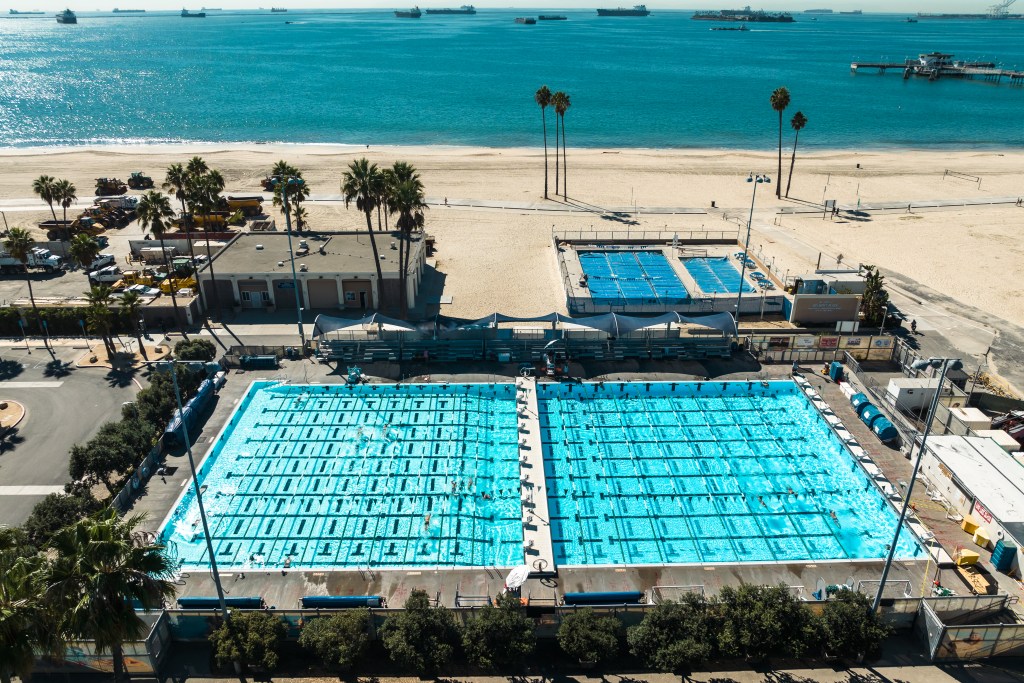 Residents swim laps inside the Belmont Plaza Pool in Long Beach on Oct. 25, 2022. (Richard H. Grant | Signal Tribune)
The Tidelands fund is mainly made up of oil revenue, which is rapidly shrinking amid California’s mandates to phase out oil production. Projected revenues for the Tidelands fund has it facing a $4.5 million deficit by 2028, with no projected surplus in the near future.
The options to cover this deficit are either to find revenue sources within the Tidelands Fund or to use the General Fund. Modica said he did not recommend using general funds, likely since the City is expecting a growing deficit, largely due to shrinking oil funds.
To make up for this deficit, the City is hoping that sponsorships, advertising and philanthropy could contribute to a revenue of $250,000 for the Belmont Pool. The remainder of the Tidelands Fund deficit will be covered by increased parking fees along the coast. Estimates include $3 million in tidelands parking at Alamitos Bay Marina and overnight parking, $300,000 in other tidelands parking structure revenue and $150,000 in general fee increases for certain programs at the pool.
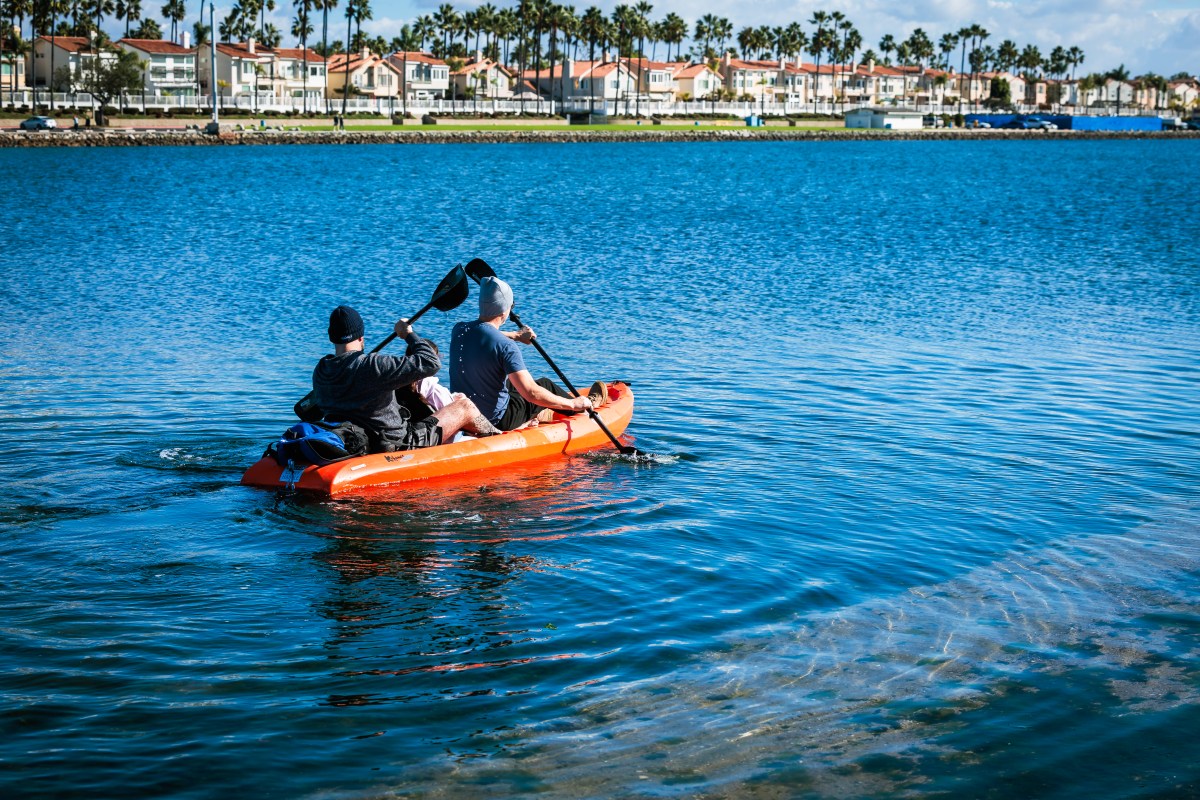 A family piles into a kayak heading into Alamitos Bay from Marine Stadium on Jan. 3, 2024. (Richard H. Grant | Signal Tribune)
These “other” parking increases were already approved by city council in the 2026 budget cycle, but the 1,800 parking spaces in Alamitos Bay, which are currently free, will begin charging people for the first time ever. At just 20% occupancy of these spaces, the revenue expected annually for them is around $3 million.
With these parking revenues, the Tidelands fund can go from a steady deficit to breaking even and seeing $3 million surpluses by 2035.
City staff said all permits and planning documents are completed and approved, and immediate next steps for the project include a branding and sponsorship feasibility study.
At this time, the temporary pool will stay up during construction, and the City has three years to decide whether or not to keep the temporary pool in place once the new aquatics center is completed.
History of the Belmont Pool and long planning process
The original Belmont Plaza Pool opened in 1968 and featured a 50-meter by 75-meter pool, a diving platform, 2,500 spectator seats and an electronic touchpad system to record swimming times. The 1968 Olympic trials were held in the original Belmont Plaza Pool the same year.
The facility closed in 2013 after being deemed “structurally and seismically unsafe,” and was replaced by a temporary pool later that year. The original structure was demolished in 2014, but the temporary construction remains. Also in 2013, the city council approved a plan for a permanent replacement with a larger indoor pool and a deep-water pool for competitive water polo, along with some amenities in the older structure.
Around $100 million was allocated towards the Belmont Plaza Pool, and in 2014 the City entered into a contract with Harley Ellis Deveraux (HED) to serve as an architect on the project. Oil was the main funder of the project, City Manager Tom Modica said, and the price of oil per barrel has gone from about $120 to around $60 per barrel, heavily impacting the expected funds for the project.
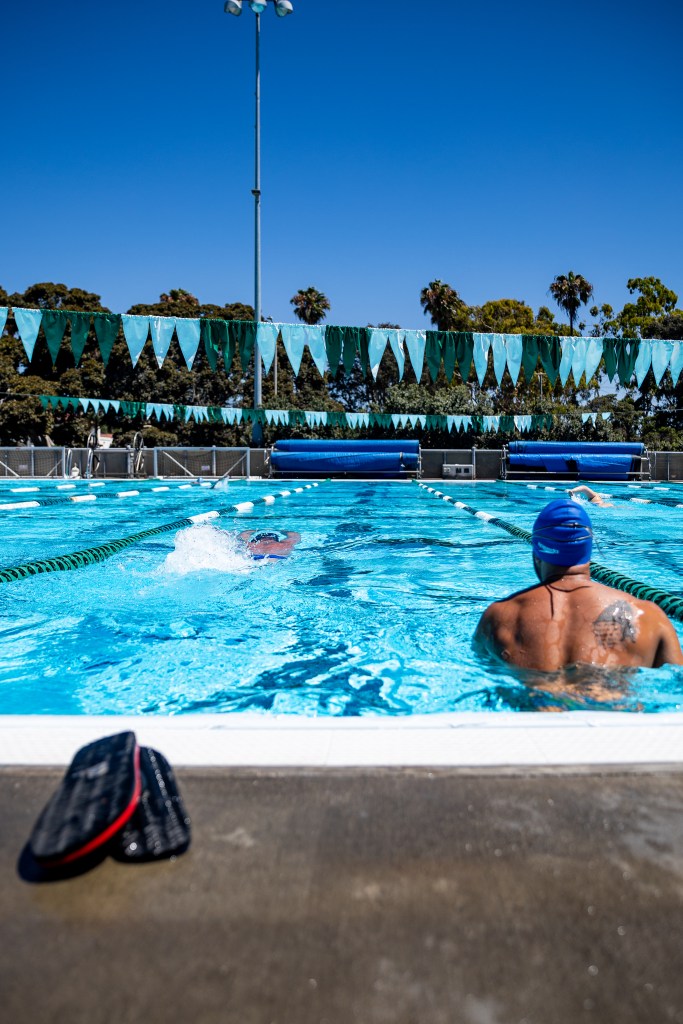 AJ Rae (right) watches as Ryan Smith (left) swims down the lane at the Belmont Plaza Pool in Long Beach on August 3, 2021. (Richard H. Grant | Signal Tribune)
Over the next few years, the project bounced between study sessions, stakeholder meetings, city council and planning commissions, with the pool gaining planning approval and completing environmental study requirements by 2017. The pool was quickly challenged in a courtroom by the Citizens About Responsible Planning, claiming the project violated the California Environmental Quality Act. Judge James C. Chalfant ruled that the project did not violate CEQA in 2018.
From September 2018 to November 2019, the California Coastal Commission gave feedback on the project which prompted multiple redesigns to address issues like the rising sea level, the height of the building, cost escalation and more. At this time, the Belmont Pool Plaza was estimated to cost $145 million, but was brought down to $85 million after another round of redesigns.
Long Beach City Council approved the redesigned construction in 2020, followed by the Coastal Commission’s approval in 2021 with 19 special conditions attached. After a year of preparation and searching for construction bidders, the project was again facing a ballooning budget, due to the aforementioned special conditions, COVID-era inflation on supplies and a loss of oil revenue due to SB1137. The City had $61.5 million budgeted for the Belmont Plaza Pool, and faced a $117 million estimated cost.
Yet another round of redesigns commenced to address the budget, and city council approved a new design in October 2023, the cost estimated at $75 million.