
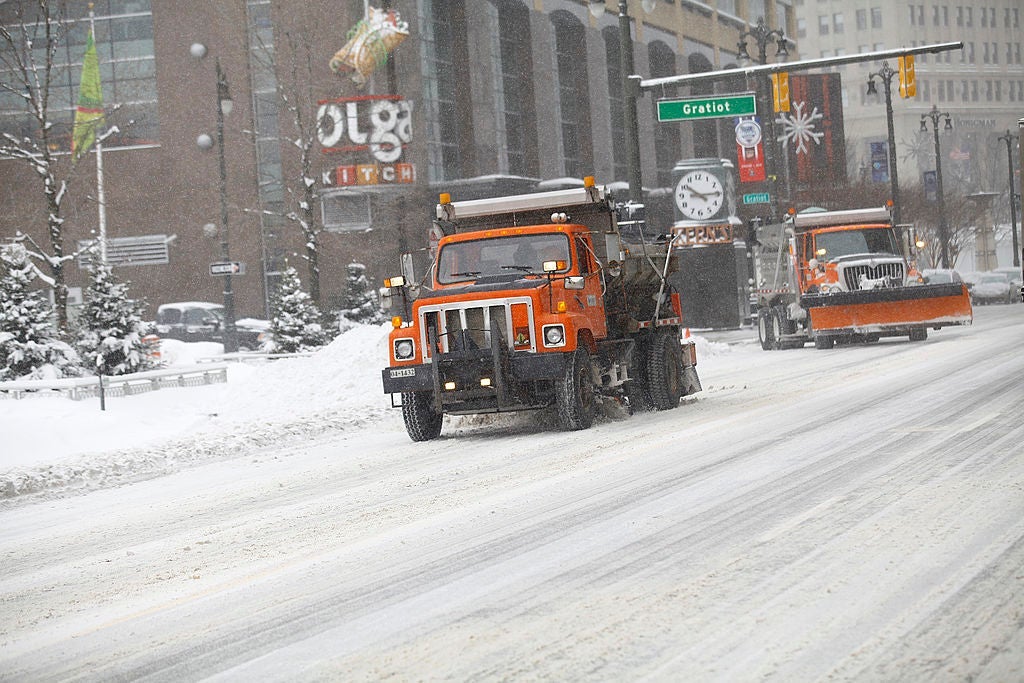
The Road Commission of Oakland County sent out more than 100 snowplows to clear streets as Southeast Michigan fights through snow and icy weather this week. They have 155 drivers who can run salt trucks. Spreading those workers around so they can cover roads all day and night, every day for nearly a month now, hasn’t been easy.
“We’ve got about 155 people right now who can drive salt trucks. So spreading those people out so that we can have coverage, 24 hours a day, seven days a week, as we have for almost a month straight now, is the biggest challenge,” said Craig Bryson, senior communications manager of the Road Commission of Oakland County, according to CBS Detroit.
Wayne County runs about 150 plows on 100 routes. They cover somewhere between 4,500 and 5,000 lane miles—that’s like going from Michigan all the way to Los Angeles and then turning around to come back home.
“Our snow and ice clearing routes total up to somewhere between 4,500 to 5,000 lane miles. So that’s about the equivalent of driving from here to LA and back,” said Scott Cabauatan, deputy director of the Wayne County Department of Public Services, via CBS Detroit.
How hot or cold it gets makes a big difference in whether salt actually does its job. Salt works best when it’s between 20 and 30 degrees outside.
“Salt works great from 20 (degrees) and above 20 to 30 (degrees) is perfect for salting. When you get below 20, it begins to lose effectiveness. You get into the single digits, and it’s pretty ineffective,” Bryson said, as shared by CBS News.
Traffic jams slow down how fast crews can finish clearing streets. When rush hour hits, trucks putting down salt crawl along with everyone else.
“Especially when there’s rush hour traffic, we have, you know, we run at the same pace traffic does. So if traffic is really heavy and congested, we’re not going to be as efficient moving through the traffic and applying salt,” Cabauatan said, as reported by CBS News.
Wayne County adds more trucks to routes whenever drivers can work. They’ll send out extra vehicles if they’ve got the people and equipment ready to go.
“If we have available drivers, we’ll stick additional trucks out there. So we won’t stay with the one truck to one route. We will put additional trucks out there if we have the available resources,” Cabauatan said, according to CBS News.
Michigan Law requires drivers to stay at least 200 feet behind plow trucks.