

The State of California has moved to block the federal government from taking over regulatory control of two oil pipelines owned by Sable Offshore Corp., claiming that the move was done illegally.
California Attorney General Rob Bonta filed a lawsuit Friday in the U.S. Court of Appeals for the Ninth Circuit challenging the Pipeline and Hazardous Materials Safety Administration decision that two Santa Barbara County oil transportation pipelines fall under its jurisdiction, not the state’s.
In a statement issued on Friday, Bonta called PHMSA’s decision an attempt to evade state regulations.
“In its latest unlawful power grab, the Trump administration is illegally claiming exclusive federal authority over two of California’s onshore pipelines,” Bonta said. “California has seen firsthand the devastating environmental and public health impacts of coastal oil spills — yet the Trump administration will stop at nothing to evade state regulation which protects against these very disasters.”
Bonta also accused President Donald Trump’s administration of prioritizing the goals of his donors over people and communities. He continued by saying California will not stand by while the administration endangers the state’s coastlines and communities.
In December, PHMSA announced its decision that the Las Flores pipelines, CA-324 and CA-325, were an interstate system and fell under its authority. The pipelines were previously under the authority of the Office of the State Fire Marshal.
CA-324 is the same pipeline that ruptured in 2015, causing the Refugio oil spill on the Gaviota Coast of Santa Barbara County.
The current pipeline owner, Sable, is working to restart oil production at the Santa Ynez Unit of offshore oil platforms, which has been shut down since the oil spill. The company has been applying for permits and approvals through multiple agencies, including a restart plan to the OSFM.
However, the OSFM denied the proposal, pending a more comprehensive plan.
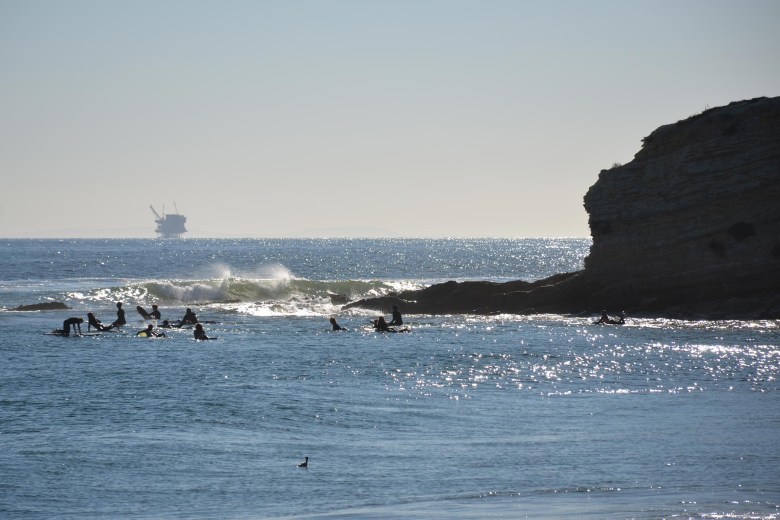
One of Sable Offshore Corp.’s offshore oil platforms is seen from Refugio State Beach. Credit: Giana Magnoli / Noozhawk file photo
The pipelines never leave the state of California, but were classified as an interstate pipeline system before the spill, with PHMSA jurisdiction. After the spill, they were reclassified as an intrastate system with OSFM jurisdiction.
Sable petitioned PHMSA in November to take over regulatory control, arguing it was an interstate system. The agency agreed.
The OFSM was informed that PHMSA would be talking over the authority of the pipelines on Dec. 17. Sable announced on Dec. 22 that it had received an emergency permit from PHMSA to restart the pipelines.
PHMSA investigators determined that the Refugio oil spill was caused by external corrosion and the pipeline owner’s failure to detect it.
The aftermath of the spill included criminal convictions and multimillion-dollar settlements against the then-owner of the ruptured pipeline, Plains All American.
There was also a consent decree laying out regulations for repairing the pipelines and restarting oil and gas production.
Bonta’s statement described PHMSA’s new stance as “a significant departure from this agreement and the way in which PHMSA historically viewed the pipelines.”
The consent decree also acknowledged and approved the OSFM’s role in reviewing and approving any restart plans for the pipelines.
Sable had not responded in court to the lawsuit as of Friday.
In response to the lawsuit, State Fire Marshal Daniel Berlant confirmed his office’s commitment to ensuring the pipeline is safe.
“The Office of the State Fire Marshal is committed to its mission to protect the people, property, and natural resources of California,” Berlant said. “Our team has worked diligently to uphold the terms of the consent decree and ensure the safety of lines CA 324 and CA 325.”
Linda Krop, the chief counsel for the Environmental Defense Center, said that besides gaining approval from the OSFM, there are multiple lawsuits and injunctions preventing a restart of the Las Flores pipelines.
The EDC filed its own lawsuit against PHMSA and the Department of Transportation on Dec. 26. The lawsuit, with plaintiffs including the EDC and other local activist groups, claims that the pipeline did not meet the basic standards for restart approval.
Krop added that a federal judge recently ruled that the EDC’s injunction against Sable and a restart is still in place. The two sides are scheduled to return to the court on that case Feb. 27, where the judge will hear arguments on whether to eliminate the injunction.
Sable has indicated that the only thing preventing a restart is the injunction, according to court records. The company also stated to the court that it has not introduced any oil to the Las Flores Pipelines.
Krop said Sable still needs other approvals before it can begin production at the Santa Ynez Unit.
Krop said one of the main obstacles for Sable includes an easement through a portion of Gaviota State Park, which will need to be approved by the State Parks Department. Krop stated that Sable had not yet started the process for an easement.
She added that the easement will need an environmental impact review before it is granted, and that could take up to a year.
In addition to the easement, Krop said Sable will need to obtain a coastal permit from the California Coastal Commission for the coastal pipelines.
“Some of those processes could take six months to a year,” Krop said. “Some they haven’t even started the process yet, so they are a long way from starting up.”