
Disasters strip things down to what matters most and reveal the character of a community.
A year ago, as wildfires tore through the Los Angeles area with unimaginable fury, we saw incredible courage and grit: heroic first responders, neighbors delaying their own escape to aid others, and places of faith, schools, and local organizations rallying to help however they could. In the middle of that chaos, the animal welfare community braced for a crisis of its own.
On a normal day, most shelters are full. On a bad day, they’re overcrowded and overwhelmed, with staff juggling every available space to avoid life-or-death decisions. As the Eaton and Palisades fires raged, city, county and private shelters faced extraordinary strain as they worked to protect the animals already in their care.
What followed wasn’t a reinvention of animal welfare. It was a collective decision to abandon “normal,” respond to the reality in front of us and tap into the animal-loving heart of California.
Animal welfare organizations typically tend to stay in their lanes — each focused on what they do best. During the fires, those lanes disappeared. Different strengths, same direction. Work that might normally take weeks came together in hours, not because protocols changed but because urgency stripped away hesitation.
That urgency quickly clarified the most immediate need: space.
There were already hundreds of adoptable dogs and cats in the L.A. city and Pasadena shelters. Creating room for pets displaced by the fires meant acting fast: ramping up foster placements, finding adopters and moving adoptable animals out of the region.
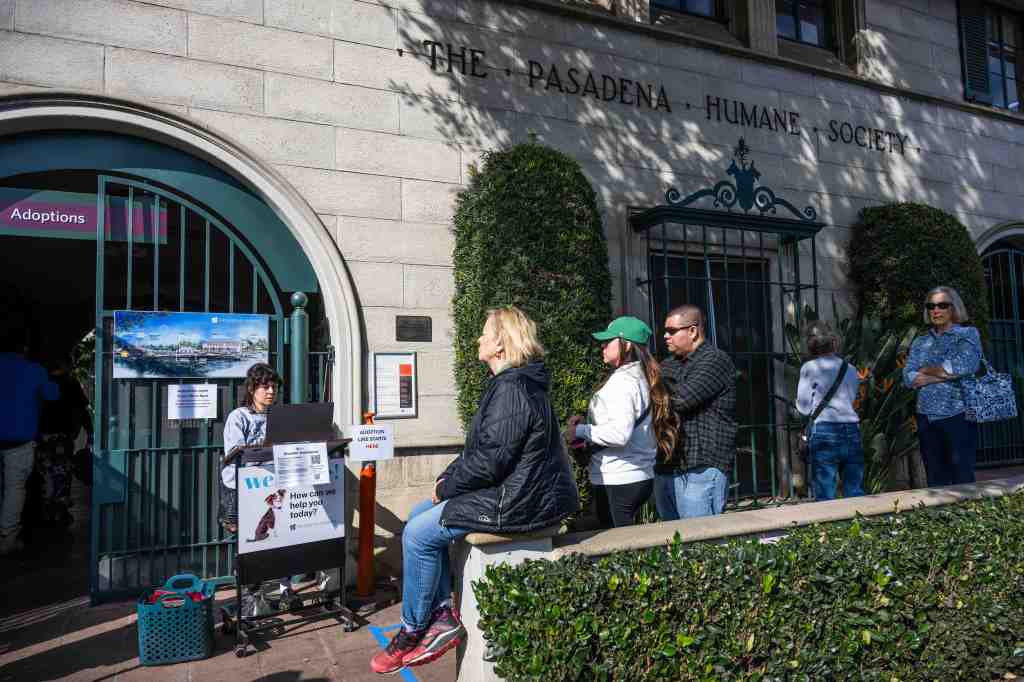
Californians responded immediately. Foster volunteers and adopters lined blocks around animal care centers. At the Best Friends Pet Adoption Center, more than 350 foster and adoption applicants crowded the lobby even as thick smoke darkened the sky. For the first time, we were responding to a large-scale disaster while one of our own centers was directly at risk.
With support from donors, partners across the country and residents, Best Friends worked alongside local organizations to move more than 1,700 adoptable animals out of local shelters and away from danger. When roads weren’t enough, dogs and cats took to the skies. Working with Wings of Rescue, the Philadelphia Eagles and other partners, more than 300 animals were flown to safety — to Salt Lake City, New York, Best Friends Animal Sanctuary in Kanab, Utah, and partner organizations nationwide.
In Pasadena, that same dynamic took hold. Pasadena Humane took in animals from evacuation zones, treated burn and smoke injuries, and transferred adoptable pets to partner organizations to create emergency capacity. They transferred out around 500 cats and dogs in 2025 compared to about 200 in 2024, with 18 of those transfers happening in January 2025 alone.
A year later, Pasadena Humane is still caring for animals displaced by the Eaton fire while supporting families piecing their next steps together. And even amid that increased intake, their save rate hovered around the no-kill benchmark of 90% throughout 2025.
That’s what it looks like when a local system works the way it should — when community responsibility kicks in. The fires made something unmistakably clear: Lifesaving doesn’t belong to any one organization. It belongs to the community.
And while the flames burned out, the urgency for animals didn’t. What changed was visibility.
During a disaster, urgency is unavoidable, and the response is collective. But animals in shelters face that same urgency every day, without smoke in the air or headlines to demand attention. Now, the question is whether we respond with the same commitment once that urgency is no longer front and center. The progress we’ve made shows what happens when we do.
The lesson is clear: This work succeeds when it belongs to everyone. When communities move together, treat systems as shared and act without waiting for perfect conditions, animals live. The responsibility now is to carry that commitment forward — to keep shared responsibility alive even when there is no disaster forcing our hand. Let’s not go back.
Brittany Thorn is executive director of Best Friends Animal Society in Los Angeles.