
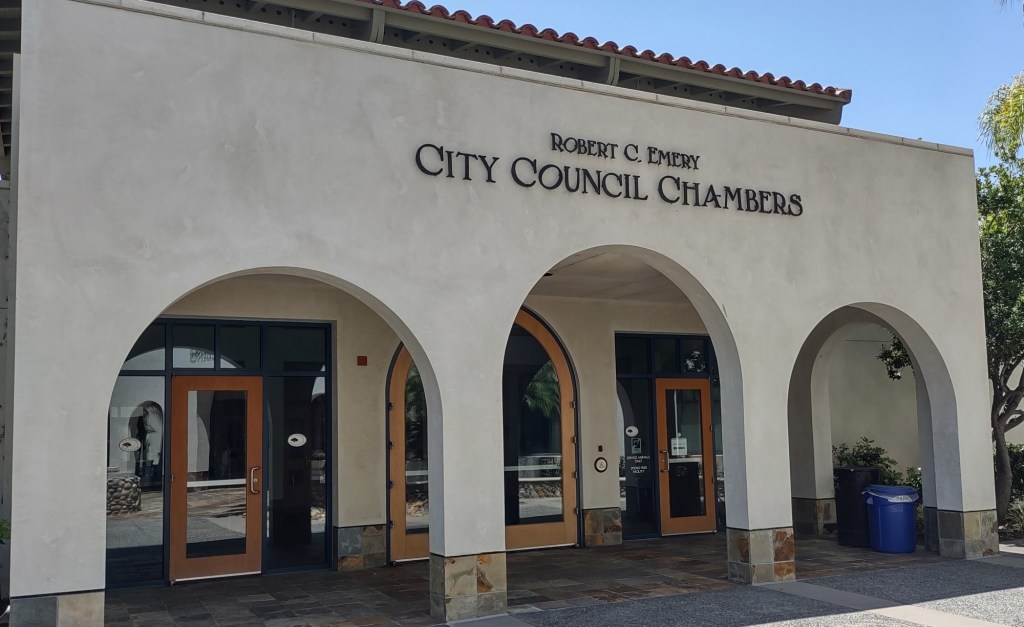
Poway residents will be paying more for water after the City Council’s Jan. 20 approval of a 9.9% rate increase this year, with another 4% hike each year for the next four years.
Additionally, the cost of recycled water is increasing by 23% this year and wastewater costs are scheduled to rise by 3% each year from 2028 through 2030, according to a staff report.
The 2026 rate increases started with the Jan. 21 water bills, said the city’s Director of Finance Craig Schmollinger. The average customer is expected to pay $24.22 per month more, or $48.43 more per bimonthly billing period for water.
Before the increase, the average customer was paying $302.69 per bimonthly billing period for water, which is expected to increase to $351.12 this year, and rise to $365.16 in 2027, $379.77 in 2028, then to $394.96 in 2029 and $410.76 in 2030.
The vote on the five-year rate adjustment was 3-1 with Councilmember Jenny Maeda opposed. Maeda asked council members to change the motion to help lower-volume residents pay for their water.
“While some level of increase is inevitable, I’m concerned how this will impact low-volume and low-income users,” she said. “When people are struggling to make ends meet, they reflectively start cutting back on expenses so it seems a bit cruel to impose such a high meter service charge in which you create a situation where even cutting back to zero gallons won’t help much.”
Councilmember Chris Pikus said if the rate increases were not passed, it could result in reduced maintenance of the water and sewer systems, reduced services or a depletion of reserves, which could lead to violations of state or federal laws.
Water customers expect safe, reliable and inexpensive water, he said, adding that court cases have decided fixed charges are more equitable than tiered systems of paying for water.
“Cost allocation says this is what it costs,” he said. “Unfortunately, this is what we have to pay.”
City staff reported that over the five years the increased water revenues would generate $33 million for the city, and wastewater increases would total $1.5 million.
At the Nov. 18 council meeting, officials discussed why water rates are being raised.
The increases are needed to fund the costs of imported water, capital expenses, operational expenses and appropriate reserve levels, according to a report for the city by Raftelis Financial Consultants. The firm has consulted on water and sewer rate-setting in the state for more than 30 years, officials said.
“The two largest rate drivers are the cost of imported water and capital projects,” the report said.
The city’s largest capital project is the Water Infrastructure Improvement Program, which started in 2020. The project includes the Clearwell Bypass, the Clearwell Replacement and the Treated Water Facilities projects.
Officials said Poway’s main water supplier, the San Diego County Water Authority, increased its rates to the city by 9.2% this year. Those rate increases were driven by an average rate increase of nearly 8% from the Metropolitan Water District, which is a major water authority supplier, they said.
Also leading to the rising rates are the wholesale costs associated with operating the Claude “Bud” Lewis Carlsbad Desalination Plant and from the detachment of the Rainbow and Fallbrook municipal water districts from the County Water Authority, which results in fewer agencies sharing the costs of water supplies, according to the Raftelis report.
The report included water, recycled water and wastewater projections.
“New rate increases are needed to ensure the financial sustainability of the enterprise systems to ensure the city can continue to provide safe and reliable water and wastewater service,” the report said.
In her recommendation to reduce costs, Maeda suggested decreasing bimonthly water meter service charges for single-family utility customers by 25% and increasing the commodity per unit charge by 12% while maintaining the yearly rate of increase. This would generate about the same amount of revenue assuming the average customer uses 29 units of water every two months as referenced in the city staff report, she said.
But Schmollinger noted that water rate revenues from one set of water customers cannot be used to offset other water customers’ costs.
He said Maeda’s proposal would reduce the amount of revenue needed to cover a “significant number” of fixed costs. A balance is needed between fixed charges and fixed revenue sources, he said.
“So if there was a drought or low-volume uses there would be an imbalance there which could spiral us downward and we would have some financial issues,” Schmollinger said.
Poway resident Jim Bunner told council members that water customers are being penalized for conserving water because if water use goes down, revenues from water sales decline and that drives increased water rates.
“I took out my entire lawn,” he said. “Now I’m paying more because I saved water.”
Bunner also raised concerns about mobile home park residents not being included among the 15,946 property owners who were notified of the Jan. 20 public hearing. If written protests against the proposed rate increases are presented by a majority of property owners, or more than 7,973 property owners, the water rate increases would not have been approved.
Some mobile home parks are similar to an apartment complex and have a master meter serving the entire property, which counts as one vote, spokeswoman Rene Carmichael said in an email.
Poway City Clerk Carrie Gallagher said 49 protests were received by the Jan. 20 deadline and 10 protests were received after the noon deadline. Additionally, no legal objections were received, Gallagher said.
Mayor Steve Vaus said moderate increases to the city’s water rates are the responsible action to take to provide safe and reliable water service. He suggested residents who struggle with paying bills call 2-1-1 to get connected to information about housing, utilities, food, health and mental health services.
The city of San Diego is facing similar water rate hikes that cumulatively add up to 90% over six years, according to a recent San Diego Union-Tribune article. Predicted rate hikes could possibly shrink substantially if the water authority limits large capital projects, reduces operating expenses and finds a way to “right size” its water supply, according to San Diego’s independent budget analyst.
One of the key recommendations for San Diego is to also demand that the water authority negotiate deals to sell excess water to agencies outside the region, most likely out of state, within one year.
City Manager Chris Hazeltine said the rate increases are “not to exceed” amounts. So there is a possibility of lowering the rates if additional revenues or cost saving measures are discovered. But, he said increasing the rates would require noticing residents again through the Proposition 218 process.
The proposition requires municipalities to notify property owners at least 45 days in advance of a public hearing related to proposed water, recycled water and wastewater rates.
Union-Tribune staff writer David Garrick contributed to this story