
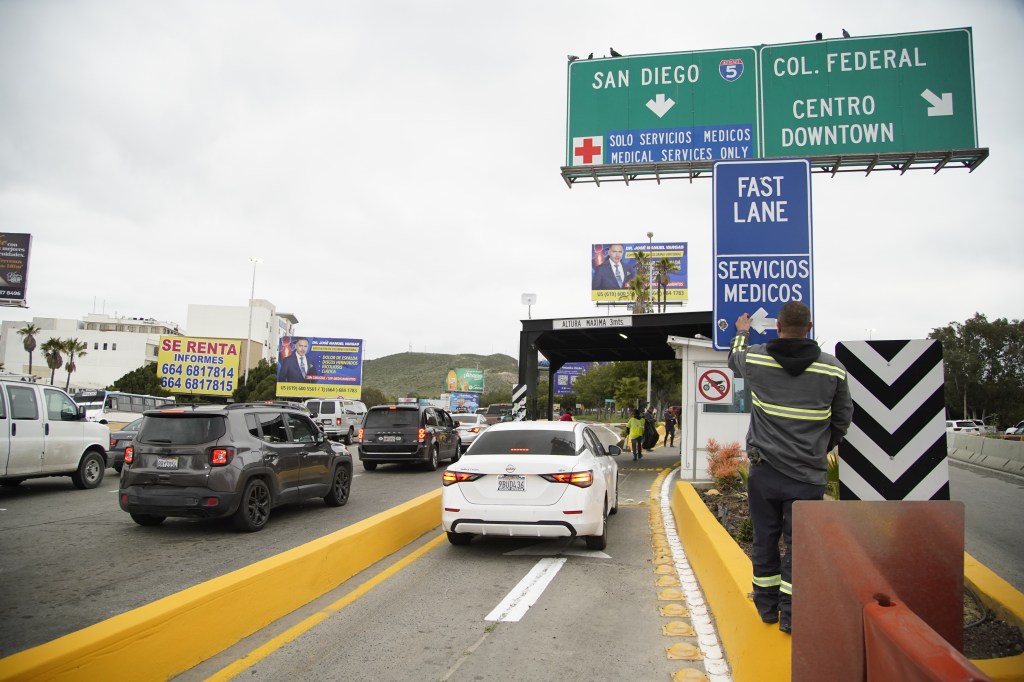
It was once a special border crossing lane for U.S. tourists traveling to Tijuana for medical care. The program later expanded to include those visiting Tijuana for business. Then, cross-border students. And now, cross-border workers are next.
Tijuana officials recently announced that Baja California residents who cross the U.S.-Mexico border for work can now enroll in the city’s Fast Lane program. The program allows participants to use special lanes for faster crossings at the San Ysidro and Otay Mesa vehicle ports of entry.
But joining the program comes at a cost.
Cross-border workers have two options. The first costs about $905 per month and allows two daily crossings through the program’s designated lanes at the San Ysidro or Otay Mesa ports of entry.
The second option is about $614 per month for one daily crossing, and only through the dedicated lane at the Otay Mesa Port of Entry. With either option, users can register two vehicles and up to three additional members for carpooling.
By comparison, U.S. Customs and Border Protection’s Trusted Traveler Programs, such as SENTRI and Global Entry, which allow for expedited crossings in different designated lanes, cost $120 for a five-year membership. Applicants must undergo a thorough vetting process to be approved.
The Fast Lane program is operated by the city of Tijuana, not CBP. It does not change the inspection process for entering the U.S., but instead allows participants to get in the inspection line ahead of non-participants.
The two San Ysidro designated lanes are available for cross-border workers from midnight to 8 a.m. and from 4 p.m. to 8 p.m., while the sole program’s lane in Otay Mesa is available 24 hours a day.
Tijuana Secretary of Economic Development Pedro Montejo Peterson said that the schedules were intended to prevent congestion in the Fast Lane, which is also used by students, medical patients and visiting businesspeople.
He said that about 56% of Fast Lane traffic crosses the border between 9 a.m. and 4 p.m., a time that will not be available for cross-border workers using the two dedicated lanes in San Ysidro. He noted that most Tijuana residents who work in San Diego usually cross the border early in the morning.
“We’re making sure that the fast crossing remains fast — and that it benefits more people,” Montejo Peterson said in Spanish at a press conference in Tijuana earlier this month.
Joaquín Luken, executive director of the nonprofit Smart Border Coalition, pointed out that, despite the cost, the program still provides an alternative for many people who have to wait in line for hours to get to work.
Participants who carpool can help ease wait times and split costs, he said. “If many plan ahead, there’s a way to make it more accessible,” he said.
Luken noted the changing purpose of the Fast Lane program, which was initially designed to promote medical tourism in Tijuana. Even today, many border commuters still commonly refer to the program as the “línea médica,” or medical lane.
Currently, 898 medical institutions and 105 businesses are registered with the program, according to Montejo Peterson. Enrollees pay for single-use passes to give to patients or businesspeople visiting Tijuana from the U.S. There are also 332 cross-border students enrolled, who must pay a $350 monthly fee.
The city is currently accepting online applications from cross-border workers. Although no start date for workers has been set, it is estimated that this group will be able to start using the dedicated lanes around mid-February.
Workers must provide proof of U.S. citizenship, such as a birth certificate, or a work visa for Mexican nationals. Other requirements include proof of employment with a U.S. company, proof of Baja California residency and vehicle documentation.