
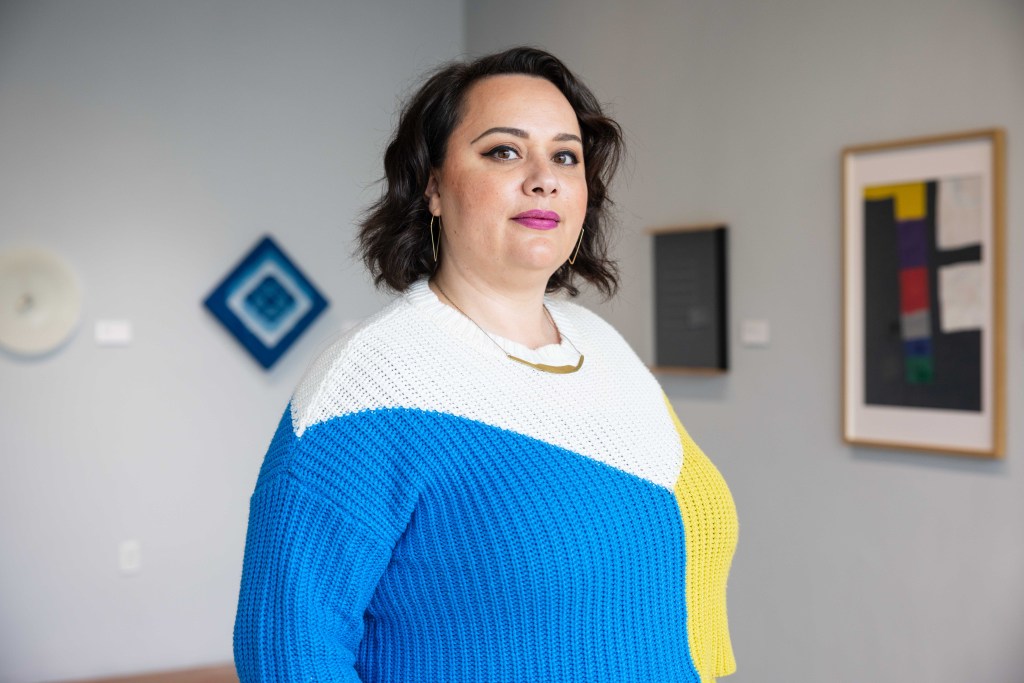
Katie Ruiz was finding it, her appreciation for abstract art. Trained as a figurative artist and working as a textile-based artist who’s also a maximalist, the more minimalist abstract she found when she arrived in San Diego in 2017 was mystifying—and compelling.
“When I came to San Diego and I saw this very minimal, experimental abstract art, I was, to be honest, just confused. I was like, ‘What am I looking at? Why is this art?’ It took me a while to wrap my head around it,” she says. “Then I realized, ‘Wow, I’m thinking about this a lot, so it must mean something because that’s the sign of a good artwork, is that you’re thinking about it, right?’ Then I realized that I’d started buying abstract art because I wanted it on my walls because it was calm and quiet and contemplative.”
This is part of what she wants to share in “Non-Objective Lessons,” Space 4 Art’s abstract art exhibition on display at Art Produce Gallery through Feb. 12. Curated by Ruiz, who also serves as Space 4 Art’s programs associate, this exhibition is the first in a series of seven exhibitions produced by the local nonprofit that provides working space, living space, and arts education programming. A $200,000 Arts Ecosystem Grant from the Prebys Foundation allows Space 4 Art to plan a year of exhibitions, artist talks, performances, panel discussions, and workshops in a residency at Art Produce through October, along with partnering with other local art spaces. Ruiz took some time to talk about the abstract art scene in San Diego. (This interview has been edited for length and clarity. For a longer version of this conversation, visit sandiegouniontribune.com/author/lisa-deaderick/.)
Q: What is meant by the title of this current exhibition, “Non-Objective Lessons”?
A: There’s abstract art and there’s also non-objective art, which means there’s no form within the work that you could say, ‘Oh, this is a person or a cat or a dog,’ so that’s what is meant by “non-objective,” is that it really is non-objective. There are no objects that you can point out, specifically. It’s sort of like a conversation on what is non-objective. This is a lesson in very minimalistic, non-objective, abstract art. For example, abstract expressionist art is not minimal, but it is abstract. There are a lot of brushstrokes in it, or it’s very colorful; this work, in particular, is minimal in color, minimal in mark making. Tom Demello’s artwork, for example, features one mark that he puts on the page, so it’s extremely minimal work. Some people love it and some people hate it, and some people battle with it. I kind of like that because I did, too, as an artist.
Q: What was your process for selecting the artists whose work is featured in this exhibition?
A: I didn’t start out understanding or loving abstract work, which is why I think it was important for me to make this show because this kind of work can shut people down. You know, some people walk into a gallery and say, “I don’t understand this. I feel frustrated.” I would say that I started there, and here I am now curating a show on it; you can get there. If you don’t understand it yet, you can get to a place where you love and appreciate it. Over the years, I’ve built friendships with these artists, like Melissa Walter, who’s in the show and whose work is very abstract. Her piece is like sediment that’s thrown on a piece of paper, so some people might look at that and just say, ‘Well, that’s just dirt on the wall,’ but if you take the time to listen to what she’s talking about and where it comes from and how she created it, you’ll gain a much deeper understanding. So, I picked people who I admire, people whose work I collect personally, and people who are not necessarily friends, but whose work I’ve just been watching for a long time. I’ve been in the art scene in San Diego art scene for nine years now, so all of these people have been making work for a long time, and some of them I’ve just recently met at Space 4 Art, as well, so I wanted to bring in some artists who are more well known for this work, as well as some newer artists who are coming into the scene. So, that’s how I chose.
Q: What was important to you to show to viewers through the works that were selected for this show?
A: There’s a quietness to the work. Then, there’s also, I would say, sort of an in-your-face aspect to the work just because it is so blatantly experimental. I wanted to push the limits of what people are showing in San Diego, and I think these artists are not really getting enough of what they deserve. I just wanted to highlight the really good art that I think is being made in San Diego that can sometimes be overlooked.
Q: How would you describe the abstract art scene in San Diego? Is there a particular style or point of view that you’ve seen?
A: Well, there are some pivotal figures, namely John Baldessari and Bob Matheny and Robert Irwin, who work in this very minimalist, raising light, some assemblaging objects together, and it’s a definite California or West Coast style that I had never really experienced, except for maybe some (Marcel) Duchamp, which is the guy who put the urinal in a gallery. I guess that’s what you’d call one of the first experimental art pushes. Like, “is this art?” People are really pushing that boundary, I’d say. So, when I came here, I looked at these artists because people kept saying, ‘Oh, this is my inspiration,’ so these artists are directly inspired by those three artists I mentioned—John Baldessari, Bob Matheny, and Robert Irwin—and they’re sort of the pioneers in this experimental abstract art movement that is, to me, very much San Diego styled. I haven’t seen this anywhere else, even LA. It’s very experimental, and I contemplate that, too. Like, why are these artists able to be so experimental and, therefore, in my opinion, brave. It takes a lot to do this and sort of bravely say, ‘This is art, and take it or leave it.’ To me, I think it has something to do with how we don’t really have an art buying scene, like LA. So, we have the ability to just experiment for the art sake of art making. It’s lovely when people buy your work, but then you also start thinking about what people are going to buy and making art from that vision, rather than from a very original vision, or authentic way of making art. To me, I call the work super authentic because it’s coming from a place of just making for the sake of making, rather than making for selling or making for showing.
Q: What kinds of conversations were happening between you and the artists for the show as you were working to put it all together?
A: It was really more just me choosing, the works. If you ask someone if they want to be in a show, they want to know what kind of show it is and why. Once I explained to them what it was, everyone was really excited that I was creating a show that was about San Diego-based abstract art because there’s just not a lot of that being shown. Some people get a lot of play and they get several solo shows, and other people don’t get any shows at all. I also wanted to highlight some of Revision San Diego’s artists. I work at Revision’s creative workspace, as well, which is an art space for adults with disabilities. I think the work they’re making is absolutely incredible, especially the abstract art, so I wanted to add in a couple of those artists, as well.
Q: Have you gotten any feedback, any response to the exhibition?
A: I think (the opening) was a huge success. I think we had over 200 people come through, so that was really exciting. There are those people who walk into the room and they’re like, ‘Oh, I don’t see anything here,’ and that did happen. So I started saying, ‘OK, this piece by Lynn is made from one of those glass lamp things that you have in your bathroom, that holds the light bulbs in, plus a handle of some sort. These are objects that she found in her home or in her space, and started putting them together as art.’ Or, ‘This one was inspired by another abstract artist who’s very minimalist, and she meditated to receive the information from her artworks.’ Then they start catching on.