
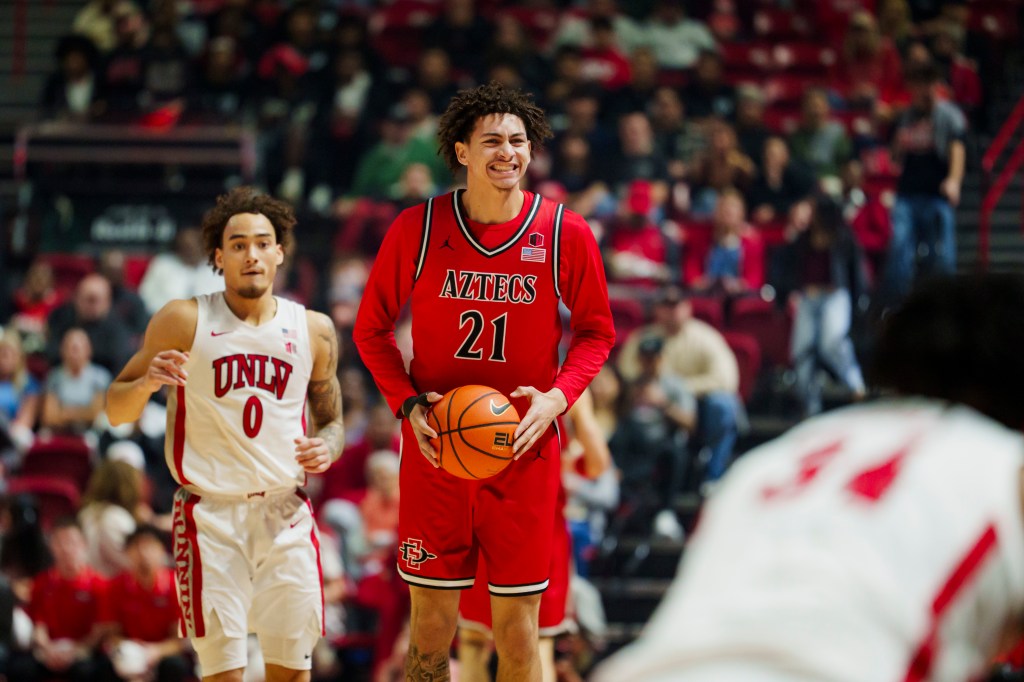
LAS VEGAS – Three thoughts on San Diego State’s 82-71 win at UNLV on Saturday afternoon:
1. Shot selection
The team chartered home after Wednesday night’s game at Grand Canyon. The game tipped at 9 p.m. local time, there was a delay in getting the plane to Phoenix and then weather forced an airport change from Brown Field at the border to McClellan-Palomar Airport in Carlsbad.
Miles Byrd got to his apartment after 3 a.m. He didn’t immediately go to bed, however, replaying the game on his laptop and reliving the agony of a 70-69 loss.
There was the final sequence that involved a controversial foul with 1.8 seconds left that put Grand Canyon’s Makaih Williams on the line for a pair of free throws. There also was his own performance: six points, 2 of 10 shooting, 0 of 6 on 3s.
“I wasn’t very fond of the ones I took,” Byrd said of his shot selection from deep. “I think sometimes you don’t get some clean looks and you start to force a little bit more. … Obviously, I know it messed up some of our flow offensively.”
Coach Brian Dutcher nodded.
“He knows,” Dutcher said. “And he’s got a dad (Calvin) who coached in college and played in college, so he’s getting good advice from everybody. Now he just has to try to slow himself down a little bit at the offensive end from time to time.
“Byrd is Byrd. He is so energetic and emotional that sometimes he presses the game too hard. You can see it at both ends of the floor. That’s why he gets steals. He’s always pressing the issue. He needs to not press so hard offensively when things aren’t going well, you know?”
The more he tries to make shots, the more their degree of difficulty rises — deeeeeeep 3s, step-back 3s, off the dribble 3s.
His line Saturday at UNLV: 23 points, 7 of 8 shooting, 5 of 5 on 3s.
“I did a better job of taking good ones,” said Byrd, who is now shooting 34.6% from 3 this season, best in his career. “I’m a confident 3-point shooter, so that’s what I’m going to do. It’s just finding that balance between the good ones and the forced ones. Today they were all step-in 3s, and I think I’m a 45-50% 3-point shooter if it’s a step-in, wide-open 3.”
The unwritten pact between Dutcher and his players if that they play defense and rebound — the game’s less glorious facets — at the elite level he demands, he will grant them a measure of offensive freedom and won’t micromanage shots.
“I don’t like guys taking bad shots,” Dutcher said, “but sometimes I have to live with a bad shot or two in order to get the best out of them.”
For that to work, though, it also requires a certain amount of self-evaluation and restraint from players to not abuse the privilege. Byrd, in his fourth year in the program, gets it.
“You’ve got to be mature and learn from mistakes,” Byrd said. “For me, I think this is a big steppingstone, just for my own maturity to have my worst game of the year offensively, in my opinion, in my last game and to come into this one and step up big and make some big shots.”
The next question is whether he can do it again. In the next game following his previous six 20-point performances, he is averaging 7.8 points while shooting 25.8% overall and 13.9% behind the arc.
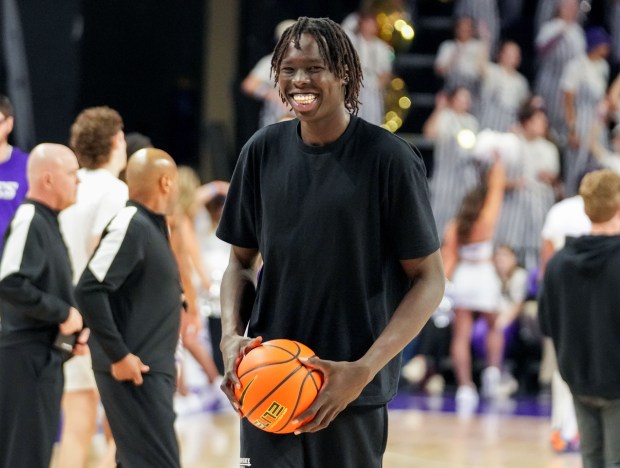 Out with a hip injury, SDSU’s Magoon Gwath smiles before the Jan. 21 game against Grand Canyon at GCU Arena in Phoenix. (Darryl Webb, for The San Diego Union-Tribune)
2. Gwath’s hip
Magoon Gwath missed his second straight game with a hip injury, and afterwards Dutcher admitted the 7-foot starting forward is “doubtful” for Wednesday against Colorado State.
When might he be back?
“I just say week to week, because I really don’t know,” Dutcher said. “It might be two weeks, three weeks, four weeks. It might be just two weeks. It might be 2½, I don’t know. I can’t rush the injury.
“If he’s available, I’ll find a way to get him out there. If he’s not, I won’t stress over it.”
He won’t because Gwath hasn’t been himself all season, and in a weird way that’s made playing without him an easier adjustment.
Jeremiah Oden, a sixth-year senior who knows the Mountain West well from three years at Wyoming, slides into the starting lineup. Tae Simmons, the productive true freshman, comes off the bench as the primary backup.
The Aztecs also increasingly have been going “small,” deploying a lineup with four guards and one big instead of two.
And even when Gwath was playing, he often was not on the floor in crunch time after stiffening as games go on.
“He hasn’t been at full strength all year,” Dutcher said. “He’s had moments for us, but coming off the (knee) injury … he’s just been battling the whole season. Hopefully he gets some good news and starts healing, where he’s at full strength.
“If he’s your MVP at this point and you lose him, then there’s more to replace. But we have a lot of depth, and that depth has proven valuable.”
That depth also affords them the luxury of shutting down Gwath for a few weeks to give him a better chance of healing for the stretch run instead of playing through the pain. Hip injuries, in particular, tend to worsen the more you play but respond favorably to rest.
“I’ve got a deep team,” Dutcher said, “and I’ll get him in good health and get him back when I can.”
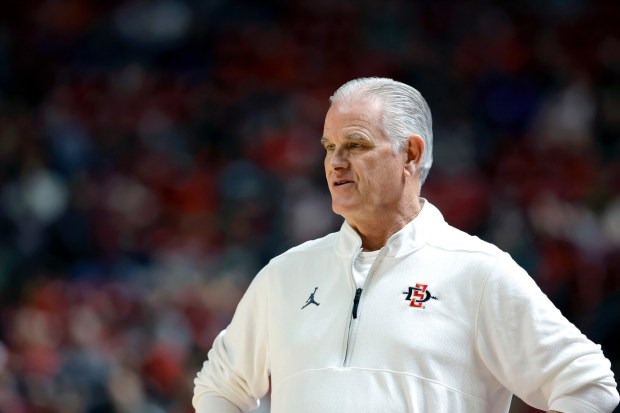 SDSU coach Brian Dutcher watches during the first half of the Aztecs’ 82-71 game at UNLV on Saturday afternoon. (Steve Marcus/Las Vegas Sun via AP)
3. Charter members
Many of SDSU’s Mountain West brethren regularly fly charter to road games. The Aztecs don’t, typically allotted four charter legs (the equivalent of two round trips) per season.
They always burn two for the trip to Wyoming, which knocks off about four hours each way from the door-to-door travel time via commercial carrier to Denver. They scheduled the other two for the March 3 trip to Boise State, given the lack of nonstop commercial options there and the short turnaround before the March 6 regular-season finale against UNLV at Viejas Arena.
They got a fifth leg this season, thanks to donations from a small group of boosters, and used it after Wednesday night’s game in Phoenix.
On the surface, it seems counterintuitive. On Thursdays, there are 18 daily nonstop commercial flights from Phoenix to San Diego.
But the charter made sense for numerous other reasons, and they’d like to think it contributed to Saturday’s key bounce-back win that kept the Aztecs atop the Mountain West standings.
For one, their other remaining road games didn’t require charters. Three have early tips that allow for commercial flights home that same day. And the one that doesn’t — Saturday, Feb. 7 at Air Force — is followed by the bye week, so there’s no rush to prep for a midweek game and no missed class time flying home Sunday.
Another factor: Flying home Wednesday night allowed players to attend Tuesday-Thursday classes in the first week of the spring semester after missing them on Tuesday traveling to Grand Canyon.
The biggest advantage might have been sleeping two nights in their own beds before heading back on the road to face UNLV, knowing the level of focus required in the abbreviated practice time. It was a shorter week than usual, with the late tip at Grand Canyon and a 1 p.m. CBS game in Las Vegas, which eliminated the morning shootaround and another chance to implement a game plan.
They didn’t do much on the floor Thursday, then ran out of time Friday to work against UNLV’s offense before having to leave for the airport. They got an hour at Thomas & Mack on Friday night and finished the scout then.
UNLV, meanwhile, played Tuesday and had an extra day of rest.
“This was a hard one,” Dutcher said. “At that point, I was worried about our legs. I didn’t want to do too much, but we had to do something. I think they did a good job concentrating on a one-day prep, basically, to play a good team on their home floor.
“To be 4-1 on the road in this league right now, we take great pride in that.”