
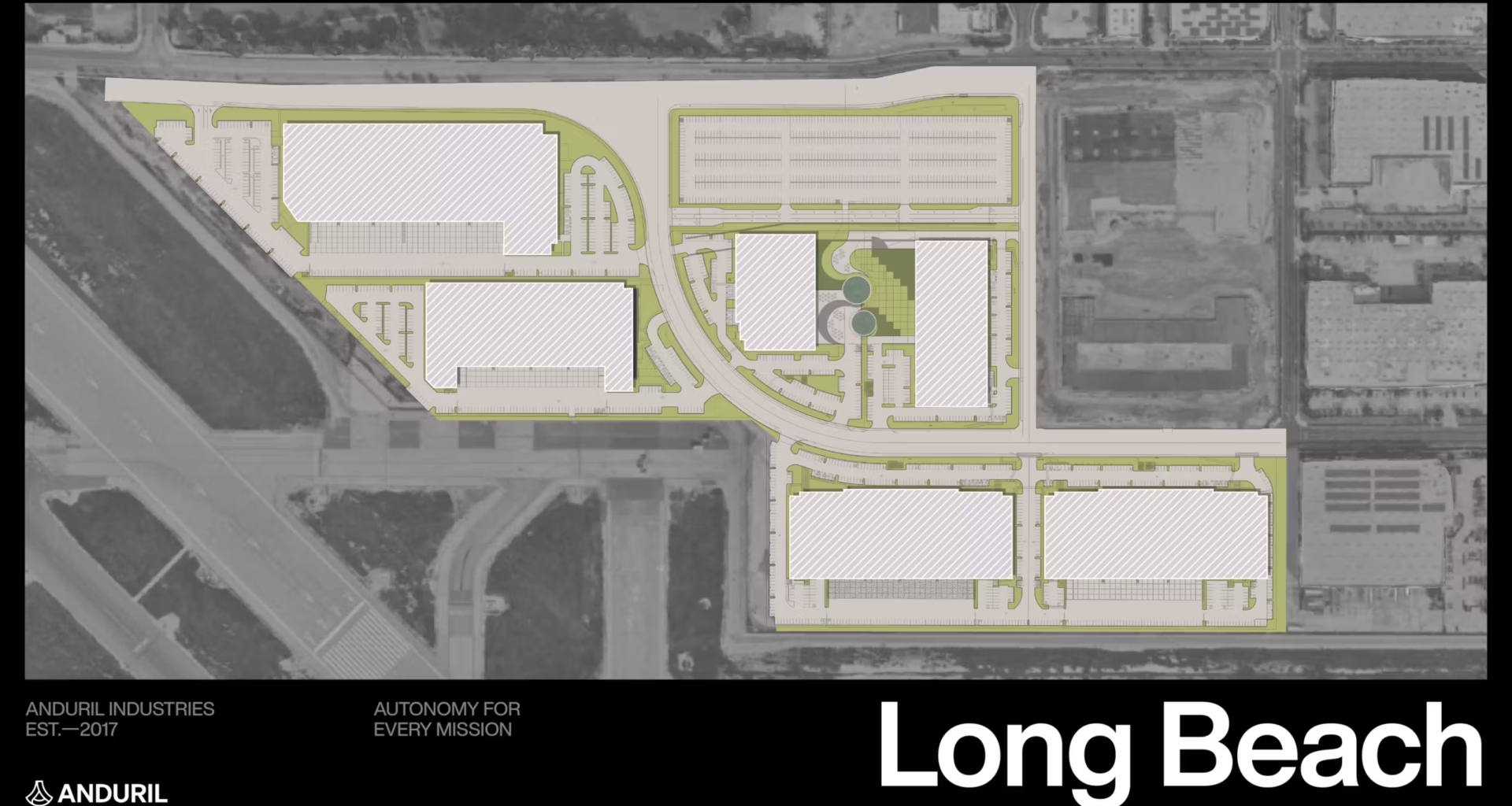
Anduril is expanding its facilities in Long Beach, California, to provide greater capacity as it responds to growing demand from the US and other customers.
BLUF:
Anduril is expanding its facilities in Long Beach California to provide greater office and R&D space.
Building is set to be complete in 2027 and will double the size of Anduril’s footprint in California.
Anduril is building a new facility in Long Beach California that will add up to 5,500 new staff to its head count, according to a January 22 press release. The new campus is to be built in an area that is increasingly known as “Space Beach,” thanks to the growing presence of aerospace companies there including Rocket Lab and JetZero.
The new facility will be close to the Long Beach Airport and provide 750,000 square feet (69,600 square metres) of office space alongside 435,000 square feet (40,400 square metres) of research and development facilities, the press release states. The California Chamber of Commerce estimates that the campus will cost around $1 billion, building on Anduril’s reputation for investing ahead of need.
The most striking example of this is the company’s plans to build Arsenal-1, which it calls a hyperscale factory, in Ohio. This facility will effectively double the company’s footprint in California, which is also home to its headquarters in Costa Mesa.
Why Long Beach, you might ask. Well, Anduril states that, “California remains one of the few places in the world where advanced technology, industrial capacity, and a deep technical workforce come together at scale. Southern California has long been a center of American aerospace and defense innovation, and Long Beach sits at the heart of that ecosystem.”
But it is also notable because Palmer Luckey, the company’s CEO and founder, grew up in Long Beach, and developed his passion for electronics and software there. It is perhaps something of a home coming for the defence tech firm.
Anduril has won multiple large contracts from the US DoD since its founding in 2017. In March 2025, it was awarded a $642 million (£505 million/€591 million) indefinite delivery/quantity contract to provide counter drone capabilities for US Marine Corps installations over a ten year period. And in January this year, the USMC placed a contract for the company’s Bolt-M loitering munition.
Calibre comment: How can Anduril beat established players?
The counter-drone and loitering munition space is relatively new, with some established players but enough novelty to provide space for new companies. So, it is not altogether surprising to see that Anduril has secured market share in those areas. However, it has also supplanted established players. It won one of the first development contracts for YFQ-44A, its collaborative combat aircraft in 2024, beating Lockheed Martin, Boeing, and Northrop Grumman. In another major coup, the company was given responsibility for delivering the US Army’s Integrated Visual Augmentation System (IVAS), a $22 billion contract that had originally been awarded to Microsoft. After a range of issues and software development cycles measured in months rather than days, Anduril was given control of the contract and its delivery.
So, what gives? How is a relatively new company able to win over some of the world’s most valuable entities? There are a few aspects: Anduril is certainly responsive to customer needs, placing a premium on developing systems quickly, as opposed to perfectly. Investment goes hand-in-hand with this, however. Many defence companies are reluctant to invest their own capital without some form of guarantee from a relevant national customer that there will be an order at the end of it. This is understandable, dozens of large programmes have been cancelled before any production orders in the past 30 years. But Anduril fronts its own capital, promising the DoD some sort of capability for little in return and reduced risk. This approach is being followed by others in the defence tech space, notably Tiberius Aerospace and Helsing.
By Sam Cranny-Evans, published on January 26, 2026. The lead image shows the planned expansion in Long Beach. Credit: Anduril.