
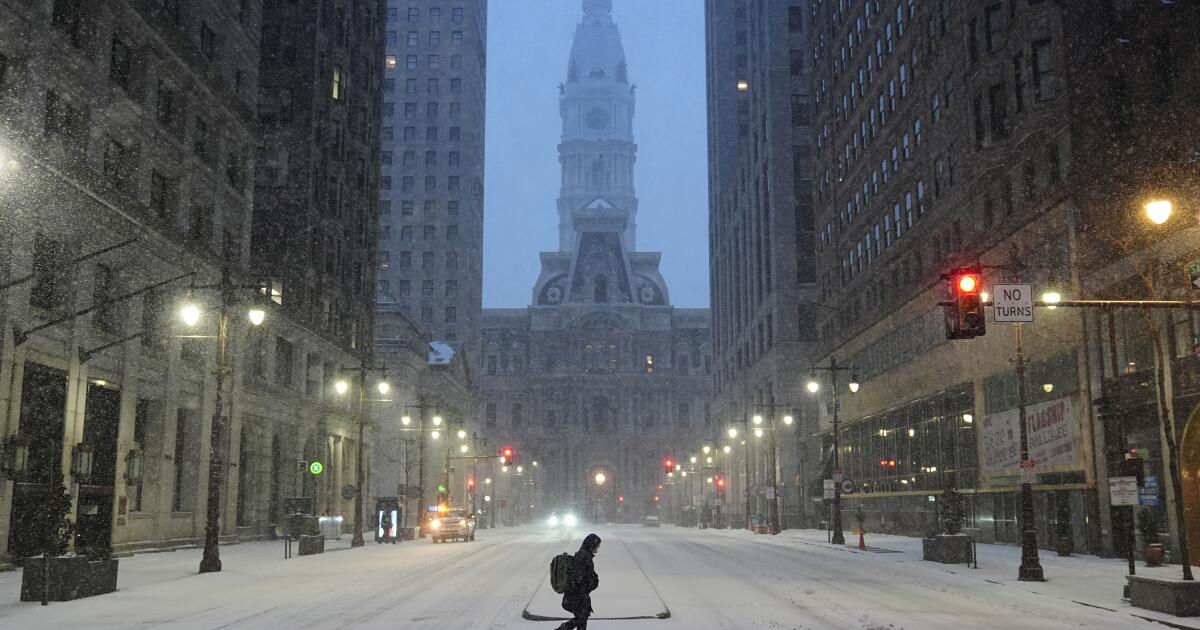
A massive winter storm dumped sleet, freezing rain and snow across much of the U.S. on Sunday, bringing subzero temperatures and paralyzing air and road traffic. Tree branches and power lines snapped under the weight of ice, and hundreds of thousands of homes and businesses in the Southeast were left without electricity.
The ice and snowfall were expected to continue through Monday in much of the country, followed by very low temperatures, with “dangerous travel and infrastructure impacts” to linger for several days, the National Weather Service said.
Heavy snow was forecast from the Ohio Valley to the Northeast, while “catastrophic ice accumulation” threatened from the Lower Mississippi Valley to the Mid-Atlantic and Southeast.
“It is a unique storm in the sense that it is so widespread,” weather service meteorologist Allison Santorelli said in a phone interview. “It was affecting areas all the way from New Mexico, Texas, all the way into New England, so we’re talking like a 2,000-mile spread.”
President Trump had approved emergency declarations for at least a dozen states by Saturday. The Federal Emergency Management Agency pre-positioned commodities, staff and search and rescue teams in numerous states, Homeland Security Secretary Kristi Noem said.
New York Gov. Kathy Hochul said the state was bracing for the longest cold stretch and highest snow totals it has seen in years. Communities near the Canadian border have already seen record-breaking subzero temperatures, with Watertown registering minus-34 degrees and Copenhagen minus-49, she said.
“An Arctic siege has taken over our state,” Hochul said. “It is brutal, it is bone-chilling and it is dangerous.”
Effects of the storm
In Corinth, Miss., where power outages were widespread, Caterpillar told employees at its remanufacturing site to stay home Monday and Tuesday.
“May God have mercy on Corinth, MS! … The sound of the trees snapping, exploding & falling through the night have been unnerving to say the least,” resident Kathy Ragan wrote on Facebook.
In Clarksdale, Miss., Sanford Johnson’s family still had power Sunday while nearby towns had outages. Enough snow and sleet fell that few motorists were out, he said.
“I had to break it to my youngest daughter that the play date she scheduled likely won’t happen today. We have no plans on driving,” Johnson said.
It already was Mississippi’s worst ice storm since 1994 with its biggest-ever deployment of ice-melting chemicals — 200,000 gallons — plus salt and sand on roads, Gov. Tate Reeves said at a news conference.
He urged people not to drive anywhere unless absolutely necessary. “Do please reach out to friends and family,” Reeves said.
On the east side of Nashville, Jami Joe, 41, had power Sunday afternoon, but she feared the juice might not last long as ice-heavy limbs from mature oak and pecan trees continued to crash around her house. “It’s only a matter of time if a limb strikes a power line,” she said.
Because of icy roads, Josh Martin figured he and his wife, Misti, were “locked in” for a while at their home on a steep hill in Columbia, Tenn.
“Getting in and out of the neighborhood is not an option,” Martin said. “I can get down because gravity will take me, but I could not get back up.”
Elsewhere, deep snow — over a foot in a 1,300-mile swath from Arkansas to New England — halted traffic and canceled flights.
On Manhattan’s Upper East Side, January Cotrel enjoyed the fresh snow on a block that always closes down for residents to play in the snow.
“I pray for 2 feet every time we get a snowstorm. I want as much as we can get,” she said. “Let the city just shut down for a day and it’s beautiful, and then we can get back to life.”
Air travel disruptions
As of Sunday morning, about 213 million people were under some sort of winter weather warning, Santorelli said. Hundreds of thousands of customers were without power, according to poweroutage.us, with Tennessee and Mississippi especially affected.
Some 12,000 flights had already been canceled Sunday and more than 20,000 have been delayed, according to the flight tracker flightaware.com. Airports in Philadelphia, Washington, Baltimore, North Carolina, New York and New Jersey were hit particularly hard.
Bitter cold makes things worse
Even once the snow stops falling and the ice clears, the danger will continue, Santorelli warned.
“Behind the storm it’s just going to get bitterly cold across basically the entirety of the eastern two-thirds of the nation, east of the Rockies,” she said. That means the ice and snow won’t melt as fast, which could hinder some efforts to restore power and other infrastructure.
Along the Gulf Coast, temperatures were balmy Sunday, hitting the high 60s and low 70s, but temperatures were expected to drop into the high 20s and low 30s by Monday morning. The National Weather Service warned of damaging winds and a slight risk of severe storms and even a brief tornado.
In New York City, Mayor Zohran Mamdani said at least five people who died were found outside as temperatures plunged Saturday before the snows arrived in earnest, though the cause of their deaths remained under investigation.
He pleaded with New Yorkers to stay inside and off roads: “We want every single New Yorker to make it through this storm.”
Two men died of hypothermia related to the storm in Caddo Parish in Louisiana, according to the state health department.
Across the affected areas, officials announced that school would be canceled or held remotely Monday.
Recovery could take a while
In Oxford, Miss., police on Sunday morning used social media to tell residents to stay home as the danger of being outside was too great. Local utility crews were pulled from their jobs during the overnight hours.
“Due to life-threatening conditions, Oxford Utilities has made the difficult decision to pull our crews off the road for the night,” the utility company posted on Facebook early Sunday. “Trees are actively snapping and falling around our linemen while they are in the bucket trucks.”
Tippah Electric Power in Mississippi said that it was contending with “catastrophic damage” and that it could take “weeks instead of days” to restore power to everyone.
The Tennessee Valley Authority provides power to some utilities across the region, and spokesperson Scott Brooks said the bulk power system remains stable but overnight icing had caused power interruptions in north Mississippi, north Alabama, southern middle Tennessee and the Knoxville, Tenn., area.
Icy roads made travel dangerous in north Georgia, where the Cherokee County Sheriff’s Office posted on Facebook, “You know it’s bad when Waffle House is closed!!!” along with a photo of a closed restaurant. Whether the chain’s restaurants are open — commonly known as the Waffle House Index — has become an informal way to gauge the severity of weather disasters across the South.
Brumback and Walker write for the Associated Press and reported from Atlanta and New York, respectively. AP writers Kristin Hall and Jonathan Mattise in Nashville; Philip Marcelo in New York; Ed White in Detroit; and Jeff Martin in Kennesaw, Ga.; contributed to this report.