
Carolyn Siegel remembers her grandfather, a Holocaust survivor, telling her it would be the job of her generation to make sure the world never forgets the murder of 6 million Jewish people during World War II so that it never happens again.
What started as a promise to her grandfather became a nonprofit that tells the stories of Holocaust survivors as they were heard by their grandchildren, the last generation to hear survivor stories firsthand. The stories describe lives lost, but also lives rebuilt.
“The stories honor the experience of survivors during the Holocaust, and also celebrate the resilience with which they rebuilt their lives,” said Siegel, founder of If You Heard What I Heard.
Siegel started the nonprofit five years ago after a synagogue in her hometown Los Angeles was vandalized with antisemitic graffiti. She thought of what her grandfather had said. But he was no longer alive to tell his story. So she started making videos of grandchildren of Holocaust survivors sharing what they heard from their grandparents.
“I kept thinking if more people today heard the stories about what grandparents like mine endured during the Holocaust, and how they rebuilt their lives afterward, we wouldn’t see so much hatred or indifference–people would be able to relate to their stories,” Siegel said.
There are 75 video stories so far and many more to be told. A new collection of videos is being released on ifyouheardwhatiheard.com Jan. 26, the day before Holocaust Remembrance Day, which commemorates the liberation of the Auschwitz-Birkenau concentration camp by Soviet soldiers on Jan. 27, 1945. The annual global event remembers the 6 million Jewish victims and millions of other victims and the commitment to stand against hatred and intolerance.
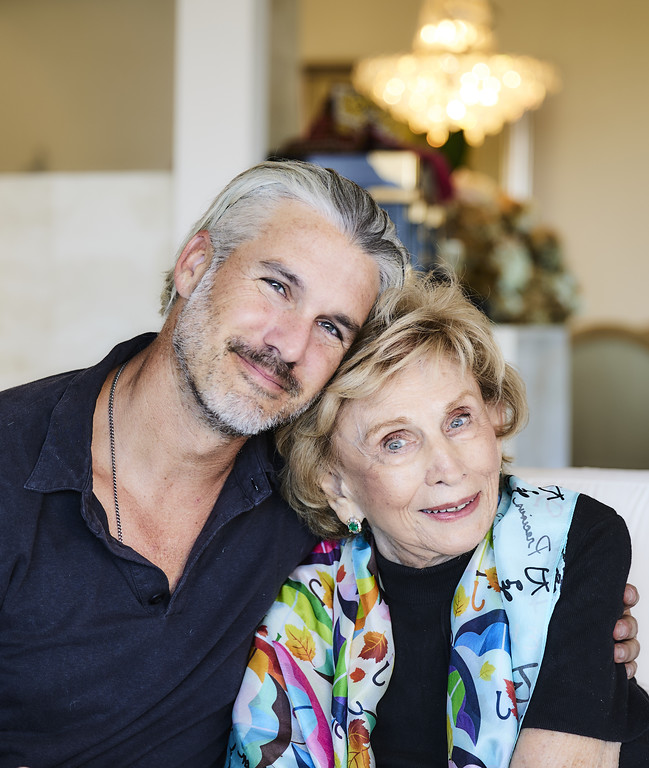
The new collection of videos features a filming of San Diego resident Jordan Engle telling the story of his grandmother, Dr. Edith Eva Eger, who survived Auschwitz and Mauthausen and later wrote The Choice: Embrace the Possible, a New York Times bestseller, with reviews by Oprah Winfrey and Desmond Tutu. Eger, 98, is an internationally known speaker and psychologist who has a clinical practice in La Jolla and held a faculty appointment at UC San Diego.
Engle, 45, describes what his grandmother told him. How she grew up in Hungary and how in March 1944, at age 15, she and her parents and one sister were forced out of their apartment after Nazi agents broke the door down.
The family was forced into a cattle car packed full of mostly Jewish people, forced to go to what was supposed to be a work camp at Auschwitz in Poland, but was an extermination camp. Many people died on the way.
Eger watched her parents taken away to the gas chambers where more than a million people, primarily of Jewish descent, were murdered. Eger’s blonde hair was shaved and her earrings were pulled off, leaving her ears bleeding. But she was spared death.
The guards gave her a piece of bread to dance for them. She suffered starvation and typhoid fever and was found on a pile of corpses when the camp was liberated in May 1945.
Later, overwhelmed by the past trauma and flashbacks, Eger was close to taking her life, but didn’t because “she was curious what her life would look like.”
Eger went on to help others cope with overwhelming trauma, including veterans with post-traumatic stress disorder. She has helped establish shelters for female victims of domestic abuse.
“I believe we all have to ask ourselves, what are we going to hold on to, and what are we willing to let go of? This has been my life journey, and the good news is, I am still climbing that mountain.” She found freedom in forgiving, letting go and moving on; not forgetting, but coming to terms with the pain.
People around the world have found healing in Eger’s story.
“My grandmother had every reason to be angry but she didn’t give in to that,” said Engle, founder and CEO of San Diego-based Lens & Soul.
“Growing up with Edie’s powerful message of hope and forgiveness, which was always the greater force than hate and anger, I feel that my job is to continue moving her story – our story – into the common space for humanity. I have seen firsthand how her work transforms people from victims, from their anger, and replaces it with purpose and love,” Engle said.
Engle ends his grandmother’s story saying what she often told others struggling in dark places, “If I can do it, then you can do it.”
Engle’s story of his grandmother is at https://www.ifyouheardwhatiheard.com/
“Many of us promised our grandparents that the world would never forget. If You Heard What I Heard is my generation’s way of making good on that promise to our grandparents,” Siegel said.