
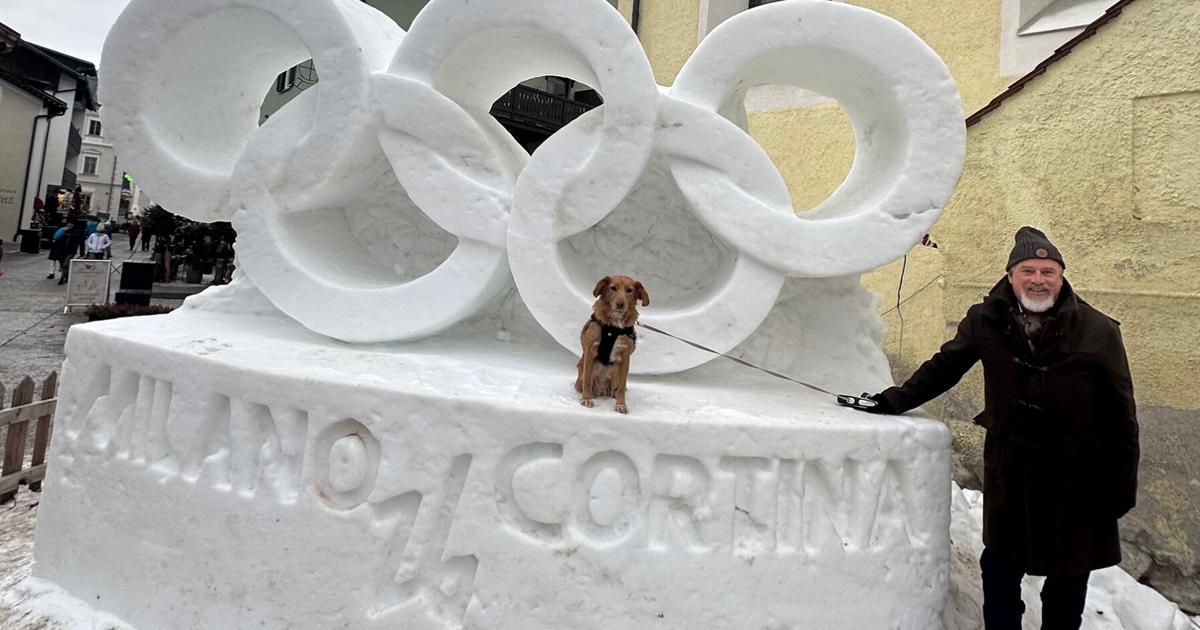
Matteo Garbelotto-Benzon, campus adjunct professor and researcher in forest pathology, was recovering from a ski accident while on a summer holiday in Sardinia, when a puppy appeared on his doorstep. The puppy, adopted and later named S’Abba, would become his service dog, helping him regain the ability to walk, return to skiing and resume his work in the forests.
Years later, Garbelotto-Benzon will carry the Olympic torch alongside S’Abba in Canazei, Italy, on Wednesday as part of the relay leading up to the 2026 Winter Olympics, co-hosted by Milan and Cortina.
“It’s a huge recognition of what these animals can do for us,” Garbelotto-Benzon said. “It’s exciting that they let (S’abba) walk because they understand that she’s not just a dog. She’s somebody that makes it possible for people like me who have disabilities.”
Garbelotto-Benzon noted he feels a “strong connection” to these Olympics, having grown up in a mountain community in the Dolomites near where the games are being held. Surrounded by forests and mountains, he discovered his passion for skiing and for studying trees in his community.
But in 2018, while skiing in Mammoth Lakes, he slammed into a cliff and cracked his fifth vertebra. Garbelotto-Benzon stated he was in “excruciating pain” and spent several months in a wheelchair.
“It was key for my job. I have a lot of research studies going on in the state, and they’re not always near parking lots or a road, so sometimes, I’ve got to walk miles in the forest to get to my study sites, or ski to them,” Garbelotto-Benzon said. “With my condition, it had become really difficult, if not impossible.”
That’s when he adopted S’Abba. With the help of a trainer, Garbelotto-Benzon said the dog was able to support his walking, helping him maintain balance on uneven ground.
He noted that to an outsider, he may seem “fully functional,” but said that having the support of a service dog has allowed him to “live life more fully.”
“We’re very much in tune,” Garbelotto-Benzon said. “When you break one side of your spine, you lose your sense of balance. You want to activate your muscles on one side, and you really can’t, and so that’s kind of what she does. She pulls me. She knows when the pressure on the leash goes down or up, and she makes sure that I don’t fall.”
He added that S’Abba’s support has been critical for continuing his work in locations surrounded by rugged terrain. Garbelotto-Benzon traveled across steep coastal mountains for his research on sudden oak death, a major disease destroying oak trees in coastal California.
He discovered the pathogen causing the disease alongside Dave Rizzo, a professor in the department of plant pathology at UC Davis. The two met in graduate school several decades ago and have now worked together for about 25 years, according to Rizzo.
“It was just great to see (that he’s been selected to carry the Olympic torch),” Rizzo said. “He had all those health issues a few years ago, so a lot of us were really worried, but I’m so happy that he’s come through.”
Following the torch relay, the 2026 Milan Cortina Winter Games will kick off with an opening ceremony on Feb. 6, broadcast live on NBC and Peacock.