
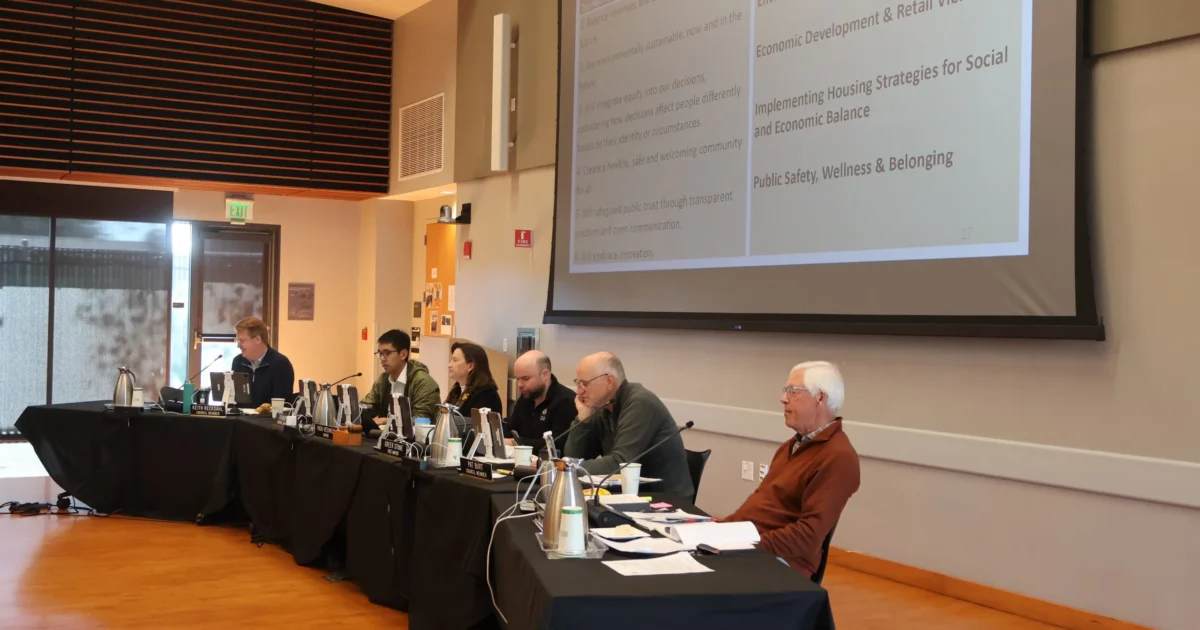
After floundering for hours in their own stratified vocabulary, Palo Alto officials coalesced on Saturday around a new list of goals for 2026: government efficiency, housing production, economic development and the renovation of Cubberley Community Center.
The City Council direction, now led by Mayor Vicki Veenker and Vice Mayor Greer Stone, marks a departure from previous agenda-setting retreats by replacing broader ideals with concrete topics. With Manhattan Beach Council member Amy Howorth serving as a facilitator for the meeting, which took place at the Mitchell Park Library, the council worked to clarify the terms “values,” “priorities” and “objectives” before voting on its priorities for the year.
The goal of the exercise was to identify the areas that would require special attention this year. City staff will return with a workplan for each of the priorities and track progress throughout the year. Over the past five years, the city’s priority list remained fairly static, with council members routinely choosing housing, the local economy, sustainability and community safety, with minor modifications in wording. This year, the council tried to separate perennially important items from those that will require a particular focus in 2026.
Items that require attention every year are classified as “council values.” The council adopted a list of values in 2022 — and has not updated them since. The priorities are chosen every year, and objectives are specific projects or milestones developed by city staff to further those priorities.
As Howorth noted, though, the council values and 2025 priorities had plenty of overlap, to the extent that many council members accidentally referred to priorities as values and vice versa. Council members Keith Reckdahl and Pat Burt came prepared with a list of updated values that they worked on together, as did Mayor Veenker — but a hearty wordsmithing discussion on those will take place at a future Policy and Services Committee meeting.
“Now that we have the consensus that core values are going to be something different, we have a blank slate on what should be our priorities,” Burt said.
“That was the goal,” Veenker added.
As for the meat of Saturday’s retreat, the council landed on a priority list for 2026 that includes “government efficiency,” “achieve near-term priority housing milestones,” “Cubberley acquisition and renovation funding” and “enhanced business vibrancy.”
The first three priorities were adopted unanimously, while the fourth priority regarding retail was tacked on at the end of the six-hour meeting, with Reckdahl and Council member Ed Lauing opposing the motion to do so.
“It comes at a cost that we lose focus, and with these three existing priorities, we’re trying to make unusual progress,” Reckdahl said. “The more we muddle it, the more we lose focus of making progress on those three.”
Narrowing the list of priorities to three, and then eventually four, was not an easy task. Each council member offered a short-list of their ideal priorities under the new framework that they refer to specific goals to be completed within the next year.
“Efficiency” seemed to be the buzzword of the day, with Mayor Veenker and Council members Reckdahl, Burt, Lauing and Julie Lythcott-Haims specifically naming it as priority they wanted to see (in fact, Reckdahl made it the theme of all three of his proposed priorities: efficient operations, efficient service delivery and efficient progress related to California Avenue and Ramona Street). Progress on Cubberley was another common item, as was housing development.
Where the council diverged was on economic development and retail vibrancy. Council member George Lu was the first to voice the idea of keeping a priority that simply listed “economic development,” in the goal of broadening the 2025 priority of “economic development and retail vibrancy.” Vice Mayor Stone agreed with that assessment; meanwhile, Lauing and Veenker wished to move away from listing economic development at all, with Veenker suggesting that it become a specific objective instead of an umbrella priority.
Lauing and Stone were also the only two members of the council to express a desire to maintain the priorities from 2025. When they were initially developed, they were planned as two-year priorities to allow time for their many goals to materialize. But the rest of the council appeared eager to move forward with the new framework — and a new set of priorities to accompany them.
“I’m in favor of not carrying the current priorities forward as priorities, but elevating them as values, freeing up room for more specific things at the priorities level,” Lythcott-Haims said.
What emerged from the hours-long discussion were four priorities in total, two of which are tied to specific goals for the city. The other two, especially the government efficiency priority, are less so. City staff are now tasked with developing a list of 30 to 40 objectives, which are specific and targeted goals to fulfill either a priority or value.
Howorth attempted to steer the council toward a more concrete priority in that area, describing it as “very vague,” but the dais was united around government efficiency — especially as the city prepares for substantial cuts to offset deficits that total more than $80 million over the next decade.
The topic of efficiency also came up long before the priority discussion began in earnest. At the beginning of the meeting, council members were invited to reflect on the most surprising aspect of becoming an elected official.
“What surprised me the most is that here we are right in the middle of Silicon Valley with the lightning pace of getting everything done. That does not describe our city in terms of how we execute,” Lauing said. “This is not negative or a criticism, it’s just a fact.”
This story originally appeared in Palo Alto Weekly. Riley Cooke is a reporter at Palo Alto Weekly and Palo Alto Online focusing on city government.