
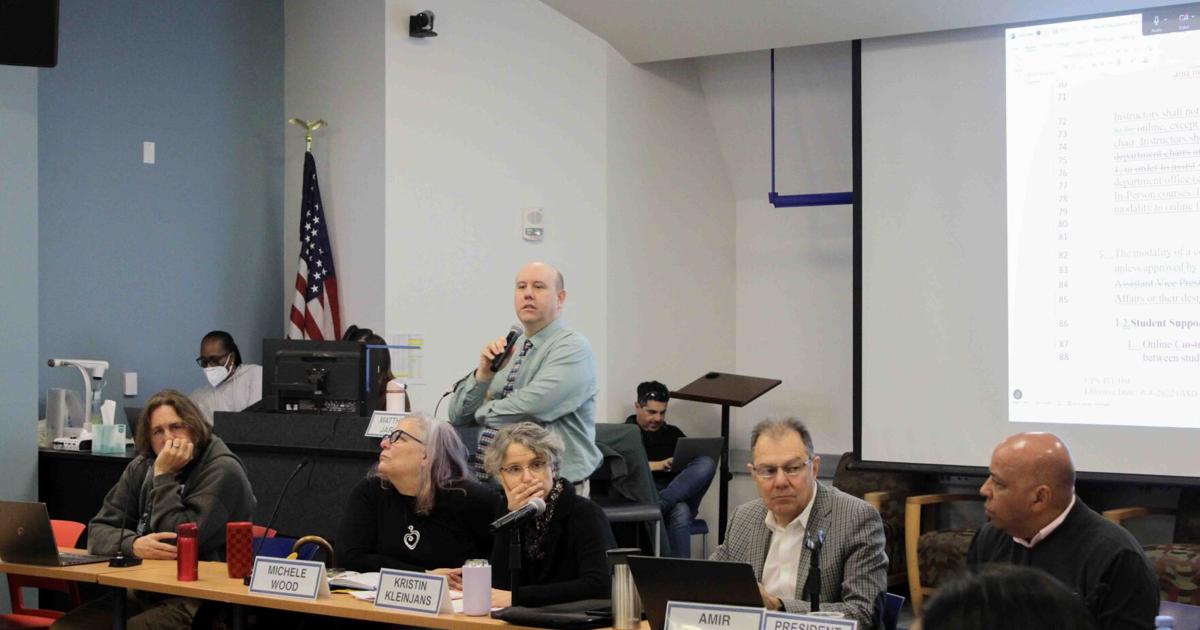
Cal State Fullerton’s Academic Senate discussed potential updates to the university’s online learning policy at last Thursday’s meeting.
The current policy, UPS 411.104, was brought to the senate meeting to clarify the language surrounding online instruction, which the university defines as both hybrid and fully online courses.
According to some senators, like Academic Senator Kristi Kanel, the need to clarify languages arises from concern that faculty who teach in-person courses will misread the provisions of policies to unnecessarily move their classes online.
“It’s to use it in emergencies or if you go to conferences and things like that. So we should try to respect a little bit about the intent of the policy,” Kanel said.
Current policy dictates that an instructor cannot change an in-person course to have more than 20% of its instructional time online without approval from the department chair.
While current policy does not specify when faculty members are permitted to move courses online, an amendment to the policy brought by Provost and Vice President of Academic Affairs Amir Dabirian, proposed to require in-person instructors to alert their department chairs if they intend to move the first or last weeks of instruction from in-person to online.
According to Dabirian, these weeks are crucial due to the amount of information students need during the first week of classes, including syllabus questions, potential communication about modality changes to the class and “instructor-initiated drops” used by the university to drop students from a section who do not attend the first two weeks of class.
As for notifying the department chair in the last week before final exams, Dabirian stated that changing class sessions from in-person to online when it was not stated on the syllabus could potentially cause confusion for students because of their lessened ability to get information on their final examinations.
According to supporters of the amendment, communication with the department chair could also provide clarity for students who may miss communications from their professors about modality changes and seek help from the department.
However, this raised concerns among academic senators that the language used in the policy was not clear enough to indicate which week the campus considers the last week.
Other members of the Academic Senate took issue with requiring faculty to alert their department chairs of schedule changes during the last week of the semester, before finals week, because the structure of some courses’ final assignments or examinations do not require in-person meetings.
“I don’t see the point of adding an extra bureaucratic process in something that should be our classes, and we know our students better,” said Academic Senator Ricardo Valencia on the idea of emailing department chairs to alert them of modality changes.
Another policy area that was discussed was the type of material offered to students in online courses. The policy draft directs faculty to provide “direct instruction” during online instruction.
Some urged for the language to be changed to require those who teach these courses to provide direct instruction with original content created by faculty.
In response to this amendment, some showed concern that the language could be interpreted as requiring the instructor on record to create their own materials, thereby prohibiting shared course materials, such as lecture slides, among certain departments.
This spoke to rising concerns among staff who solely rely on materials made by publishers, which brings issues regarding the quality of education when the syllabus relies mostly on outsourced materials.
“Cengage and all the other publishers are very happy to help you do that (use provided premade course materials) because it’ll be easy and you’ll come back and use their book again,” said Academic Senate Chair Matthew Jarvis. “We kind of have to protect from faculty being tempted by that easy solution.”
Concerns about Artificial Intelligence use in online courses were briefly mentioned as it pertains to the use or original content made by faculty, and is expected to be revisited at future meetings.
The updated policy is still undergoing editing and has not yet been adopted. Deliberation on updating UPS 411.104 will occur at upcoming Academic Senate meetings.