
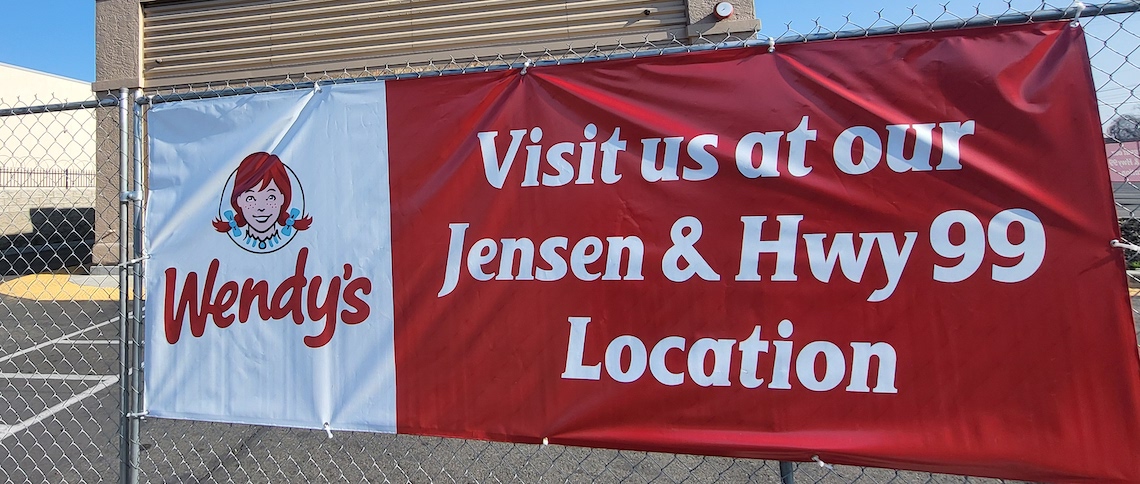
The Wendy’s location in West Fresno closed in December as part of a larger consolidation of franchise restaurants. Photo by Gabriel Dillard
Longtime Fresno-based franchise operator JEM Management is closing Wendy’s and KFC locations across the Central Valley, part of a broader contraction sweeping the fast-food industry as companies consolidate underperforming stores.
The Wendy’s Co. announced in a November 2025 earnings call that it expects U.S. closures in the “mid-single-digit percentage” — meaning between 3% and 7% of locations — as part of its turnaround strategy. With approximately 6,000 U.S. Wendy’s restaurants, that translates to between 180 and 420 potential closures, on top of nearly 200 U.S. locations already shuttered in 2024.
Those closures are bearing out locally. The Wendy’s location in Selma closed last week, following the December closure of a Fresno location at 1140 C St., west of Highway 99 near downtown. A Visalia location at 2125 N. Dinuba Blvd. also recently closed.
A message left for JEM Management regarding the closures was not returned Monday morning.
JEM Management currently operates 14 Wendy’s locations across the Central Valley: eight in the Fresno-Clovis area, four in Tulare County, one in Hanford and one in Madera.
The company has deep roots in the region’s fast-food landscape. Founder Joe Desmond established JEM Management in 1964, but his restaurant career began even earlier when he opened Uncle John’s Pancake House in Fresno in 1959. It was there he met Colonel Harland Sanders and struck a deal to become one of the first 10 KFC franchisees, paying Sanders a nickel per piece of chicken sold at Uncle John’s Pancake House, according to the company’s website.
But the legacy brand now operates in a different kind of retail environment. In the face of challenges, JEM Management has also been closing KFC locations — three in Fresno in 2025, according to an October Fresno Bee report. The company currently operates about 20 KFC locations in the Central Valley.
The closures reflect mounting pressure on California’s franchise restaurant operators. The state’s $20-per-hour minimum wage for fast-food workers, which took effect in April 2024, significantly squeezed already-thin profit margins. Combined with commercial rents, rising food and utility costs and changing consumer habits, many operators are consolidating their portfolios.
In addition, some operators are also exploring technology investments — like kiosks and mobile ordering — to offset labor costs.
In a recent earnings call, Wendy’s interim CEO Ken Cook framed the broader consolidation as necessary pain. “These actions will strengthen the system and enable franchisees to invest more capital and resources in their remaining restaurants,” he said.