
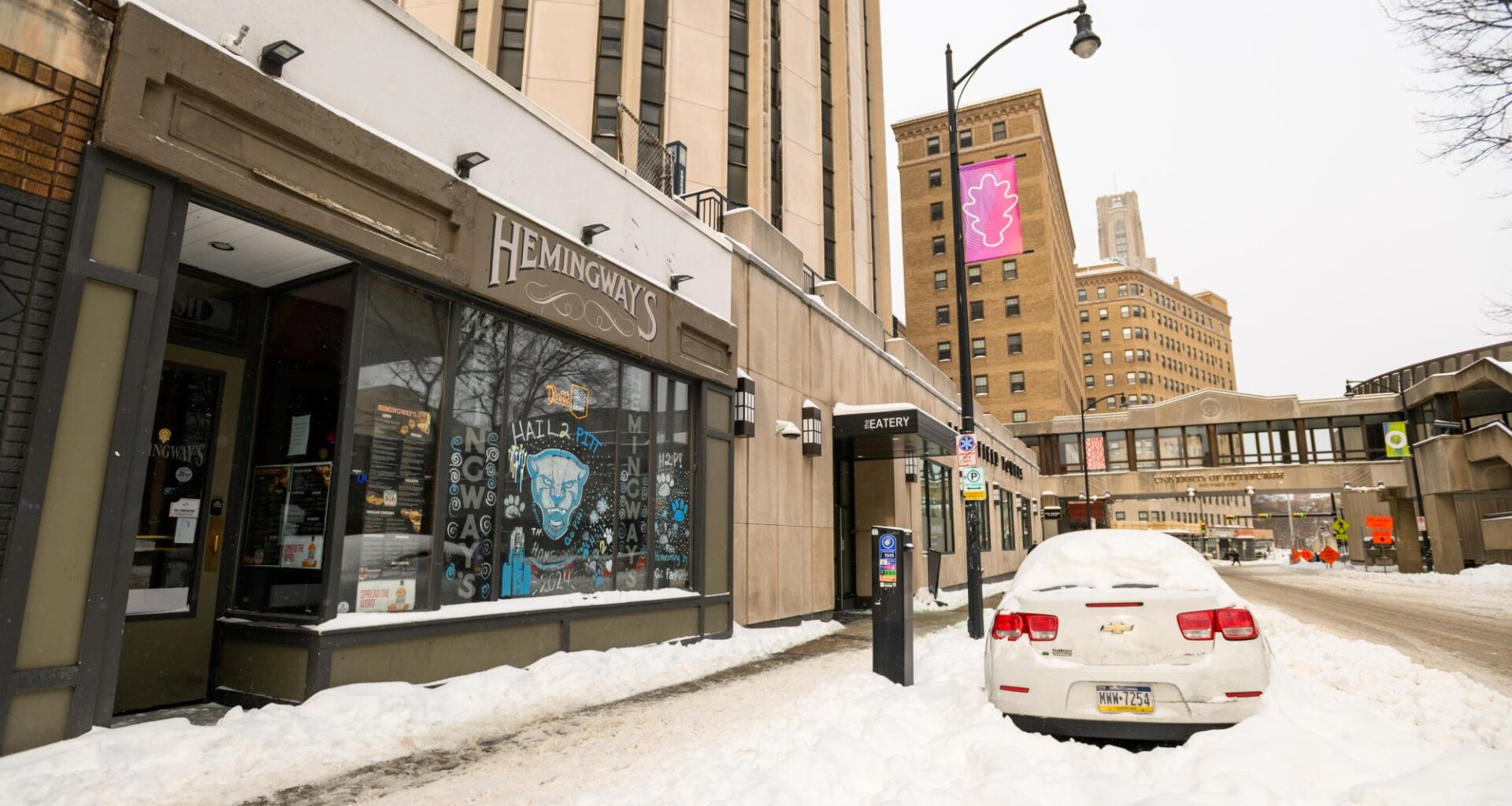
Students are losing establishments to drink and socialize in Oakland, which follows a broader cultural trend of young people straying from alcohol use.
The impending closure of Hemingway’s Cafe follows the continuing trend of bars in Oakland ceasing operations. The disappearance of third spaces, such as bars, connects to larger shifts in college culture that leave students with fewer spaces for socializing. With fewer bars and a changing drinking culture, some young people are choosing not to drink at all.
Gene Ney, the owner of local bar Gene’s Place for 21 years and business professor at Carlow University, said there used to be 14 to15 bars in South Oakland in the 90s and early 2000s. Ney said keeping a bar open in Oakland has been difficult since the loss of Pitt’s on-campus football stadium in 1999.
“You need those football Saturdays,” Ney said. “When that was moved down to the North Shore, everybody [went] to the North Shore, and you basically almost had to write off your Saturdays, so that really ruined things.”
Ney said other factors such as the growth of Uber and Lyft and higher rent also makes it hard for businesses to stay in Oakland.
“You and your friends can jump into an Uber and Lyft and go to some other area relatively inexpensively. Back in the day, you had to either take a bus or a cab, so that hurt,” Ney said. “We’ve [also] had a lot of major real estate companies come in and buy up properties here in Oakland, and they’ve jacked the rent up real high. If you don’t own your building, it’s very difficult to make ends meet with the rent.”
Colt Pierce, an urban studies teaching assistant professor, said bars as third spaces are important whether or not students drink. A third space is defined as a place where people can gather outside their home or workplace.
“To me, what a third space is, is a space where all these different identities collide together,” Pierce said. “That is actually really essential for the college experience — to be in a space where you can meet so many different kinds of people.”
Pierce said that while alcohol can be helpful as a “social lubricant,” it isn’t required for a third space to be successful.
“Places like Hemingway’s are more than just drinking spaces. They are social spaces,” Pierce said. “I think that places like [bars] just need to adapt. If students aren’t drinking alcohol as much as they used to, [they need to ask] ‘What are they doing?’ and ‘How can we provide that for them?’”
Pierce said that institutions that have been near Pitt’s campus for decades, like Hemingway’s and Gene’s Place, are essential to keeping Pitt’s history and traditions alive for future students through old photos and Pitt paraphernalia on the walls.
“They’re nostalgic spaces, because you can go into a bar like Hemingway’s, and you can see 40 years of Pitt social history there,” Pierce said. “That’s really important to the community. It makes you feel like you’re part of something.”
Lauren Bailey, a senior natural sciences major, said she has noticed a slight “vibe” shift in the environment of the bars she has gone to since last spring semester.
“A lot of bars now have older crowds. Whenever I used to go to Tequila Cowboy last spring semester, it was a bunch of people between 21 and 25, but now, wherever I go, I feel like I’m always surrounded by adults,” Bailey said. “It’s creating a weird divergence in culture.”
Bailey said that she has noticed drinking culture change as more people her age place a greater focus on their health.
“People are becoming more concerned with the rates of cancer associated with alcohol, they’re starting to take their mental health seriously, they’re more conscious about how much they’re drinking and how late they’re staying up,” Bailey said. “People are realizing that certain aspects of drinking culture in college aren’t preparing them for success.”
Ney said that through the years, Gene’s Place has been an integral part of the community — he has served hundreds of Pitt alumni and has even watched some of them propose and host wedding receptions in the establishment.
“It’s really an Oakland tradition. That’s one of the things that we need more of and we just don’t have enough of,” Ney said. “We’ve lost a lot of it.”
Ney said the best way to help Oakland and keep Pitt’s out-of-school traditions alive is to support the small businesses in the area.
“If people did support [small businesses], it would definitely help more places be here,” Ney said. “Not just the bars — any kind of business here in Oakland. If you look at Oakland over the last 30 years, we’ve lost so many mom-and-pop businesses, and now it’s all corporate chains, and the reason is those places can’t afford to pay the rents here in Oakland.”