
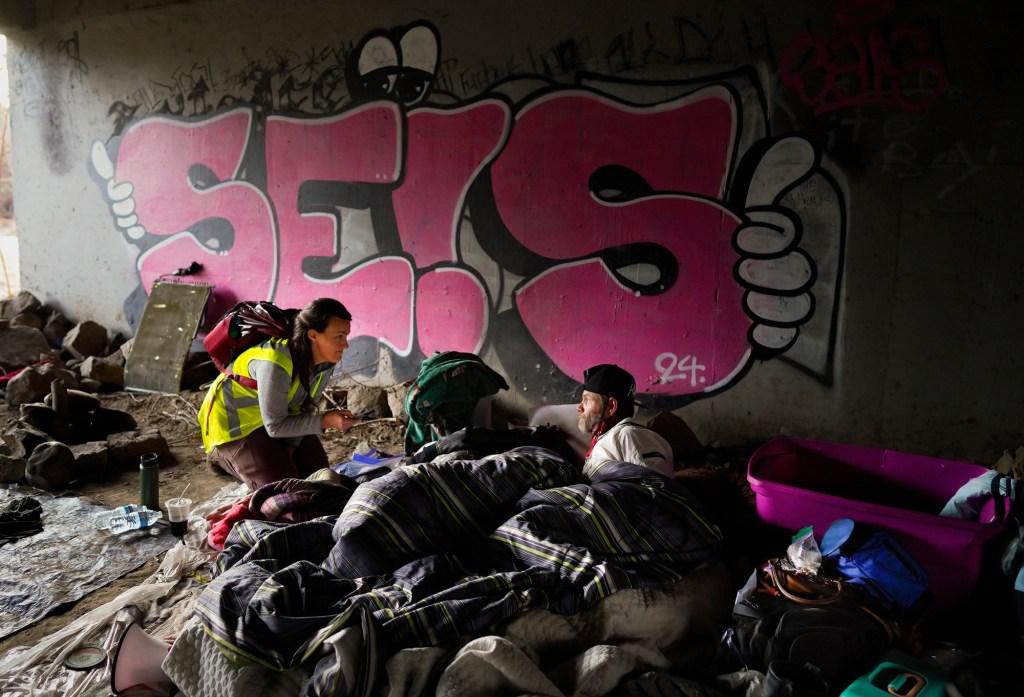
A man we will identify as “James” for the purposes of this commentary lives in a tent in San Diego’s East Village, struggling with the necrotic lesions characteristic of xylazine-associated wounds. The pain makes walking difficult, yet recently, he faced a stark choice: seek medical treatment and risk losing his belongings, or stay put while his infection worsens.
He knows the risk because it has happened before. During a previous clinic visit, he returned to find his clothing, sleeping gear and medical supplies stolen. Today, his fear is compounded by San Diego’s Unsafe Camping Ordinance, which bans camping in public spaces and authorizes crews to rapidly clear encampments. Because enforcement requires him to be physically present to move his belongings on short notice, James cannot afford to leave his site. As a result, he has been forced to abandon his follow-up appointments.
His predicament highlights a shifting crisis, underscored by the county’s first major health alert regarding xylazine in 2025. Unlike opioids, this veterinary sedative constricts blood vessels and starves skin of oxygen, causing severe, necrotic lesions. The threat is escalating: Local syringe service programs reported that 31% of samples tested in 2024 were positive, confirming its rapid entrenchment in San Diego’s supply. Our outreach teams now encounter the characteristic wounds daily, a complication that was virtually unseen previously.
The rising use and drug poisonings due to xylazine are so difficult to address because we have yet to create effective tools to respond to it. Since it is a sedative and not an opioid, Narcan/naloxone, which is used to reverse an opioid overdose, cannot reverse its effects. Additionally, fentanyl testing strips cannot detect its presence in a drug sample. Rescuing someone from a “tranq” overdose requires immediate identification and extensive breathing support. However, when enforcement pushes the unhoused population out of downtown and into freeway underpasses, they move out of the reach of first responders. By design, the city’s Unsafe Camping Ordinance makes the crisis less visible and its victims invisible, making the xylazine crisis fatal by losing the “golden hour” for intervention.
For those who survive the night, the constant displacement is equally devastating. Xylazine causes severe wounds by starving the skin of oxygen, creating lesions that require daily hygiene and monitoring. In medicine, the gold standard for recovery is “continuity of care” — the principle that a patient has a stable relationship with their providers. Clearing an encampment disrupts the vital connection between patients and the street medicine teams working to save their lives. It forces a “healing in motion” strategy that is, quite simply, medically impossible.
As we approach the 2026 Point-in-Time Count on Thursday, San Diegans will see a statistical snapshot of homelessness. However, these numbers cannot capture the human toll of a population in constant motion. We understand the desire for clean, accessible sidewalks; public order is a valid concern for all of us. However, we must acknowledge these measures are inflicting an unsustainable cost to our health care system.
Instead, San Diego should pivot to a “stability-first” approach. This policy recognizes that a patient’s physical and geographic stability is the fundamental requirement for medical intervention. We need low-barrier wound clinics that provide care without requiring government ID or appointments. Furthermore, code enforcement must coordinate directly with medical outreach teams. The economic argument is as compelling as the humanitarian one: Evidence indicates that consistent, site-based wound care can reduce emergency room visits for soft tissue infections. We must choose between funding preventative bandages on the street today, or paying for six-figure emergency amputations and ICU stays tomorrow.
San Diego has the expertise, resources, and the heart to manage this crisis. By prioritizing the stability of our most vulnerable neighbors, we can ensure our local policies create a city that is truly healthy and safe.
Zhu is a public health researcher at UC San Diego specializing in social determinants of health. Connolly is a San Diego-based harm reduction volunteer with experience supporting unhoused community members through mobile outreach.