
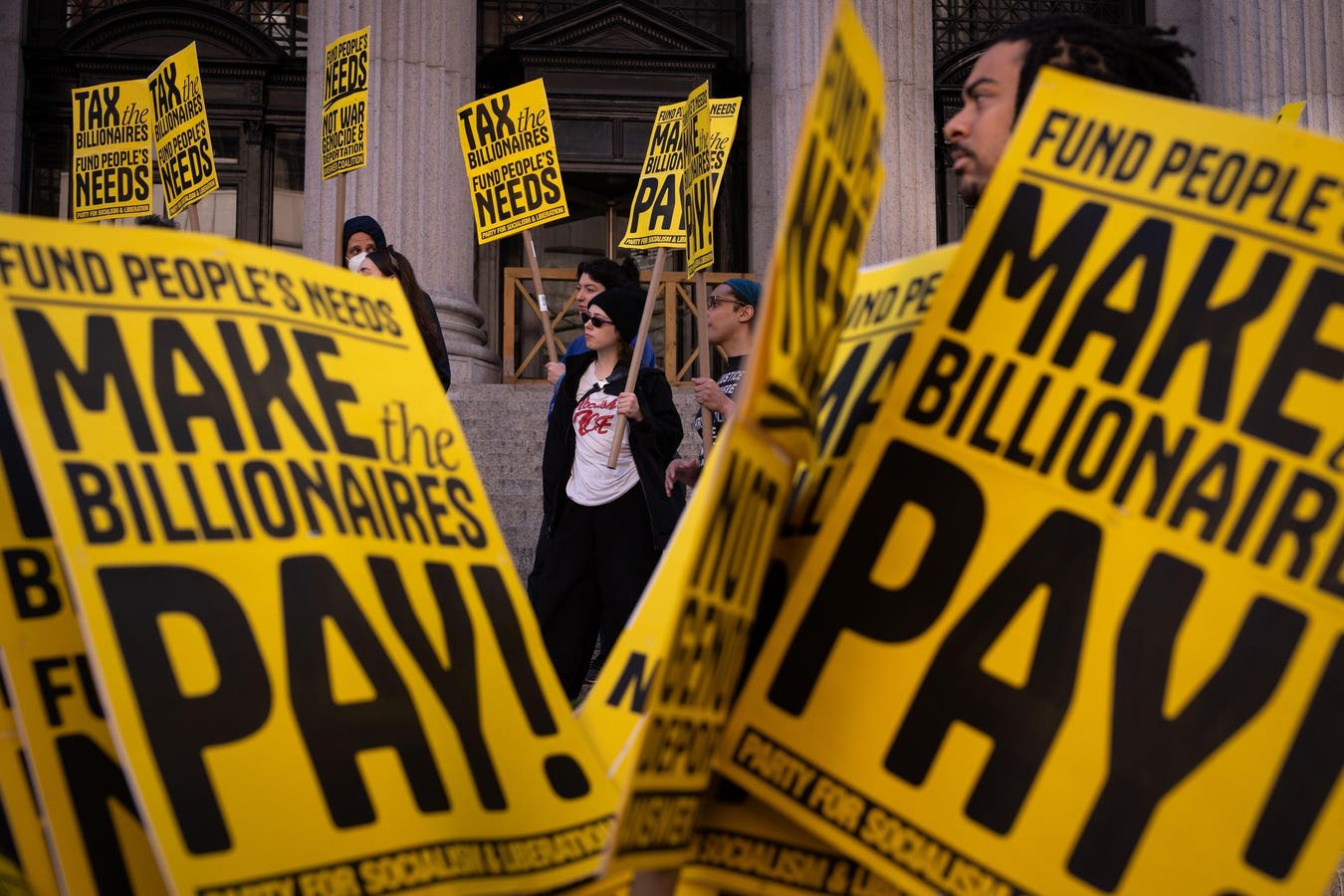
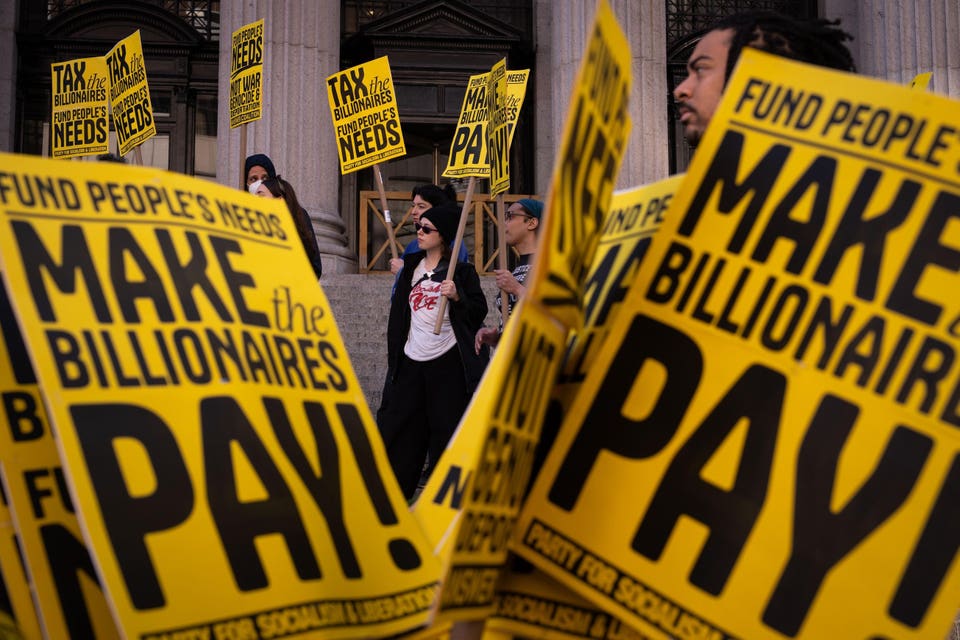
NEW YORK, NEW YORK – APRIL 15: People protest on tax day calling for billionaires to pay more tax on April 15, 2025 in New York City. Activists suggested a 90% wealth tax to guarantee universal healthcare, free college education and to eliminate hunger and homelessness. (Photo by Adam Gray/Getty Images)
Getty Images
California’s proposed one-time tax on billionaires has generated significant interest, and it is likely to increase. There’s no question that the state’s billionaire Tax Plan has some rich Californians looking to exit. Some have already moved in view of the retroactive January 1, 2026 effective date of the law–if it passes. This is not the first time a wealth tax has been proposed in the golden state. For example, in 2020, California legislators proposed a 0.4% wealth tax, and a 16.8% income tax rate. Neither was passed, but way the 0.4% wealth tax would have worked is interesting in light of the new ballot proposition. The proposed 0.4% tax rate would have applied to a person’s net worth above $30 million. At the time, proponents said that was about 30,400 Californians.
Wealth Tax And Income Tax
Cleverly, the latest California Billionaire Tax targets only a fraction of this number, with a one-time rate. The proposed ballot measure known for the 2026 Billionaire Tax Act would impose a one-time 5% tax on billionaires living in the Golden State, said to be about 200 people. Supporters say that this measure could raise about $100 billion to help fill funding gaps in health care and education. They say the tax is needed to offset massive cuts in federal spending on Medicaid and food aid recently signed into law by President Trump. As proposed, the tax would apply to the net worth of California billionaires in the 2026 tax year.
Wealth Tax Administration
Real estate holdings would be exempt, but most other assets — from private company shares to investment portfolios — would be subject to the 5% levy. The tax could be paid over five years. A small group of billionaires who might have to pay a mere 5% seem unlikely to generate much sympathy from most California taxpayers, or sympathy nationally for that matter. But as with the prior wealth tax proposals, some of the objections appear to focus on floodgates concerns.
There are administrative worries too. Wealth isn’t about income, but about assets. How do you determine the value of everything you own? For example, what about stock options in private companies? You can bet that you might say one figure, and the notoriously aggressive California Franchise Tax Board might say something quite different.
California has long been an innovator, and in that sense, some fear that its wealth tax could set a precedent for other states. There is also the exit factor. Already, California has had waves of taxpayers leaving California over taxes in favor of no tax or lower tax states. The loss in numbers and dollars is palpable, and some say that the risk of pushing out some of California’s richest residents is a mistake. Taxes aren’t the only reason people move, of course. When Elon Musk left California he cited high taxes and regulation. Now SpaceX too has relocated.
The tax is not even on the ballot yet, as 870,000 signatures are needed before the wealth tax can hit the California ballot. Then, every California voter has the chance to give the new tax a thumbs up or thumbs down. High taxes are normal in the state, with a top 13.3% income tax that does not distinguish between ordinary income and capital gain. Indeed, the top 13.3% tax can grow to 14.4% in some cases. There are audit and administration concerns too. California’s Franchise Tax Board is notoriously tough, many say tougher than the IRS.
California’s latest wealth tax proposal is targeted, and it may stand a better chance of passing than the wealth tax proposals of the past. But more residents of varying meant may still exit. As you might expect, physical presence is probably the biggest issue. If you spend more than 9 months in California, you are presumed to be a resident. If you spend 6 months or less in California, you may qualify as a seasonal visitor, but only if you don’t work while you are in the state and meet other tests. If you are a California resident but are heading for the exits, consider this checklist:
Get a new other state driver’s license, and turn in your California one.Move and register your car(s) in your new state.Notify California DMV, move vehicles and re-registration.Insure cars and real estate with insurance in the new stateRegister to vote in the new state.Cancel California voter registration for old residence.Terminate California club memberships.Join clubs and social groups in the new state.Relocate family to the new state.Move cherished family heirlooms (photos, keepsakes, etc.) to home in the new state.Sell, list for sale, or lease (preferably a long-term lease) any California property—selling is best.Terminate lease of any California property.Lease (long-term) or buy residence in the new state. Buying is best.Notify friends and family of permanent move out of California.Notify banks, credit card companies, etc. of move and provide new state address for statements. Have correspondence including bank statements, credit card statements, etc., sent to new state address.Use healthcare providers and other advisors (except with regards to advice concerning California taxation) in the new state.File change of address forms with US Postal Service and IRS.Notify all contacts of change of address and permanent move.Obtain new state phone numbers.Send holiday cards, birthday cards, and other correspondence from home in the new state.Change professional affiliations and licenses as needed to the new stateEstablish office or workplace in the new state.Limit physical presence in California as much as possible.