
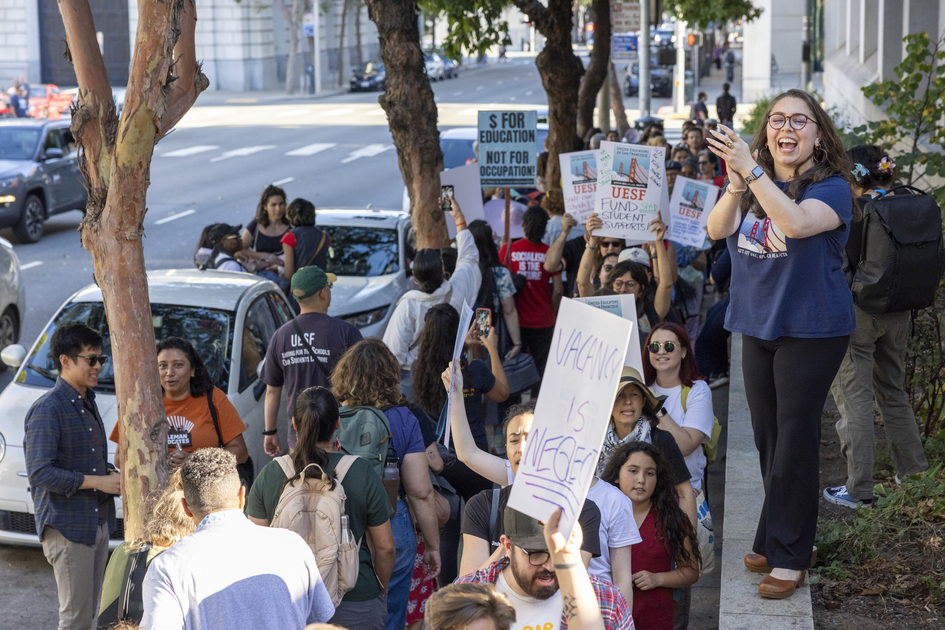
It’s the stuff of working parents’ nightmares: San Francisco public school teachers are hurtling toward a strike.
Negotiations between the San Francisco Unified School District and its teachers union, the 6,000-member United Educators of San Francisco, have reached an impasse, and both sides are indicating they’re digging in for a fight.
“This is the longest, most extended situation we’ve been in with the district, where we remain so far apart,” UESF President Cassondra Curiel told The Standard Friday. Meanwhile, a formal fact-finding session between the parties last week yielded no progress, according to a letter (opens in new tab) SFUSD Superintendent Maria Su sent to parents.
In a video posted (opens in new tab) to YouTube, Su said schools would remain open this week but gave no further reassurances, aside from a commitment to keep families informed.
Since California requires public schools to offer instruction 180 days a year, Su conceded that if there is a strike, the district may have to keep schools open beyond June 3, the scheduled last day.
There are a few more dominoes to fall before the first San Francisco teachers strike in half a century could begin. Here’s where things stand and how to get prepared.
When would a strike begin?
Potentially as soon as next week, though it is likely to be later in February.
Educators are in the midst of their second and final strike authorization vote, which ends Wednesday. More than 4,250 educators have voted, according to UESF. Based on a preliminary vote in December, in which a strike was authorized by 99.3% of voting union members, the measure is almost certain to pass.
Teachers can not choose to strike until a neutral fact-finding process is completed and a final report is released by Feb. 4. That report will include recommendations for a settlement but will not be binding for either party.
Will schools be closed?
In her video to parents Friday, Su said a strike means the district “will not be able to open schools to students safely.” As of Monday, principals had not received information on whether their schools would remain open or closed in the event of a strike. Students and parents may be encouraged to join in on the protests, with most educators on the picket lines.
During the four-day West Contra Costa County School District strike in December, schools remained open, with principals and support staff responsible for supervising students.
While the district has given no other word about its instruction plans during a strike, some lessons can be found from the last San Francisco teachers strike, in 1979. The six-week strike that began in September delayed the start of the school year and forced Mayor Dianne Feinstein to get involved. Feinstein reportedly bore the brunt of the criticism for the length of the work stoppage and took it upon herself to negotiate the end of the strike. She was near the end of serving out George Moscone’s term as mayor after his 1978 assassination and was days away from reelection by the time the strike ended in October.
Loading…
Who will fill in for teachers?
During the 1979 strike, some teachers returned to work before others, and some schools opened before others. The district aggressively recruited substitute teachers to fill the gap, although that might not work this time around, since many SFUSD substitutes are part of the union. That strike was sparked by a district plan to lay off around 2,000 teachers after the passage of Proposition 13 fundamentally altered how public education would be funded. It ended after more than half of the teachers were reinstated and new annual raises were put into place.
What are the union and district at odds about this time?
Contract negotiations have included issues around benefits, understaffing, working conditions, working hours, and resources for special education. But the main point of contention boils down to pay.
The union is pushing for raises of between 9% and 14% for educators over two years, far above the district’s offer of 2% annually over the next three years.
Su said the offer was one of SFUSD’s “creative suggestions” it presented to the union at the bargaining table. Other suggestions included augmenting the salaries of special education teachers and identifying a pathway for the district to fully fund family health benefits. Those offers were rejected by the union without a counteroffer, according to Su.
The district claims that it simply can’t meet the union’s salary demands while also closing its roughly $100 million budget deficit and avoiding state oversight.
Wasn’t there a contract negotiation just two years ago?
Yes, in 2023, San Francisco educators passed a strike authorization vote, but a work stoppage was averted after a last-minute agreement was reached and teachers were granted a $9,000 raise the first year and a 5% raise the next.
However, stakeholders from all sides report that the current situation is more dire.
Curiel said this is the closest the union has been to striking in the 16 years she’s worked at the district.
Are SFUSD teachers underpaid compared with their peers?
Of the 10 largest school districts in California, SFUSD had the fifth-highest annual average salary in 2024-25: $103,472.
Some neighboring suburban districts, like San Leandro Unified, Fremont Unified, and Palo Alto Unified, generally pay teachers higher salaries than SFUSD. Oakland Unified has a lower annual average salary.
A San Francisco civil grand jury report (opens in new tab) released in 2023 identified SFUSD’s low starting salaries compared with other Bay Area districts as a factor that hampers retention and recruitment.
Can the district afford to give teachers the raise they want?
It depends on whom you ask. Curiel argues that providing the requested pay increases is a question of priorities for the district, while Jaime Huling, vice president of the SFUSD board, has said the district has its hands tied in raising salaries due to its current monitoring by state auditors and its desperate fiscal situation.
Budget proposals presented to the board for the next school year have mainly been predicated on staffing cuts and other cost-saving measures, such as closing campuses and ending general education busing.
Are SFUSD teachers the only ones potentially striking?What has the mayor said about the strike?
Not much of substance. When asked directly about the potential work stoppage on KQED’s “Political Breakdown” podcast last week, Mayor Daniel Lurie said his office has not gotten directly involved in negotiations. He pointed out that the district is run by the elected board of education.
“Having said that, we spend $200 million a year of your taxpayer dollars on SFUSD, and I want to make sure we take care of our teachers, always,” he said. “I also want to make sure our kids have a great education.” He added that he would step in at Su’s bequest.
Lurie’s two children don’t attend SFUSD schools, leaving many district parents to wonder if the mayor is as worried about the situation as they are.