
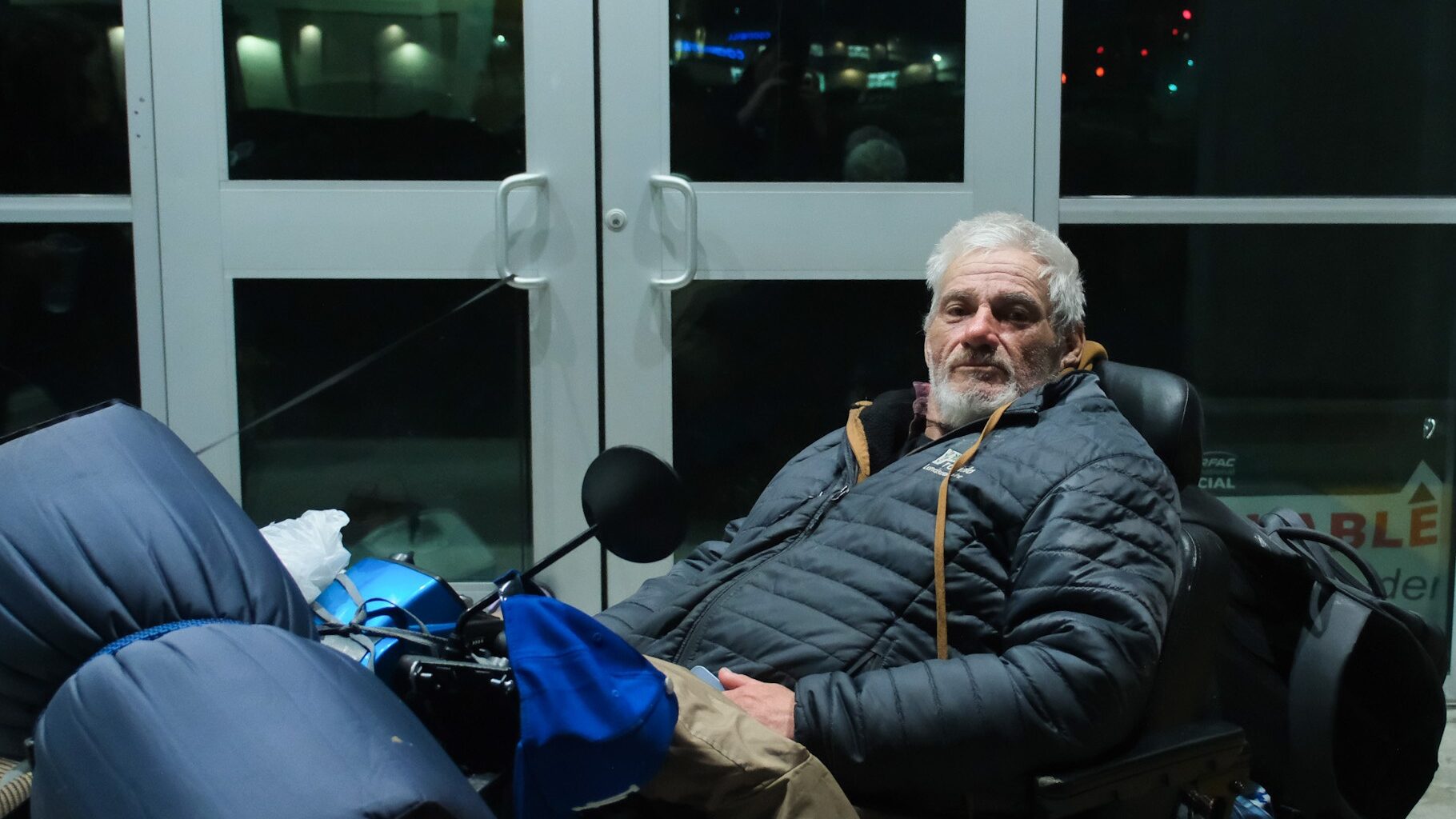
Ralph Tikker has been living outside in Sacramento since 2019. While he’s had some respite through the Sacramento Housing and Redevelopment Agency, he’s back on the street.
The shelters he’s tried to stay in can’t accommodate his power chair, something Tikker’s needed to use since he fell while riding his e-bike a year and a half ago. At 65, he sees a gap in resources for people with disabilities in his age group.
“I can’t fit this on a bus for transportation, I’m stuck here with no battery,” Tikker said.
Ralph Tikker is one of hundreds of people living on the streets of Sacramento County being counted in Sacramento Steps Forward’s 2026 Point-In-Time, or PIT count. This year, they’re sending 800 volunteers out to get a sample size of the number of unhoused people in Sacramento.
The PIT count is federally mandated and has been conducted every two years on the last week in January in Sacramento since 2009. The federal Housing and Urban Development Department uses the data to determine funding for shelters and programs that assist unhoused people across the country.
The survey gives community members a way to directly interact with those experiencing homelessness and better understand their challenges.
Amongst the volunteers was co-chair of Sacramento Steps Forward’s Partners With Lived Expertise Committee, Darrell Rogers. The committee helps advise the organization’s Continuum of Care board on how best to close gaps in the care of unhoused people in Sacramento. He said that when faced with homelessness, he chose to go to prison instead.
“I would rather go sit in a cell and get three hot [meals] and a cot and medical, than just being on the street,” Rogers said. “I was actually causing more harm to myself and to my family, living that life.”
Rogers said that when he got out, after being in youth authorities and jail from age 13 to 37, he decided to go back to school and make a change for himself.
“To date, I’ve been home and successfully housed and for eighteen years I haven’t had a traffic ticket,” Rogers said. “I needed to go through what I needed to go through to get to where I’m at.”
He said that while doing the PIT count allows for funding to be allocated, there’s more to doing the count.
“It’s important for [people] to see the condition that people are in,” Rogers said. “Talk to them, let them know that they’re loved, and there is someone thinking about them.”
Rogers said that he believes that the best way to help unhoused people is to help them help themselves.
“You have a built-in workforce. You don’t have to rely on such an overburdened budget because that same group of people will help themselves,” Roger said. “We’ve been pushing that for sometime.”
This sentiment was echoed by Eric Rock, who said he’s been living on the streets for three years.
“The city can’t do anything without the people involving themselves as well,” Rock said. “The city needs to provide better areas with bathrooms, places to charge phones, places to rest safely, places where we don’t have to get our things stolen or thrown in the trash.”
However, he said that it can be hard for unhoused people to feel able to be productive and help themselves.
“Each day of my life, I’m not welcome in many stores, and I understand the reason. I understand the root, I understand where it comes from,” Rock said. “For us to keep a positive attitude and be productive and want to help solve the problem, it’s nearly impossible when you’re treated like that all day long.”
City and county officials show out for PIT
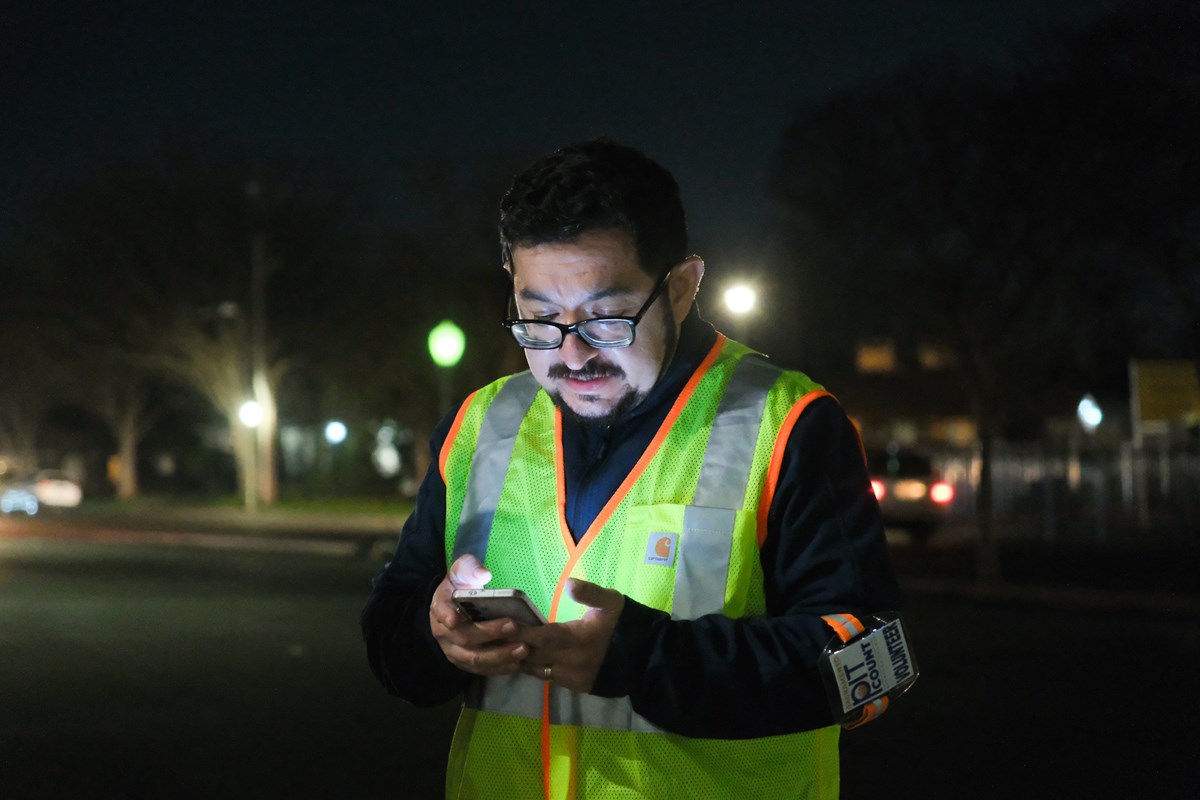 Eric Guerra takes down answers to survey questions during the Point-in-Time Count on Jan. 26, 2026.Ruth Finch/CapRadio
Another volunteer that helped with PIT count was Councilmember Eric Guerra, who represents District 6 in Sacramento. In addition to volunteering, he was helping connect people to services.
“We’re scheduling time to get them connected to the shelter locations,” Guerra said. “We have folks getting signed up to our different shelter locations.”
He said that many of the people he’s talked to have been seniors, struggling with disabilities and PTSD. According to Guerra, it can be difficult to get services to people who need them on the borders of his district.
“As someone who lives here, part city, part county, you have this issue of who’s working with who,” Guerra said. “We’ve gone a long way there, but we definitely still have a lot more work to do.”
He said that after living in his car when he was 18 and dealing with his father being in and out of correctional facilities, he wants to ensure people can succeed.
“We have to make sure that we don’t set people up to fail,” Guerra said. “We [have to] make sure we create opportunities for people.”
Sharon Jones, who was with another group at the PIT count, founded Camp Resolution, a self-governing homeless camp that was shut down in August 2024. She said that while the last PIT count in 2024 showed a drop in the number of unhoused people, she doesn’t believe that the count was accurate.
“They had swept everybody beforehand,” Jones said. “We only came across like eight people for the whole thing.”
A “sweep” is a term used to describe when police officers or park rangers come into an encampment and seize unhoused people’s belongings after being issued a notice to vacate.
“We just started a few minutes ago,” Jones said. “This is more people than we saw last time.”
Lisa Bates is the CEO of Sacramento Steps Forward. She said that the PIT count is an estimate, and that across the country the count is going to be lower than the actual number of unhoused people.
“I think what’s important to remember is the trends,” Bates said.
She said that the PIT count will now become an annual event, instead of every two years.
Rich Desmond is Sacramento County’s Supervisor for District 3. He attended the PIT count in 2024, and said that the weather plays a factor in the number of people counted.
“I don’t think the decrease was as dramatic as it would have been had the weather been better two years ago,” Desmond said. “First time in a while we’ve seen some sun.”
Desmond and Guerra joined other city officials at the PIT count kick off event, including Sacramento City Councilmember Rick Jennings, County Supervisor Patrick Kennedy and Mayor Kevin McCarty.
“That’s why you see so many dedicated elected officials here, because at the local level, that’s what it’s about,” Desmond said. “To actually be out there on the streets, in our open spaces and see and interact with folks who are living unsheltered, there’s no better way for us to get an understanding of what their needs are.”
Darrell Rogers, in his work with Sacramento Steps Forwards Continuum of Care board, helps the organization understand unhoused people’s needs.
“I like to meet system-level work with ground-level work,” Rogers said. “[I] try to merge the two and work out what works and what doesn’t.”
He works directly with people who are making first contact with people experiencing homelessness.
“Instead of just having a person sit down and start filling out paper,” Rogers said, “maybe make them feel human and ask them, ‘Is this a good time? Have you eaten?’”
Through that work, he said they’re able to reach out more effectively.
“We teach that those things alone will get you a whole lot more information,” Rogers said. “Just by showing that you care.”
Data from the PIT count is usually released in the summer.
Follow us for more stories like this
CapRadio provides a trusted source of news because of you. As a nonprofit organization, donations from people like you sustain the journalism that allows us to discover stories that are important to our audience. If you believe in what we do and support our mission, please donate today.