
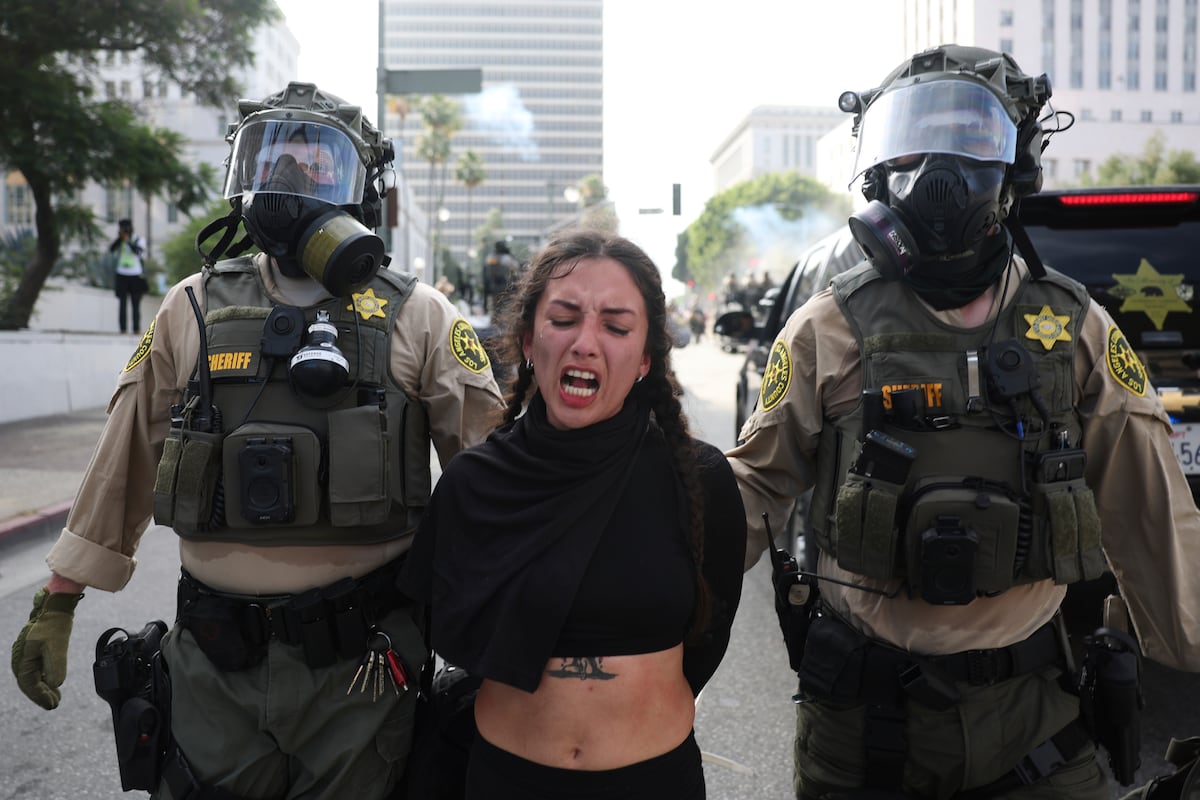
The California Senate on Tuesday passed a bill that will allow people to file civil lawsuits in state courts against federal officials — including Immigration and Customs Enforcement (ICE) agents — who violate constitutional rights. The so-called No Kings Act seeks to create a new legal avenue under state law for seeking compensation, as President Donald Trump’s administration continues its immigration crackdown on cities governed by Democrats.
The bill now needs to be passed by the State Assembly and receive the approval of Democratic Governor Gavin Newsom to become law. Democrats hold a supermajority in the Assembly, which should allow them to pass the legislation with little Republican opposition.
The No Kings Act — the name given to the massive protests against the Trump administration last year — seeks to fill the legal void of what are known as Bivens lawsuits, civil actions that allow people to sue federal agents directly — not the federal government as such — for violations of their constitutional rights.
These lawsuits are not based on a law passed by Congress, but rather are a remedy created by the courts. Their origin dates back to a 1971 Supreme Court ruling (Bivens v. Six Unknown Named Agents), in which the court determined that an individual could seek monetary damages directly from federal agents who had violated the Constitution. However, in recent decades, the courts have restricted the circumstances under which these lawsuits are permitted, arguing that it is up to Congress to legislate on the matter. As a result, many people who allege abuses by federal officials lack an effective legal alternative.
The bill’s author, Senator Scott Wiener, a Democrat from San Francisco, has said that the Trump administration “is attempting to wield unchecked power to illegally kidnap and deport people.”
“By passing the No Kings Act, we’re putting a stop to the impunity that’s enabling ICE and Border Patrol’s sickening terror rampage through American cities,” Wiener said in a statement. “We must close the loophole that makes it almost impossible for the families of Renee Good and Alex Pretti — who were executed in broad daylight — to seek justice for their family members. We must close the loophole that makes it almost impossible for the victims of Trump’s terror campaigns in our immigrant communities to seek justice […] These agents must face real consequences for terrorizing our communities.”
The law would be applied retroactively from March 2025, before the start of the immigration offensive that sparked mass protests and later the deployment of the National Guard in Los Angeles, as part of the Trump administration’s offensive against cities governed by Democrats.
Last summer, protests erupted in several parts of Los Angeles against Trump’s immigration offensive, following months of mass raids, arrests of people without criminal records, and allegations of racial profiling that resulted in a court order prohibiting arrests based on race, language, or employment, but was later overturned by the Supreme Court.
Trump ordered the deployment of more than 4,000 National Guard troops and hundreds of U.S. Marines without the consent of Governor Newsom, who challenged the move in court. It was the first deployment of the National Guard without state consent since the 1960s and served as a roadmap for an administration offensive against Democratic-run cities that later extended to Portland, Chicago, Washington, D.C., and Minneapolis, among others.
Hector Pereyra, director of the Inland Coalition for Immigrant Justice, celebrated the Senate’s passage of the bill, saying it is “more necessary than ever.” “We have seen federal agents go unpunished after shooting a family without facing significant consequences. This bill seeks to ensure that no one is above the Constitution and that federal agents can be held accountable when they violate constitutional rights.”
Senator Wiener — who is seeking to replace Nancy Pelosi in the U.S. Congress for District 11, which includes San Francisco — also championed another law last year called the No Secret Police Act, which prohibits law enforcement officers from wearing masks to conceal their identities during public interactions. The law was passed in September, but the Trump administration challenged it in federal court, arguing that it violates the Supremacy Clause of the Constitution.
The principle of federal supremacy establishes that federal law prevails over state laws. However, it has been a double-edged sword for Trump’s anti-immigrant agenda, as several states have attempted to pass restrictive laws against immigrants that have subsequently been struck down under that same principle.
California voters in November approved a law championed by Governor Newsom to redraw the state’s congressional districts in favor of Democrats, in response to efforts by other states like Texas to solidify Republican majorities. The initiative allows the use of maps drawn by the Legislature for the 2026-2030 elections, potentially giving Democrats up to five additional seats in the U.S. Congress.
Sign up for our weekly newsletter to get more English-language news coverage from EL PAÍS USA Edition