
Ask former major leaguer Trey Mancini if he thinks Brady Anderson will be an effective hitting coach for the Los Angeles Angels. Mancini will tell you a story from the spring of 2015 and a moment that occurred during a night game in Sarasota, Fla.
Anderson, a former All-Star who once stole 53 bases in a season and hit 50 homers in another, was long retired but still in the game. The Baltimore Orioles listed him as their vice president of baseball operations, second only to executive VP Dan Duquette on their front-office depth chart. But Anderson’s role was pretty much anything he wanted it to be. Helping players was his passion, bordering on obsession.
Mancini, the Orioles’ eighth-round pick out of Notre Dame in 2013, batted nearly .300 in his first two minor-league seasons but, in nearly 800 plate appearances, hit only 13 home runs. As a first baseman, he knew what the Orioles wanted out of him. More power.
The turning point of Mancini’s career occurred that fateful night in Sarasota. The Orioles, giving many of their regulars the night off, summoned Mancini from minor-league camp to be a backup. One-day call-ups of that kind are not unusual when teams are short on players in spring training.
Late in the game, Mancini emerged from the dugout. Watching him in the on-deck circle, Anderson noticed he was “super hyper.” Adjusting his batting gloves. Trying to perfect his grip. Treating the at-bat like it was the most important thing he had ever done.
“I don’t even know if he saw my at-bat. He just saw the way I was swinging on deck,” Mancini recalled. “He told Brian Graham, who was our farm director at the time, ‘Send Trey to me tomorrow at our major-league complex. I want to work with him.’”
Graham obliged, and the next day Anderson and Mancini got down to business. Anderson changed Mancini’s stance, from spread out and crouched to straight up and tall. He talked about weight transfer, taught Mancini to make better use of his body. And his lessons resonated, in ways that perhaps neither imagined.
Mancini broke out that season, hitting 21 homers at High A and Double A, finishing with a combined .938 OPS. The following September, he made his major-league debut, embarking upon a productive seven-year career.
“Brady was able to diagnose right away what I could do better,” Mancini said. “That 2015 season changed my whole career trajectory, just because of him watching me take a couple of swings on deck.”
Mancini was not the first player Anderson helped transform. Nor would he be the last.
Anderson, 62, has never held a formal coaching position. But while working with the Orioles from 2010 to ’19, he filled a variety of roles, many of which fell under the category of “coach.”
He oversaw the team’s strength and conditioning program. Collaborated with hitting coaches. Assisted with analytics. Threw batting practice. Even spent the entire 2012 season in uniform, lasting only the one year due to Major League Baseball’s limits on the number of coaches teams could keep in the dugout.
“These people who are saying Brady had no prior coaching experience? There couldn’t be anything further from the truth,” said Buck Showalter, the Orioles’ manager from 2010 to ’18. “He’s been coaching his whole life, with a lot better resume than some of the people they’re hiring.”
Showalter was among those whom Angels general manager Perry Minasian consulted about Anderson. Minasian, who worked for Showalter as a staff assistant with the Texas Rangers from 2003 to ’06, knows his former boss does not dispense praise easily and took his endorsement of Anderson to heart.
New Angels manager Kurt Suzuki was equally impressed when Nick Markakis, his famously reserved former Atlanta Braves teammate, approved of Anderson, whom he knew from his nine seasons in Baltimore.
“When he mentioned something to me about Brady and how he loved him, I was like, ‘Holy cow,’ that’s a big compliment,” Suzuki said. “When Nick says something, which he doesn’t do very often, you listen.”
Even Angels bullpen coach Dominic Chiti, someone whose relationship with Anderson in Baltimore was at times contentious, offered glowing reviews.
Chiti was Showalter’s bullpen coach with the Orioles from 2014 to ’16. He and Dave Wallace, the Orioles’ pitching coach at the time, bristled that Anderson seemed to enjoy autonomy without accountability. After the two coaches moved on to the Braves, Chiti said, “I’m not going to deny that Brady was part of why I left.”
And now?
“I’m actually one of the people who recommended him. That kind of tells you a lot,” Chiti said. “I probably misspoke 10 years ago. The quote was me more out of frustration with some other things I don’t want to get into. But it’s not an indication of anything between us. I’m excited to be around him, because of his intelligence and knowledge.”
As a player, Anderson never imagined he might one day coach. But he experienced something of a revelation in 2003, his last year in professional baseball, after the San Diego Padres released him in spring training. Rather than simply retire, Anderson surprised late Padres general manager Kevin Towers by asking if he could go to Triple A. Towers agreed, and Anderson relished his time with the Portland (Ore.) Beavers. For the first time, at age 39, he found himself serving as a mentor.
Years later, after joining the Orioles in his front-office role, Anderson gravitated not just to hitters but also to pitchers. “Seeing the potential in guys,” Mancini said, “they might not see in themselves.” The Orioles parted with Anderson after the 2019 season, Mike Elias’ first as head of baseball operations. But Anderson continued working with players on his own.
In 2024, he spent a week as an instructor with the Angels in spring training. He did not anticipate that, a little more than a year later, Minasian would contact him about becoming the team’s hitting coach.
The idea gave Anderson pause.
“I know in these jobs, and in jobs in general, if you want to be good, it has to be your life’s obsession,” Anderson said. “That was the first question I asked myself: Am I ready to make this my life’s obsession? I quickly answered yes.”
Helping players improve, he said, is a driving force in his life.
“It doesn’t just give me purpose,” Anderson said. “It’s something I’m good at.”
Ask former major-league catcher Caleb Joseph about Anderson, and he’ll take you back to when they met in 2012.
Joseph was 26, playing the third of his four straight seasons at Double A. Anderson, as the Orioles’ VP of baseball operations, was visiting the team’s affiliate in Bowie, Md.
“Brady is one of the main reasons that I actually made it to the big leagues, if I’m being honest with you,” Joseph said.
Anderson took an interest in Joseph, then called him after the 2012 season to lay out a training regimen, everything from weightlifting to proper eating. During spring training, Anderson invited the minor leaguer to live with him. He told Joseph that to get to Triple A, he needed to hit 20 homers, drive in 100 runs and catch 120 games.
“I was like, ‘What? Those are big numbers for Double A,’” Joseph said.
Newly determined, Joseph got off to a good offensive start. About a week into the season, Anderson called and asked how he was catching. Joseph explained that the team was using him only as a DH.
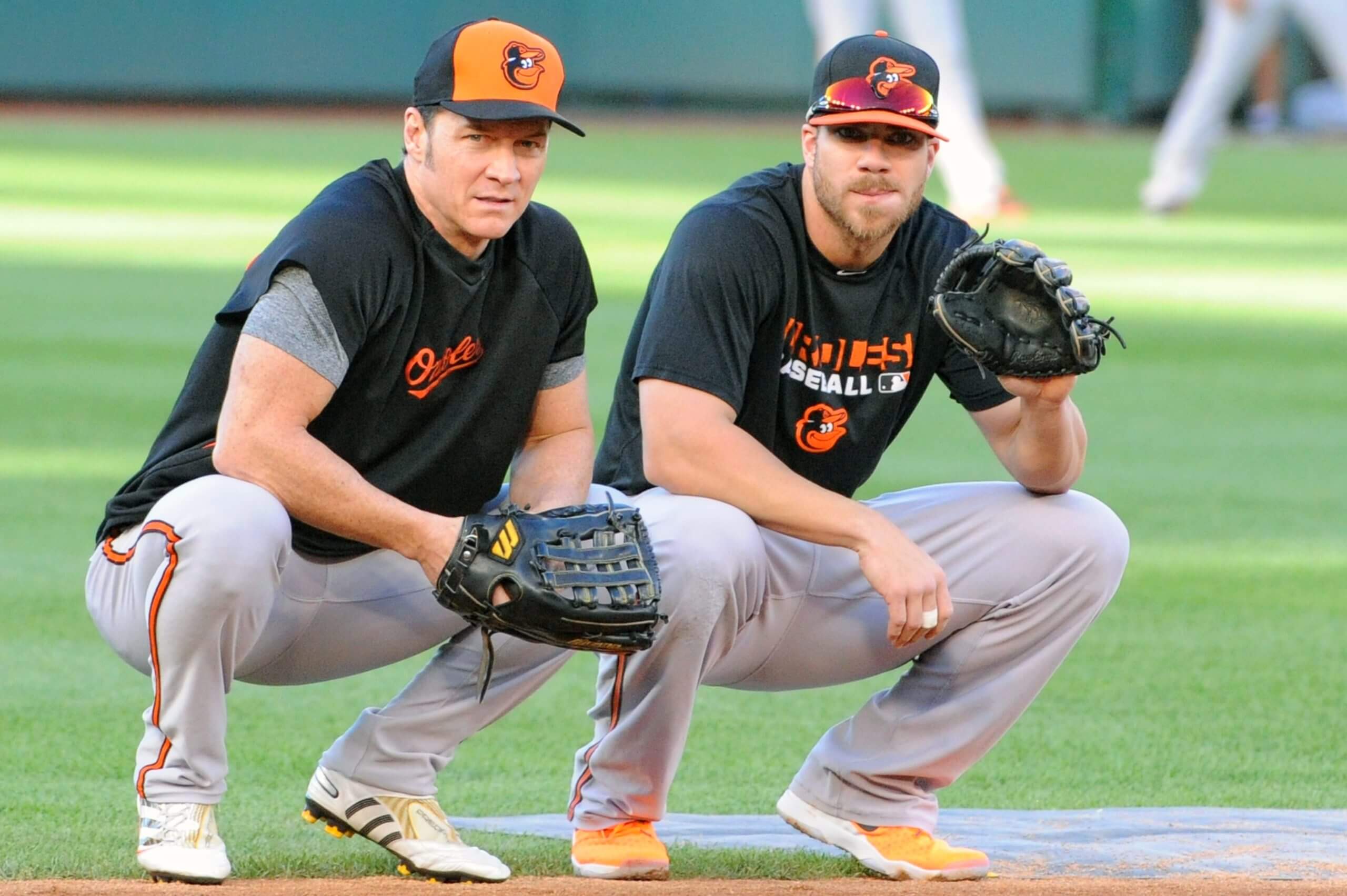
Brady Anderson worked with Orioles first baseman Chris Davis in September 2015. (Icon Sportswire via AP Images)
Anderson was appalled.
“I knew from the pitchers that Caleb could catch,” Anderson said. “I knew from watching him he had good hands, was a good framer, had a good arm.”
In his vaguely defined front-office role, Anderson said he preferred to collaborate, not dictate. But after hanging up with Joseph, he made a unilateral decision. He called Graham and said Joseph needed to start catching again.
Within minutes, Bowie manager Gary Kendall changed his lineup, listing Joseph at catcher, not DH.
“Brady was the first guy to literally say, ‘This guy is a big-league catcher. I don’t know what we’re waiting on. Let’s get him going,’” Joseph said.
Joseph finished the 2013 season with 22 homers, 97 RBIs and 135 games played, including 62 starts at catcher. He did not get a September call-up, but Anderson lobbied Showalter to give him an extended look in the spring of 2014.
About five weeks into that season, the Orioles’ starting catcher, Matt Wieters, suffered a season-ending elbow injury. Joseph was summoned to replace him, a little more than a month before he turned 28. He ended up starting three games at catcher in the postseason, which ended with the Orioles losing to the Kansas City Royals in the American League Championship Series.
Between 2014 and ’20, Joseph played in 425 major-league games. In 2022, he joined Rogers Sportsnet as an analyst on Toronto Blue Jays broadcasts.
His baseball life could have been so different.
“I would have stalled out at Double A if it had not been for Brady fighting for me,” Joseph said.
After departing as Orioles pitching coach in 2017, Wallace said Anderson made it no secret that he had little respect for major-league coaches, and added that he told Anderson that to his face.
Anderson’s frustrations with certain coaches stemmed in part from his own struggles early in his career. In the book “Moneyball,” author Michael Lewis described how Billy Beane’s negative perception of scouting was rooted in the scouting community’s failure to properly evaluate him as a player. Anderson had a similar feeling about coaches.
“Some of ’em bothered me. Some of ’em were dismissive. Some of ’em were great,” he said. “I came up through the minors without a hiccup. I don’t think I went 0-for-10 in the minors. And I wasn’t allowed to bunt. Then I come to the majors, and I struggle. I’m asked to bunt, asked to hit the ball on the ground. They wanted me to utilize my speed.
“I tried. But they did a lot of things that were counterproductive. I could easily be one of the hundreds of players who played a couple of years in the big leagues and didn’t quite get on track.”
Between 1988 and ’91, his ages 24 to 27 seasons, Anderson batted .219 with 10 homers and a .619 OPS in 1,273 plate appearances. His career ignited only after the late Johnny Oates committed to him as the Orioles’ leadoff man, and only after Anderson decided to do it his way.
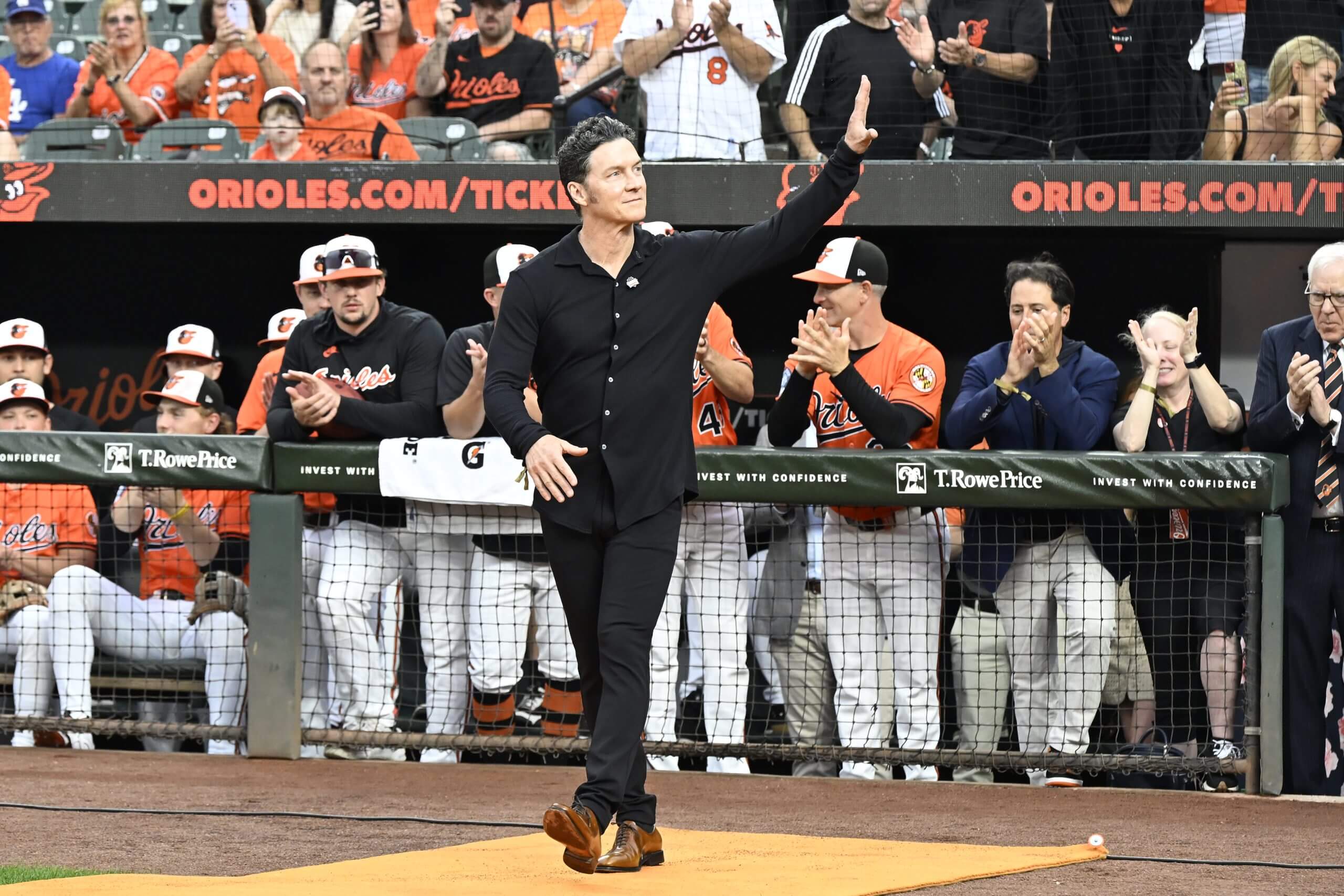
Brady Anderson waves to the crowd at Camden Yards last September during a ceremony commemorating the 30th anniversary of Cal Ripken Jr.’s record for consecutive games played. (Diamond Images via Getty Images)
The pivotal moment for Anderson occurred in 1991, following yet another demotion to Triple A. Anderson reported immediately, ready to play. But he was done trying to slap the ball to the opposite field. He asked one favor of the manager, Greg Biagini: Bat me fourth.
Anderson began standing up straighter in the box, the way he did in the minors, not necessarily trying to hit home runs, just trying to drive the ball. He hit 50 home runs in a season only once, in 1996, triggering suspicions that he used performance-enhancing drugs. Those suspicions were never supported by any form of evidence. From ’92 to 2000, Anderson averaged 21 homers, and his adjusted OPS was 20 percent above league average.
“He talks all the time about when he first came up, his struggles,” said former Oriole Ryan Flaherty, who is now the Chicago Cubs’ bench coach. “He really gravitates toward players who are struggling.”
Anderson, though, said he doesn’t limit himself simply to those types, pointing out that during his 15-year career, he experienced extreme highs and extreme lows.
“I gravitate toward people that need help,” he said.
Showalter seconded that, telling the Angels’ Minasian the worst thing about Anderson is that he will try to “save everybody.” But the Angels were drawn to how much Anderson cared about players, as well as his backstory.
“I wanted somebody who was bad and turned into being good,” Minasian said. “I wanted somebody who was a bench guy who turned into a dude.”
The Angels’ options were also limited. By holding Suzuki and his staff to one-year contracts, they reduced their chances of hiring a more accomplished hitting coach.
Ask Zack Britton about Anderson, and he’ll take you back to 2013. Unable to establish himself as a starting pitcher, the left-hander was demoted to Triple-A Norfolk four times.
Anderson, on his visits to Norfolk, occasionally would watch pitchers throw their bullpens. Seeing the potential in Britton, he would tell him, “Man, you have great stuff. You shouldn’t be here.”
“I personally hadn’t heard that in a while,” Britton said. “What I was hearing from coaches was really negative. Everything around me was negative. It was the first time I had someone talking me up, being supportive.”
The Orioles’ pitching coach at the time was Rick Adair, who, unbeknownst to the players, was dealing with personal issues and would take a leave of absence in August. Jake Arrieta, another young Baltimore pitcher Adair failed to unlock, was traded that season to the Cubs. Two years later, he won the National League Cy Young Award.
Anderson lacks pitching expertise, but pitchers were among those who would train with him in the winter; even now, in his early 60s, he keeps himself in excellent physical condition. Britton was part of a group of Orioles pitchers who worked out in Anderson’s garage during the 2013-14 offseason, trying to salvage their careers.
Britton commuted from his home in Southern California. Some players lived with Anderson at his residence in Glendale, Calif. Some years, Anderson also leased houses where players stayed in Beverly Hills and Hollywood. The Orioles paid the players’ expenses. Ryo Naito, now the Padres’ strength and conditioning coach, supervised their conditioning.
Anderson believed Britton was a star in the making. One time, he even got down in the catcher’s position, the better to get a feel for the movement on Britton’s pitches. The experience was not pleasant, leaving him with a sore thumb.
“We had a conversation where I told him what he should be,” Anderson said. “I said, ‘Zack, you’re destined to be great.’
“I don’t typically like to talk about the money part of it. But to give him an idea, I remember saying, specifically, ‘Just so you know, Zack, you’re a $150 million pitcher. Don’t think you’re a guy who is going to hang around and make $600,000 to $800,000 a year. You’re different. You have something special. And we’re going to optimize that.’”
Britton recalls Anderson telling him, “It’s your career; you need to take charge of it.” He valued not only Anderson’s positive reinforcement but also his honesty. “You always knew he was telling you the truth,” Britton said, “whether you liked it or not.”
The following season, the Orioles converted Britton to a reliever. By mid-May, he was their closer. He finished 2014 with 37 saves in 41 opportunities and a 1.65 ERA, emerging as one of the best relievers in the game.
“That was kind of my coming-out season as a reliever,” Britton said. “It really jumped-started my career.”
Britton was an All-Star in 2015 and ’16. His 0.54 ERA in the latter of those seasons set a major-league record for the lowest in a single campaign, minimum 50 innings.
He didn’t quite become the $150 million pitcher Anderson predicted. But he earned more than $87 million in his 12-year career.
Anderson’s last season in the majors was in 2002, just as analytics in baseball were taking hold. During the 2010s, when he worked for the Orioles, data and technology became woven into the game’s fabric. Yet even since his departure from the team in 2019, the amount of information available has increased dramatically.
Showalter, though, said Anderson will have little difficulty incorporating all of the data a hitting coach must process in today’s game.
“He probably knows more analytically, sabermetrically, than anyone a team might have in their office out of MIT running that,” Showalter said.
Before the Orioles hired Elias in November 2018, their analytics department consisted of just three or four people, Showalter said. Anderson was heavily involved with that group, and in spring training, he helped deliver a presentation to the coaching staff that Showalter called “Analytics for Dummies.”
Joseph said Anderson was “ahead of the game,” using advanced metrics to evaluate players. And thanks to his background in track, Anderson was particularly well-versed in body movement.
During his time at the University of California at Irvine, Anderson trained with the British national track team while it was on campus preparing for the 1984 Los Angeles Olympics. He also knew American decathletes, including Steve Odgers, who went on to become the director of sports training for agent Scott Boras.
“He’s one of those guys who has very strong opinions, but if you bring something to him that is intriguing, he won’t shut it down right away,” Joseph said. “He’ll take it and go investigate it. He has an opinion, but he’s open.”
Which is the approach Anderson is likely to take with analytics.
He has been obsessed with watching hitters since he was a child. He said he would be “a mess” if as much video were available then as it is now. But while he loves the aspect of analytics that enables players and coaches to process information in real time, he won’t necessarily be beholden to data.
“Pendulums can swing too far one way or the other,” Anderson said. “Maybe when I played it was too much of an old-school baseball mentality. There was a lot of inaccurate coaching that wouldn’t have been backed by data or high-speed motion cameras. We could have avoided some of that bad coaching through information.
“Conversely, you always need to be aware as a coach and a player that you don’t become too reliant upon it to where it can cloud your natural athleticism. That information is there; it’s entirely useful. It should be used. And how you use it matters. We’ve got to get that right.”
Mancini has one more story to share about Anderson. Not from a decade ago, but from late July 2024, when Mancini was at home in Nashville, Tenn., more than a year removed from his last game in the majors.
Many fans are familiar with how Mancini missed the shortened 2020 season after undergoing Stage 3 colon cancer surgery, and how he recovered to become the 2021 American League Comeback Player of the Year. After the Orioles traded him to the Houston Astros at the 2022 deadline, he won a World Series ring. But the rest of his career was less inspiring.
Mancini signed a two-year, $14 million free-agent contract with the Cubs before 2023, only to be released in August. Soon after, he agreed to a minor-league deal with the Cincinnati Reds and was released after a week. He signed another minor-league deal with the Miami Marlins that offseason, then was released in spring training.
A few months later, Anderson reached out.
“I had told him I was pretty at peace being done, kind of saw the writing on the wall,” Mancini recalled. “He just said, ‘Come out. Hit with me.’”
Mancini thought to himself, ‘Why not?’
“I hit with Brady, felt amazing, felt like retro me, more like 2016 to ’19 me,” Mancini said. “I was taken back in a time machine.”
To Mancini’s surprise, the Arizona Diamondbacks called him, offering a minor-league deal. He accepted, and in 74 games at Triple-A Reno, he batted .308 with 16 home runs and an .895 OPS. Thinking he might get a major-league offer, he opted out last June 1.
That offer never came. Mancini, though, still felt a sense of fulfillment. And as he approaches his 34th birthday, he is going to take another shot at returning to the majors, reuniting with Anderson by signing a minor-league deal with the Angels, according to a source.
“Brady convinced me to go back and, at the very least, prove to myself I still could do it,” Mancini said. “He has always believed in me, even when I didn’t quite believe in myself.”
Now it is the Angels who will experience the depth of Anderson’s sincerity, the vastness of his knowledge, the power of his positive approach.
Showalter both marveled at and grew exasperated with Anderson’s efforts to help even players who had virtually no chance of making an impact.
“At some point, I would go, ‘Brady, he sucks! He doesn’t have the skills!’” Showalter said. “He would go, ‘As long as I’m supposed to work with him, I’m going to try to make him as good as he can be.’”