
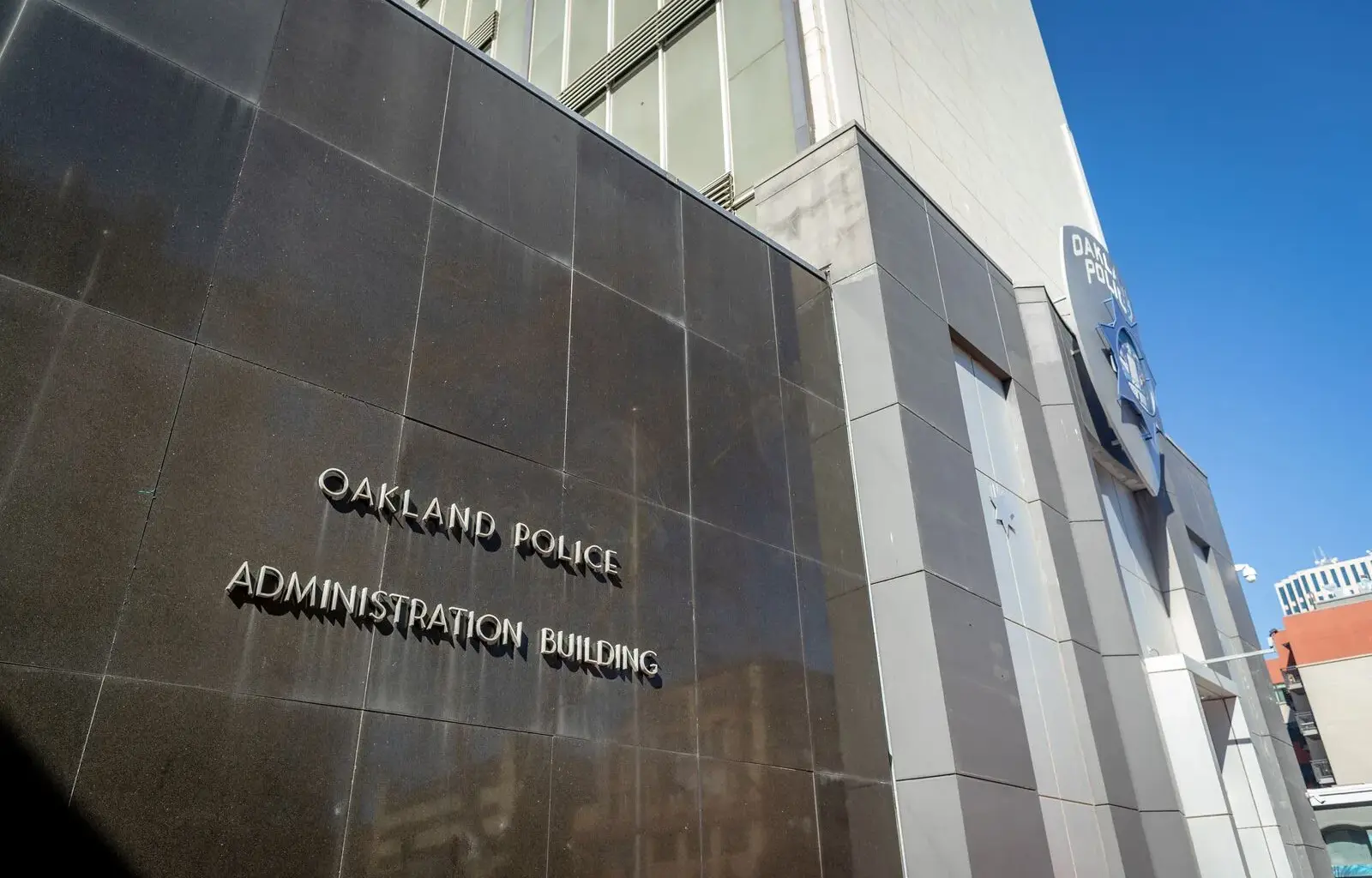
The Oakland Police Department appears near the finish line in its 23-year federal court oversight program — but there’s still work left to do. That was U.S. District Court Judge William Orrick’s message to the city at a hearing Tuesday afternoon.
During the hearing at San Francisco’s federal courthouse, Mayor Barbara Lee, OPD command staff, city attorneys, and civilian police oversight leaders presented an optimistic, unified message that they’re committed to completing the remaining reforms in the Negotiated Settlement Agreement and changing the culture of the police department.
“To institutionalize constitutional policing so that it lasts long after federal court involvement makes me very optimistic about the future, but we’re not there yet,” Orrick said.
As part of the NSA, OPD agreed to complete 52 reforms. Of those, three remain: the timeliness of internal affairs investigations, the quality of those investigations, and the consistency of discipline.
Orrick said he was particularly concerned about the racial disparities found in internal affairs investigations outcomes and officer discipline. A recent report examining OPD’s internal investigations showed that in 2024, only four white officers were “sustained” — meaning there was sufficient evidence to show they did engage in the alleged misconduct, and that it violated department rules — compared to 23 Black and 25 Hispanic officers. For internally generated cases, or accusations of misconduct reported by an OPD employee against another, white officers had no sustained findings, compared to 47% of Black and 24% of Hispanic officers.
“Inequities in the department’s disciplinary system call into question inequities in the delivery of police services to the community,” Orrick said.
John Burris, one of the civil rights attorneys who sued the city and OPD in the 2000 case resulting in the longest police reform effort in the U.S., echoed Orrick. “How you treat the officers within the department may reflect how you treat the people in the community,” he said.
Orrick asked the city and OPD to submit internal investigations data from 2025 before the next court hearing, scheduled for May 27.
Some Oaklanders have been pushing to end court oversight
Ahead of Tuesday’s hearing, a group calling itself “Oakland Neighbors for Oakland’s Future” submitted a petition to the court imploring Orrick to end federal oversight. Rajni Mandal, a public safety activist who has written critically of the federal monitor, wrote in the group’s letter that Oakland should be focused on “strengthening” its police oversight institutions, such as the Police Commission and the Community Police Review Agency, rather than indefinitely remaining under federal oversight.
“Prolonged federal oversight continues to divert millions of dollars each year away from urgent community needs such as housing, youth programs, violence prevention, and neighborhood safety,” Mandal wrote. “After more than two decades, the costs of continued monitoring now outweigh the benefits.”
Addressing the petition signers, Orrick said he agreed that city leaders and the Police Commission — not the court — should hold the police department accountable, but that the city hasn’t crossed that threshold yet.
“There’s a reason the city agreed 25 years ago to achieve 100% compliance with the NSA,” said Orrick, “and that is a recognition of the paramount importance of constitutional policing and the destructive legacy of racism, corruption, brutality, and cultural rot exemplified by the Riders.”
The Riders was a group of Oakland police officers in the 1990s who were accused of kidnapping, torturing, and planting drugs on dozens of people.
Some argue that court oversight has actually been good for Oakland’s finances. In past decades, the city paid out tens of millions of dollars to victims of police violence. In recent years, that liability has plummeted, according to KTVU.
“I contend that we have saved the city money by the low amount of payouts,” said Jim Chanin, the other civil rights attorney representing the plaintiffs in the Riders case, in an interview with The Oaklandside.
Orrick appears enthusiastic about Mayor Lee’s effort to institutionalize constitutional policing
 Interim OPD Chief James Beere, center, discusses Oakland’s drop in violent crime at a press conference at Oakland City Hall on Wednesday, Jan. 7, 2026. Credit: Roselyn Romero/The Oaklandside
Last year, Lee brought back Michelle Phillips, Oakland’s inaugural inspector general who left the city after a year to work in Minneapolis, as an assistant city administrator. Over the past month and a half, Phillips has been the city’s interim constitutional policing administrator, a role she described at Tuesday’s hearing as being embedded in the Police Administration Building while having direct lines of communication with the mayor and the city administrator.
Phillips told Orrick that she’s seen “a transformation of the culture” within OPD. “It is very encouraging for me to see on the outside looking in,” she said.
Interim Police Chief James Beere, who was appointed by Lee last month after former Chief Floyd Mitchell resigned, told Orrick the biggest obstacle to achieving full compliance with the NSA is OPD’s understaffing. The department is currently budgeted for 678 officers, but its operational strength — meaning the number of officers able to work and not on some type of leave — has hovered recently around 500. At the most recent Police Commission meeting, Lisa Ausmus, deputy chief of OPD’s Bureau of Risk Management, said 109 officers are currently on some type of leave, whether that be administrative or medical.
To address staffing issues, Beere said he’s considering transferring more officers to OPD’s Internal Affairs Bureau, which investigates allegations of officer misconduct, and training more officers to become acting sergeants.
Chanin told Orrick he was “excited” about the leadership changes, but voiced concerns about whether the culture of the department has truly changed. He mentioned high-ranking OPD supervisors’ mishandling of a case involving Phong Tran, a homicide investigator who was charged with bribing a witness and committing perjury and currently faces trial in superior court. After two murder convictions were overturned because of Tran’s actions, OPD opened an internal investigation. But the department, including command staff, cleared Tran of wrongdoing, allowing him to return to the job. Since then, a third person in another of Tran’s cases has been freed from prison because of Tran’s misconduct.
“No one’s perfect, but of this size and magnitude, it’s unacceptable, and it can’t happen anymore, as it has over and over again,” Chanin said.
“*” indicates required fields