
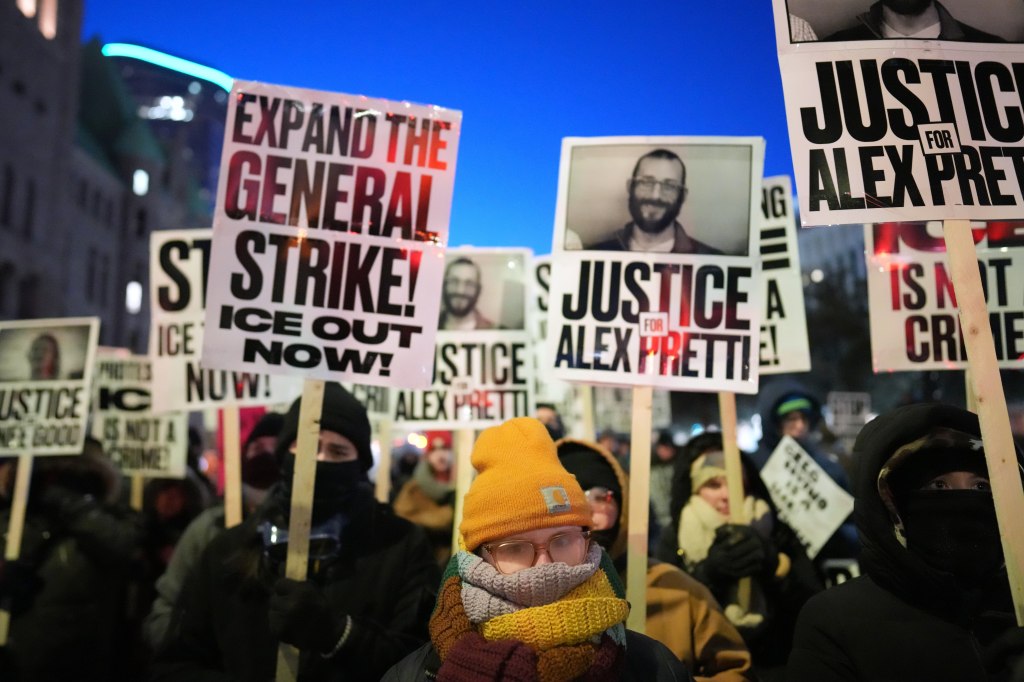
Immigration has become a fundamental test of our democracy — of whether constitutional rights still limit government power to violate our civil liberties, and of whether that power can be turned inward against the very people it is meant to serve. When federal immigration authority is used to justify secrecy, militarization, and violence in everyday life, the question is whether our constitutional protections still hold at all.
Recent events in Minneapolis make this painfully clear. There, federal immigration operations escalated into violence directed toward civilians and the killing of legal observers who were peacefully exercising constitutionally protected rights in public space. These are not battlefield casualties in a foreign land or tragic accidents. They are Americans killed by federal agents operating in what increasingly resembles a federally occupied metropolis— a city only slightly larger than Anaheim or Irvine.
What is happening in Minneapolis matters because it reflects a broader pattern. It shows what it looks like when military-style federal power is turned inward.
As a scholar of immigration who lives in Orange County and closely monitors local-level immigration actions, I regularly encounter a striking misconception: many Orange County residents believe that immigration operations — where everyday people are taken from the streets or where legal observers are violently attacked and arrested — are not happening here in our cities. They react with genuine disbelief when I explain that ICE is operating in Orange County every day, and that their tactics are becoming increasingly aggressive and violent toward immigrants, bystanders, and legal observers.
The truth is that immigration actions now take place daily in Orange County, a sprawling metropolitan region in which immigrants and their families are deeply embedded.
Orange County is home to more than 200,000 undocumented residents, according to estimates from the USC Equity Research Institute. Three quarters have lived in the United States for well over a decade. Many are parents of U.S.-citizen children. ERI data show that undocumented immigrants are embedded in nearly every sector of the regional economy — construction, landscaping, caregiving, hospitality, food service, logistics, and health-care support. This is not a marginal population; it is immigrants that allows this region to function and prosper.
And yet, federal immigration actions intensified just this past week across Fullerton, Anaheim, Santa Ana, and Garden Grove, not as isolated spectacles but as part of federal activity that is rapidly becoming routine in these cities. At the same time, violence toward legal observers and bystanders is escalating — not because agents are being provoked, but because these operations increasingly proceed without accountability or transparency.
In Anaheim last Sunday, photo and video evidence documented a violent confrontation instigated by ICE during a car wash raid. Video evidence shows that legal observers and American-citizen workers were violently pushed by masked federal agents. An American citizen worker was tackled to the ground by multiple agents and arrested — allegedly for assault — despite video showing him standing still. He sustained multiple injuries before being booked and released. In Placentia, a gardener and his teenage son were violently thrown into an ICE van while working. When the son was identified as a U.S. citizen, he was released alone in a public park — a minor abandoned following a traumatic detention.
These actions are not simply about immigration. They raise fundamental questions about due process, constitutional rights, and the exercise of federal power in which agents concealed by masks and operating from vehicles without license plates are permitted to detain anyone they want in public space with no justification or oversight. When federal immigration authority is used to justify militarized tactics, the brutalization of civilians, and what increasingly resembles the behavior of a secret police force, the issue is no longer immigration. It is the basic architecture of constitutional governance itself.
While Minnesota reveals these dynamics in their most extreme form, Orange County is experiencing it in normalized form. The difference is not the substance of state power, but its visibility. In Minnesota, federal authority is overtly militarized — brutality directed at civilians exercising First Amendment rights, secrecy, and lethal force against those simply wielding cameras in public space. In Orange County, that same authority operates more quietly but no less consequentially: through secrecy and increasingly violent immigration actions dispersed across a decentralized metropolitan region, largely invisible to those not directly affected.
This routinization matters. Immigration has become one of the primary domains through which the federal government is expanding surveillance, data collection, detention — now including U.S. citizens — and the use of extreme force inside civilian life. Tactics that would provoke immediate outrage in any other context are being normalized through immigration.
Minnesota is not an anomaly. It is a warning. It shows what happens when militarized federal agencies are turned inward on civilian populations with few effective checks. If federal agents can push and tackle Americans to the ground, abandon children in public spaces, remove people from the street without accountability, and kill those exercising constitutional rights, constitutional limits on state power have ceased to function in practice. We must ask what powers will be exercised next, and against whom.
Immigration is where those limits are now being tested — not in theory, but in practice. And that test is not happening somewhere else. It is unfolding every day, here in Orange County.
Jody Agius Vallejo is professor of sociology at USC and a resident of Fullerton