
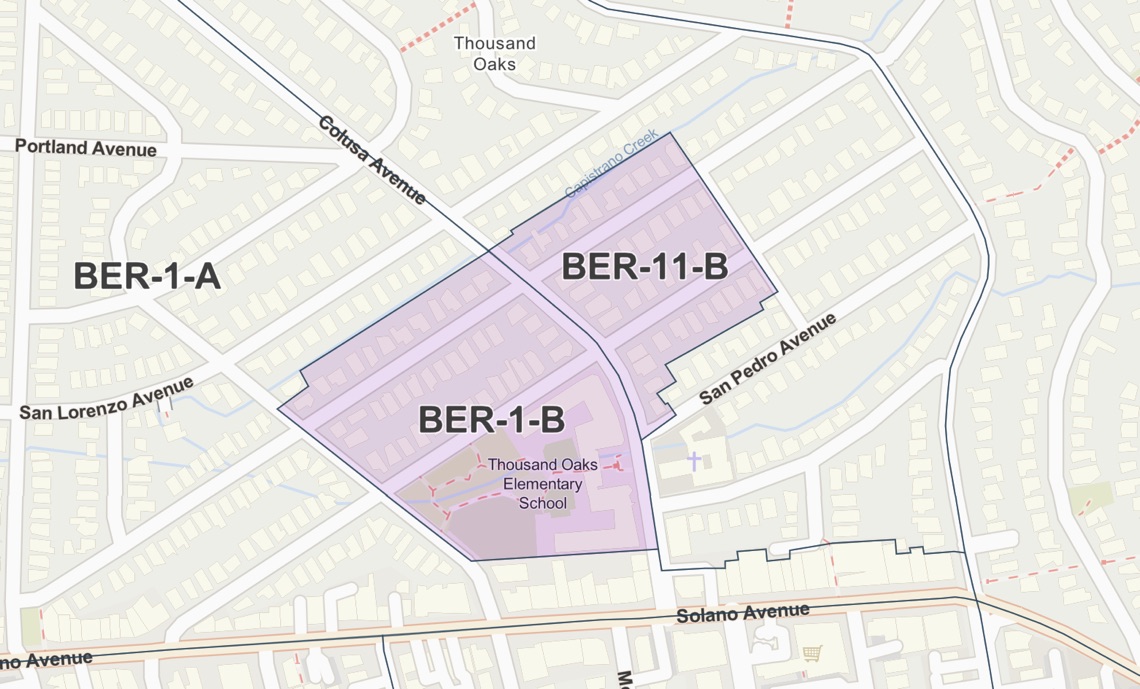
 Berkeley police and firefighters asked several Thousand Oaks residents to shelter in place or leave the area while dealing with hazardous chemicals on Jan. 26, 2026. Credit: Gensys Protect
The substance that prompted a shelter-in-place order in the Thousand Oaks neighborhood on Monday was picric acid, a compound often used to make ammunition, explosives and dyes, according to the Berkeley Police Department.
Police and other safety agencies asked everyone in roughly four city blocks around a home on Colusa Avenue to either stay indoors or leave the area for several hours Monday as they worked to remove the compound. Authorities took the chemical to a parking lot on Seawall Drive near the Berkeley Marina, where explosive ordnance disposal technicians destroyed it.
In their initial alerts Monday, city officials said only that they had found chemicals consistent with photography labs in the home. In a more detailed statement Tuesday evening Berkeley police spokesperson Officer Byron White said a resident had “reported several bottles of potentially hazardous chemicals stored in a basement.” They had most likely been stored in the basement for decades, White said.
“In its dry crystalline state, picric acid can be extremely sensitive to movement and is often destroyed in place due to risk of detonation,” White wrote. He described the amount of picric acid found at the home as being equivalent to a pipe bomb.
The house where the chemicals were found was evacuated, as were three others.
Emergency workers put the bottles of picric acid into a “frag bag” — essentially an armored suitcase used to move possible explosives and suspicious packages — and bomb techs, police and firefighters hauled it down to the Berkeley Marina in a slow-moving convoy of emergency vehicles, White said.
Police secured the Seawall Drive parking lot and the bomb techs blew up the picric acid “through a controlled detonation,” White wrote.
Safety agencies generally recommend using fume hoods when working with picric acid, but it is unclear if there are any noxious fumes associated with its detonation.
Back at the Colusa Avenue home, hazmat workers from the Berkeley Fire Department removed the rest of the chemicals from the basement for a private company to haul away, White wrote. He did not specify the company or where or how the chemicals would be disposed of, nor did he identify the other chemicals other than to say they were “consistent” with photo lab use.
Emergency workers reopened the parking lot at the marina shortly before 3 p.m.; around 4:30 p.m., they lifted the shelter order in Thousand Oaks.
“*” indicates required fields