
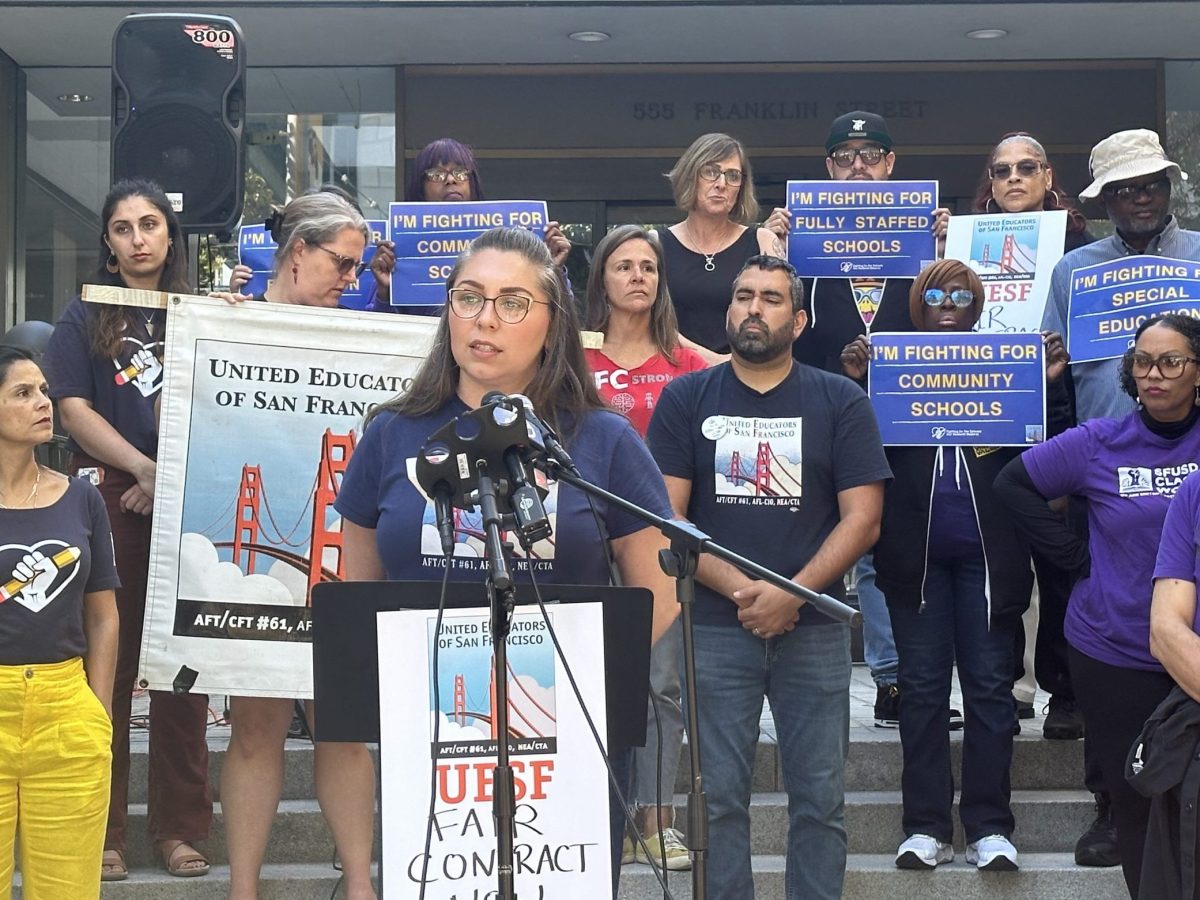
San Francisco public school teachers could be on strike as early as next week after negotiations between their union and the school district have stalled. It would be the first teachers strike in the city in 47 years.
Union officials say the likelihood of such a strike is high, saying they are too far apart on pay raises, healthcare for dependents and various proposals for students including inserting “sanctuary” district policies in a union contract.
Teachers have already started to approve a strike: About 2,400 members voted over 99% to authorize their union to call a strike in early December, the first of two votes required for a walkout. The second vote is set to wrap up by Wednesday, and the union said about 4,700 members had cast ballots.
That level of participation, they said, is “historic,” and the outcome of the vote is not in doubt.
“We’re anticipating folks are voting ‘yes,’” said Cassondra Curiel, the teachers union president, in reference to the proposed strike. “Our members feel very strongly that they’ve been disrespected by this district. The district continues to reject our highest priorities.”
Superintendent Maria Su disagreed. She announced in a district-wide email to families and staff on Friday that the district had failed to reach an agreement with the union following a fact-finding session that day. She said the union had rejected a three-year “stability package” that included fully funding family health benefits, a six percent raise over three years, and proposals addressing special education staffing and workload.
But union leaders say that proposal came at the cost of their benefits. The union’s bargaining presentation from September says the district proposed eliminating some contract stipulations, including class size limits.
“We are living in different realities,” said Frank Lara, the union vice president, on Monday.
Any strike could not occur until after an independent “fact-finding” process required under state law. That process is expected to result in a report released on or around Feb. 4, according to Curiel.
Union leadership is seeking raises of over nine percent for certified teachers and 14 percent for paraeducators over two years, which they said is aimed at closing the gap between their compensation and the high cost of living in San Francisco. The union rejected the school district’s counter offer of a two percent raise over three years.
Union members also want a new special education staffing model aimed at reducing caseloads and teacher turnover. They want contract language protecting undocumented students and mixed-status households, and expanding homeless shelters in schools like the one that was for years located inside a Mission District K-8.
Budget proposals shared with Mission Local indicate that the school district has considered significant cuts to plug a $113 million deficit. Lara, for his part, disputed that the district is experiencing a budget shortfall, calling the district’s projections “educated guesses.”
“They’re sitting on hundreds of millions of reserves,” said Curiel. “Just this December, they moved over $100 million into an extra savings account.” Both Lara and Curiel said the district has a history of “over-projecting expenditures while under-projecting revenues.”
Mary Lavalais, a paraeducator at San Francisco Community School in the Excelsior, said she voted ‘yes’ on the strike due to the district’s rejection of the union’s proposals. “They have a lot of money, rainy-day-fund money. It’s storming and they need to use it,” she said, referring to the school district. “If you have money and you’re firing people, getting rid of paraeducators who are delivering direct services to the children, that’s very immoral.”
“We’re constantly told to do more with less,” said a special education teacher who asked to remain anonymous. He said the district treats paraeducators as expendable “non-classroom” costs, while he sees them as essential to student learning and safety. Though he supports the union, he worries that prolonged uncertainty — or a strike followed by layoffs, program cuts or school closures — would fall hardest on the most vulnerable students and families. “I see no end in sight, and I really worry about the breaking point.”
In response to emailed questions from Mission Local about the union’s claims, the school district referred to Su’s Friday email and a video message to families, in which she said that the district “will not be able to open schools to students safely” if the union decides to strike after the fact-finding process.
“I am very much committed to meeting our legal obligations to providing 180 days of school for our students,” she said. “If necessary, we may extend the school year to ensure that that requirement is met.”