
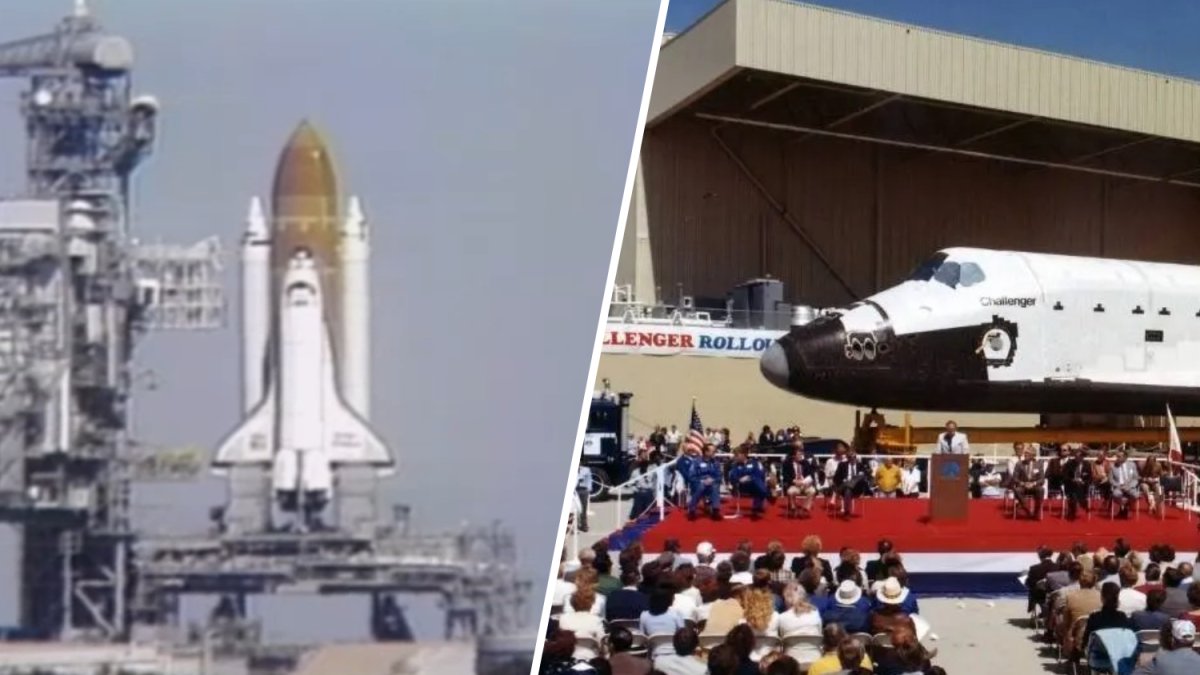
By the mid-1980s, NASA space shuttle launches were widely considered routine events after five years of the program adopted to reliably and frequently carry payloads into space.
The launches, once covered by all three major networks, did not receive the same level of national live coverage by 1986.
But the space shuttle program was still a local story for Southern California, where Challenger was built at Rockwell International in the high desert community of Palmdale. The shuttle prototype that helped launch the program was built by then-North American Rockwell International in 1972 in Downey.
The region’s connection to the shuttle program is still celebrated today, including the space shuttle Endeavour display at the California Science Center in Exposition Park. Downey’s Columbia Memorial Space Center will be home to the space shuttle prototype model as part of an expansion.
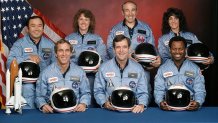
STS-51L crew members Michael J. Smith, front row left, Francis R. “Dick” Scobee, Ronald E. McNair; and Ellison S. Onizuka, back row left, Christa McAuliffe, Gregory B. Jarvis, and Judith A. Resnik. Credit: NASA
That connection was one of the reasons NBC4 covered Challenger’s 10th launch live on Jan. 28, 1986.
“We had a great stake in Southern California,” Kent Shocknek, who anchored the station’s coverage that day, told NBC4’s Conan Nolan.
Challenger was NASA’s second orbiter after space shuttle Columbia. The gleaming white spacecraft rolled out of a Rockwell International plant hangar in northern Los Angeles County and into the Southern California sun on June 30, 1982. Its maiden voyage was April 4, 1983 and marked the first spacewalk for the shuttle program.
Nearly three years later, a crew of seven astronauts boarded Challenger at a chilly Kennedy Space Center in Florida for what was to be the shuttle program’s 25th mission. The journey was meant to mark a first for NASA — the first orbital voyage of an America teacher, New Hampshire social studies instructor Christa McAuliffe.
“This was one of those situations where the launches had become so routine that NASA had to tweak each launch to make it sexier so that coverage would continue,” Shockneck said.
During the six-day mission, the crew was to deploy a large communications satellite and deploy and retrieve an astronomy payload to study Halley’s Comet. With a school teacher on board who was picked from a group of 11,000 applicants, the launch was watched by students in classrooms around the country.
The mission ended in tragedy 73 seconds after launch when Challenger exploded.
Below, NBC4’s live coverage of the Jan. 28, 1986 launch.
NBC4’s Kent Shocknek anchor coverage of the Jan. 28, 1986 Space Shuttle Challenger launch that ended in disaster. Video broadcast Jan. 28, 1986 on NBC4.
“My God. There’s been an explosion,” NBC4 anchor Kent Shocknek said as horrific images of the fireball and exhaust trails filled the screen during the first uncertain moments of a tragedy. “This is not standard. This is not something that is planned, of course.
“We have absolutely not sign at all of the shuttle itself.”
Seconds later, a voice from mission control could be heard on the live broadcast: “Obviously, a major malfunction.”
Pilot Michael J. Smith and mission specialists Judith A. Resnik, Ellison S. Onizuka, and Ronald E. McNair, payload specialist Gregory B. Jarvis, and McAuliffe were dead. The tragedy came 19 years and one day after the deaths of the Apollo 1 astronauts and was the first time a U.S. astronaut died during a spaceflight.
“I wondered if anyone would remember this anniversary because we have all moved on, but this was a very big deal,” Shocknek said. “It changed everything.”
In one of the most moving speeches of his presidency, President Reagan addressed a heartbroken nation from the White House. He closed with a quote from the poem “High Flight” by World War II Spitfire squadron pilot John Gillespie Magee Jr.
“The crew of the space shuttle Challenger honored us by the manner in which they lived their lives,” Reagan said. “We will never forget them, nor the last time we saw them, this morning, as they prepared for their journey and waved goodbye and ‘slipped the surly bonds of earth’ to ‘touch the face of God.'”
After a lengthy investigation, the cause was determined to be a rubber o-ring failure in the right solid rocket booster aggravated by extreme cold weather in Florida before the launch. The seals’ failure allowed hot exhaust gas to blow through the the joints, damaging the external fuel tank.
The shuttle program continue with Discovery, Atlantis and Endeavour before the final mission on July 21, 2011.