
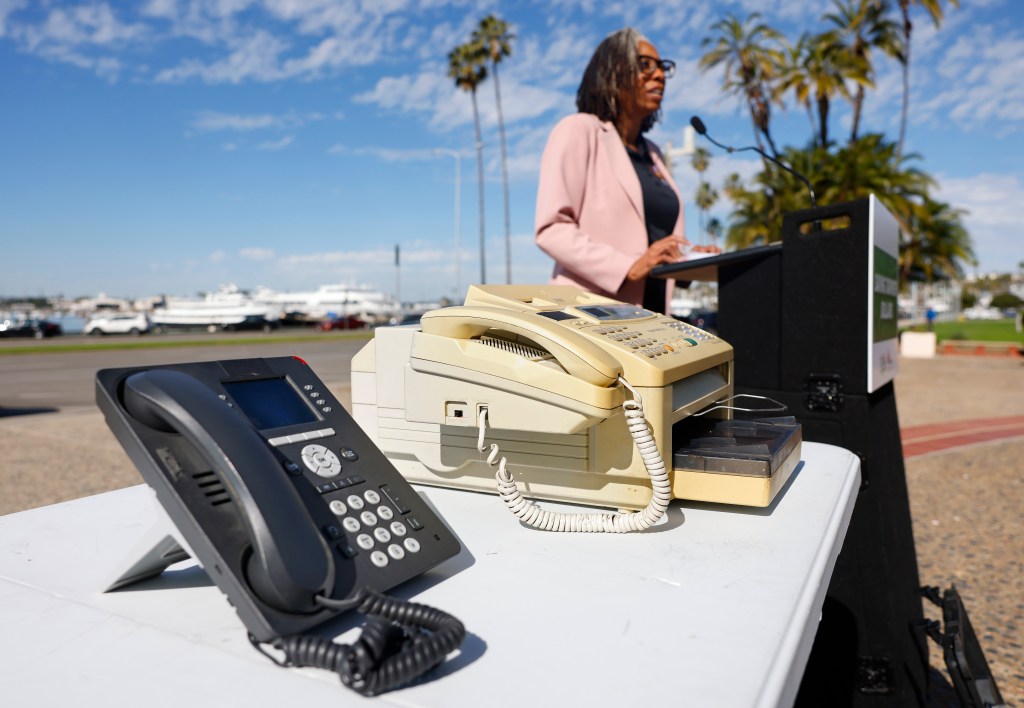
Decades into the era of email and smart phones, San Diego County is discontinuing the use of antiquated desk phones and fax machines.
Democratic supervisors want to phase out the dated office tech as they seek to cut costs for an increasingly cash-strapped county government, a situation which has supervisors and organized labor trying to put a sales-tax hike on the ballot.
Estimated savings from throwing out desk phones and fax machines ranges from $1.5 million to $7 million, according to supervisors.
Those savings don’t come anywhere close to erasing the kind of budget gap the county might face in the years ahead.
By 2028, the county will need anywhere between $200 million and $300 million a year in order to maintain current staffing and programs as a result of changes and cuts to Medicaid and food aid programs passed by Congress last year.
That’s on top of the county’s existing annual budget gaps, which totaled $139 million last year.
But Democrats still see any move to cut costs as a good will campaign aimed at constituents ahead of a potential ballot measure. Voters have become increasingly skeptical of new taxes and fees, and similar sales tax hikes failed in San Diego and the county in 2024.
“The work we are doing right now is not just about balancing numbers, but also about building trust from the people that we serve,” Supervisor Monica Montgomery Steppe said at a press conference on Monday.
Supervisors voted unanimously to discontinue fax machines and desk phones on Wednesday.
The county has about 15,000 desk phones and 500 fax machines in use over its various buildings and facilities, according to supervisors.
The move’s biggest cost-savings could come from ending the county’s legacy phone platform, Avaya. The county pays about $5 million a year to use the system.
But the legislation passed by the supervisors on Wednesday leaves the door open for county departments and agencies to opt out of the policy and keep their desk phones.
If that happens, the phone platform will still be needed, undermining the cost-savings in the proposal touted by supervisors.
The policy emerged from a subcommittee managed by Montgomery Steppe and Supervisor Terra Lawson-Remer, which has been tasked with studying the county’s fiscal strategy.
The subcommittee operates out of view of the public, and until this week, its public-facing actions have consisted of trying to hire lobbyists and consultants to help pave the way for new tax hikes.
Earlier this month, the subcommittee hired a team of public relations specialists and researchers to study whether residents would back a sales-tax hike.
The team is led by Ironwood Public Affairs, a firm run by Victor Aviña, a former county staffer turned lobbyist and public relations specialist. Also attached to the contract is Amplify Campaigns, a prominent local campaign consulting firm that has worked for the campaigns of numerous county officials, such as Supervisor Paloma Aguirre and District Attorney Summer Stephan.
Last year, the subcommittee looked to hire a firm to lobby the state Legislature to expand the county’s ability to raise taxes.
Among the changes the county wanted lawmakers to enact were steep increases to taxes on certain real estate sales and payroll taxes, according to a draft contract.
The county has since decided not to hire a lobbyist.
The county’s quest toward a sales-tax ballot measure is technically distinct from a similar push led by organized labor and nonprofits to get their own half-cent sales tax surcharge on the ballot.
A coalition led by SEIU 221, the largest union for county employees, is currently gathering signatures for the ballot measure.
SEIU 221 expects a half-cent sales tax surcharge to generate $360 million in new revenue for the county in its first year.
County Republicans are opposing the sales tax hikes, looking to claim the mantle of fighting to keep the San Diego area more affordable.
“Too many local leaders are talking about raising taxes again instead of fixing their own mismanagement of tax dollars,” Supervisor Jim Desmond said at a press conference on Tuesday.
Desmond has proposed legislation that would bar the county from lobbying for the power to raise real estate and payroll taxes.
Supervisors were set to consider Desmond’s proposal on Wednesday. But the supervisor asked for a vote to be delayed because his fellow Republican on the board, Supervisor Joel Anderson, was absent from the meeting.