
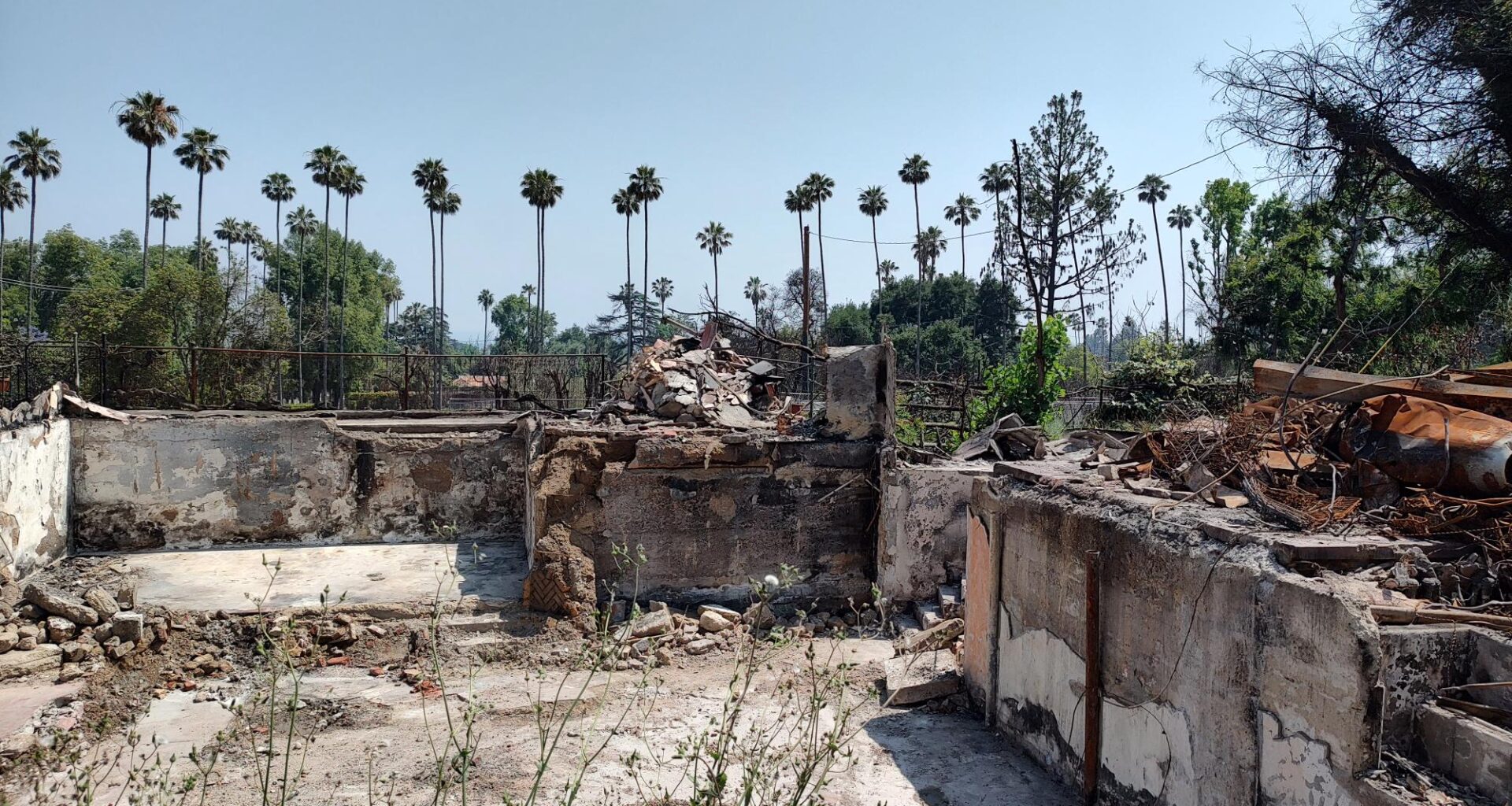
The rubble of a home in Altadena, California, nearly a year after the January 2025 fire.
Courtesy | Avedis Maljanian
As the Eaton Fire ravaged my hometown of Altadena, California last year, my family and our neighbors focused on our lives and our property. We just wanted to survive. As the fire subsided, we didn’t know it was only the beginning of our community’s struggle. In the restoration process since the fire, I’ve seen the insurance, health, and economic problems that surfaced in the aftermath of this historic disaster.
The fire began in January 2025 and burned for 24 days, destroying more than 9,000 buildings. While my family was blessed to return to an unburnt house, thousands of others found only their chimney standing, their homes scorched remains strewn around it.
 The wreckage of a house following the fires in 2025.
Courtesy | Avedis Maljanian
I evacuated with my family on the evening of Jan. 7, returning the next morning after we discovered our house had escaped the worst of the blaze. We fought fires around our property and street while warding off potential looters, including one who ran through our backyard. After several days of guarding the house, I returned to school Jan. 12 while my parents continued to protect the property. I described these events in the Jan. 23, 2025 edition of The Collegian.
The immediate issue for residents was their inability to return home. As the fire abated, the California National Guard and law enforcement encircled the neighborhood in a defensive line known as a cordon to stop looting and prevent civilians from disrupting the firefighters. While this kept out looters, guardsmen and deputies manning the cordon didn’t allow Altadenans to access their properties even with proof of residence.
In my previous article, I mentioned that my parents relieved me from guarding our property so I could rest. After I left, I couldn’t re-enter the cordon, and if my parents left, they wouldn’t be allowed back in. I could hand supplies across the cordon, but that was it. Residents within the cordon, including my parents, went without power, running water, and gas to our homes for weeks.
The physical, mental, and emotional effects on residents began immediately after the fire. Many Altadena houses, including ours built in 1930, contained lead paint, asbestos insulation, and other toxins that contributed to a noxious smoke. In addition, burning electric vehicles and appliances added lithium, cobalt, and other heavy metals to the smoke.
 The Eaton Fire tears through California last
January.
Courtesy | Avedis Maljanian
Exposure to toxins and extreme stress caused respiratory, cardiovascular, and other temporary and chronic issues for those in and near the burn zone. I have a chronic illness, and due to stress, strenuous activity, and smoke inhalation, I experienced internal bleeding and respiratory issues while at college following the fire.
In addition to health problems from smoke inhalation, hazards remained in the ash coating our properties. When I re-entered my house months after the fire before the house was cleaned, I developed a severe headache if I remained indoors without a mask for 10 minutes.
Along with physical effects, many residents report post-traumatic stress from the shock of losing homes, possessions, and pets, and seeing their neighborhood destroyed.
Returning to our houses brought mixed feelings, as we had to commute from our temporary homes to our lots through a starkly different neighborhood. I’m grateful that my house survived, but after months of seeing it in disarray surrounded by empty lots, it didn’t feel like home.
A major issue was home insurance policies’ coverage. In recent years, homes rose in value, but homeowners were not told to change their coverage accordingly. After the fires, insurance companies attempted to shortchange many homeowners what they were owed in payout.
In my family’s case, our insurance company tried to deny responsibility for items included in our policy, and when confronted with evidence, dodged the issue and left the claim unsolved for nine months. This obfuscation forced my family to relocate to various rentals, uncertain if insurance would compensate for housing costs.
My parents and other residents hired public adjusters to hold our insurers accountable for short-changing us. While some insurance companies have paid policy holders their due already, many residents report the battle with their insurers dragging on to this day.
 The same backyard as above, taken almost a year after the blaze.
Courtesy | Avedis Maljanian
Just a few weeks before Christmas, my parents finally moved back into our house, while most of our furniture is still waiting to be cleaned more than one year later.
The economic fallout of the Eaton Fire has yet to be fully realized, but it will be historic.
The sudden increase in rental housing demand from thousands of displaced fire victims made the cost of renting living space in neighboring cities rise astronomically, making affordable rentals virtually non-existent for months. Two families I know paid $18,000 per month for a four-bedroom rental, for a total of $90,000 for five months, all while pleading with their insurance providers to cover the cost. Residents’ budgets constricted as they navigated the cost of losing valuable homes and belongings and finding new lodging, sometimes without important documents they were unable to retrieve while evacuating.
While many have attempted to help fire victims financially, much of this money may not reach Altadenans. One prominent example of outright fraud disguised as help for victims is FireAid, a benefit concert that raised millions of dollars intended for affected residents and business owners. A large amount of the funds allegedly went to political action organizations and other groups unrelated to charitable efforts for fire victims, according to a House Judiciary Committee interim staff report.
The ecological impact of the Eaton Fire appeared as soon as the fire did. As I mentioned in my last article, coyotes and rats became bolder, venturing into the open to escape their burning dens and nests. It’s more common to see packs of coyotes roaming the streets, causing hazards for drivers and the large number of residents who walk throughout the neighborhood, especially those walking their dogs.
The rats living in neighbors’ houses sheltered in ours, forcing us to deal with the infestation. Bears are a more common sight, too; four new bears live on our street now and play in my neighbors’ yards, pools, and fruit trees, and use Altadenans’ basements as their dens. The large number of unmaintained pools and empty home foundations collecting water also facilitated an exponential increase in the mosquito population.
In addition to the wildlife woes that Altadena now faces, the mountains above us are unstable. The vegetation helping hold the mountains together with its root systems suffered, and heavy rain in the weeks and months following the fire caused flash floods and mudslides, some of which narrowly missed our property.
Altadena’s small-town culture and charm also suffered from the fire. Many of the now-empty streets were lined with countless historic homes built in the 1920s and 1930s. These houses contributed greatly to Altadena’s beauty and character, and their loss is deeply felt by those who enjoyed living in the environment that the houses helped create.
Many residents are concerned that affordable housing projects replacing individual homes and developers purchasing lots will change the character of the neighborhood. Some of these concerns are legitimate: several of my neighbors’ lots were purchased by Chinese developers, whose plans for the lots are unknown.
Popular restaurants and shops such as Fox’s Restaurant and Altadena Hardware were incinerated, taking with them some of the neighborhood’s culture. Additionally, many residents’ plans for their lives in Altadena were upended. Some of my elderly neighbors who had lived in the neighborhood for decades and intended to retire there, must reconsider their plans. Young families who hoped to raise their children beneath the palm trees dotting the landscape have to evaluate whether they want their children to live in a construction zone for the next five to 10 years.
State and local governments promise to build back better, but many residents want Altadena to be just the way it was. For now, the remaining houses stand in stark contrast to the empty lots next door and across the street being scraped clean of debris. Many residents and other Californians observing the fallout from the fires are increasingly disillusioned with the state and local governments’ corruption, mismanagement, and flawed policies that led to these disasters and made matters worse afterward.
Unfortunately, people not only lost homes and pets, but neighbors as well. Currently, the number of fatalities directly caused by the Eaton Fire stands at 19, more than any of the other fires burning simultaneously with Altadena’s.
The memory of the 19 residents that tragically perished in the flames is a reminder that those who survived have much to be grateful for. My family and many others are blessed that our house and property survived along with us, and for now, we plan to stay.
