
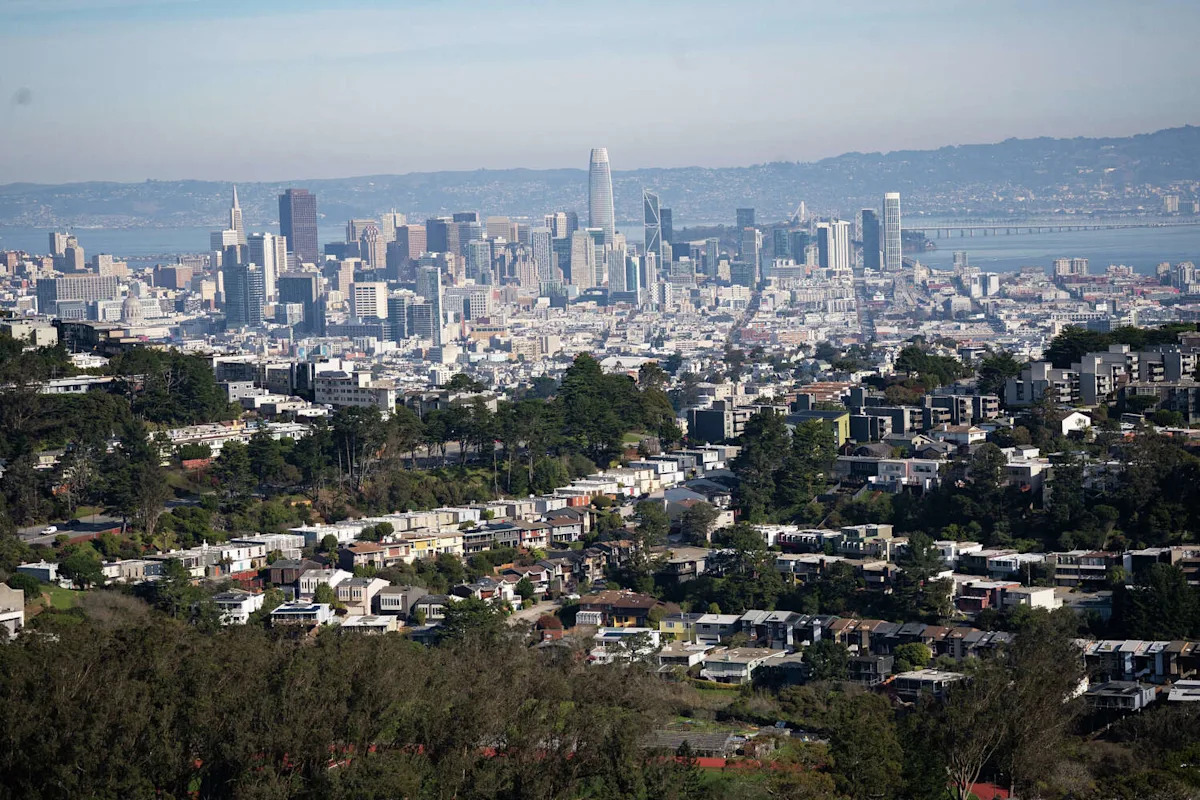
Newly released data from the U.S. census offers a detailed look at how San Francisco’s neighborhoods differ across various key demographics. The data, known as the American Community Survey, is based on responses to over 100 questions asked to about 10% of U.S. residents between 2020 and 2024.
The Chronicle used this data to make seven maps showing how San Francisco’s neighborhoods differ on characteristics like race, income, age, education and vehicle ownership.
There are a variety of official neighborhood maps used by S.F. agencies. We chose to use the Analysis Neighborhood boundaries created by the city’s Planning Department, which divides the city into 41 neighborhoods. Neighborhoods with very few residents, such as Golden Gate Park, Lincoln Park and McLaren Park, were excluded from our analysis. This story is an update of a previous set of maps we published in 2024.
Population
With about 75,000 residents, the Sunset/Parkside neighborhood continues to be the city’s most populous, accommodating nearly one out of every ten San Franciscans. The Mission (55,000) and Outer Richmond (43,000) are a distant second and third.
Sea Cliff, Treasure Island and Presidio remain the least populated neighborhoods. With fewer than 3,000 people each, they together account for less than 1 percent of the city’s total population.
{ “__type”: “devHubFreeformEmbed”, “__id”: “Datawrapper”, “__fallbackImage”: “https://datawrapper.dwcdn.net/AzUwC/mobile.png”, “__data”: { “datawrapper_id”: “AzUwC” } }
Race and ethnicity
The Marina, Haight/Ashbury, Castro/Upper Market, Pacific Heights, and Presidio Heights have the highest shares of white residents, accounting for more than 65% of the residents in these neighborhoods. The places with highest shares of residents identifying as Asian are Chinatown, Portola, Outer Mission, Oceanview, Visitacion Valley, and Sunset/Parkside.
San Francisco’s Black population is most concentrated in Bayview Hunters Point (25% of all residents), Treasure Island (24%), and Western Addition (20%). Bernal Heights and the Mission have large Hispanic or Latino populations, with around one in three residents identifies as Hispanic.
Income and Poverty
Households that earn more than $200,000 are most prevalent in Sea Cliff (63%), Potrero Hill (58%), and Presidio (57%). The Tenderloin and Chinatown had the lowest shares of high-earners.
{ “__type”: “devHubFreeformEmbed”, “__id”: “Datawrapper”, “__fallbackImage”: “https://datawrapper.dwcdn.net/g5gPc/mobile.png”, “__data”: { “datawrapper_id”: “g5gPc” } }
About 11% of the city’s residents live below the poverty line. In Treasure Island, Chinatown and the Tenderloin, nearly 30% of the population live in poverty.
{ “__type”: “devHubFreeformEmbed”, “__id”: “Datawrapper”, “__fallbackImage”: “https://datawrapper.dwcdn.net/2BbiX/mobile.png”, “__data”: { “datawrapper_id”: “2BbiX” } }
Education
Educational attainment closely aligns with income levels in San Francisco. Over 80% of residents over the age of 25 in neighborhoods like Potrero Hill, Marina, Sea Cliff, Haight Ashbury, Noe Valley, Pacific Heights and Castro hold a bachelor’s degree or higher. Chinatown, Visitacion Valley, Bayview Hunters, Excelsior and the Tenderloin have the lowest share of people with a bachelor’s degree or above.
{ “__type”: “devHubFreeformEmbed”, “__id”: “Datawrapper”, “__fallbackImage”: “https://datawrapper.dwcdn.net/lTPLD/mobile.png”, “__data”: { “datawrapper_id”: “lTPLD” } }
Car ownership
San Francisco remains an auto-centric city, with over 70% of its households having access to a vehicle. The lowest ownership rates are in the transit-dense neighborhoods of the Tenderloin, Chinatown, Nob Hill, SoMA and Japantown.
{ “__type”: “devHubFreeformEmbed”, “__id”: “Datawrapper”, “__fallbackImage”: “https://datawrapper.dwcdn.net/kZJmT/mobile.png”, “__data”: { “datawrapper_id”: “kZJmT” } }
Seniors
Japantown (38%) and Chinatown (30%) have the highest share of senior citizens among its residents. Treasure Island, Presidio, Mission Bay and Hayes Valley have the lowest shares of people above 65 years of age.
{ “__type”: “devHubFreeformEmbed”, “__id”: “Datawrapper”, “__fallbackImage”: “https://datawrapper.dwcdn.net/LEqHC/mobile.png”, “__data”: { “datawrapper_id”: “LEqHC” } }
This article originally published at New maps show the most detailed demographic data for every S.F. neighborhood.