

About 1,100 Teamsters are preparing to strike Feb. 17-20 at 22 California State University campuses.
At issue in the unfair labor practice strike are deferred wage increases over the last year for union members who include carpenters, electricians, maintenance mechanics, metalworkers painters and plumbers.
RELATED: Kaiser workers strike again in Bay Area, with no end in sight
At the same time wage hikes were deferred, CSU tuition and enrollment have risen — giving workers a possible source of cash to pay for the missing raises, according to Jason Rabinowitz, secretary-treasurer with Teamsters Local 2010. The union believes that deferred wages for its workers also could be partially repaid through Gov. Gavin Newsom’s request earlier this month for an additional $366 million in ongoing funding for the Cal State system.
The added money, if approved by the Cal State board of trustees, would help provide back wages for missing pay hikes that were to begin on July 1, 2025 — the last year of a three-year contract, according to Rabinowitz.
The union claims that CSU balked on paying contractually obligated raises and step increases for its Teamsters workers.
Cal State refutes the account offered by the Teamsters.
“The Teamsters explicitly agreed to contract language making 2025 salary increases contingent on the CSU receiving new state funding in the 2025-2026 state budget, which the CSU did not receive,” said Amy Bentley-Smith, a spokeswoman with Cal State’s Office of the Chancellor. “While the governor’s 2026-2027 proposal is very encouraging, the final budget will not be adopted for several months and remains subject to change.”
CSU will engage in full contract bargaining with the Teamsters, as it will with other unions representing CSU staff, Bentley-Smith said.
Last fall, CSU approved an operating budget that reflected the system’s dire financial outlook, but later in October received a state-approved 0% loan from the legislature for $144 million to help stabilize the university system’s finances. Cal State wanted to use the money to offer one-time bonuses for employees rather than lock-in with ongoing salary increases. The CSU must repay the loan in full by July 1.
However, faculty unions and skilled trade workers demanded permanent raises — not deferrals.
“We’re looking for the university to honor the existing contract,” said Rabinowitz. “Nobody got a raise in all of 2025. With the cost of living going up and everything else, no one got a raise, not even faculty,” he said. “The only people who got a raise at CSU last year were the presidents and other highly paid executives.”
He also mentioned a CSU proposal to scrap the policy limiting incoming presidents to no more than a 10% salary increase over their predecessors.
CSU also implemented a multi-year tuition plan that included a 6% hike for all campuses from last academic year to this year. By 2028-2929, annual tuition will reach $7,682 for in-state students, a 34% increase over five years, according to CSU.
The Cal State system also experienced an enrollment rebound in the fall 2025 term, with 471,451 students enrolled, marking a 2% increase — the largest year-over-year growth in a decade — following post-pandemic declines. The enrollment gains also mark the second consecutive year of enrollment gains following two years of post-pandemic declines, according to a CSU statement issued last month.
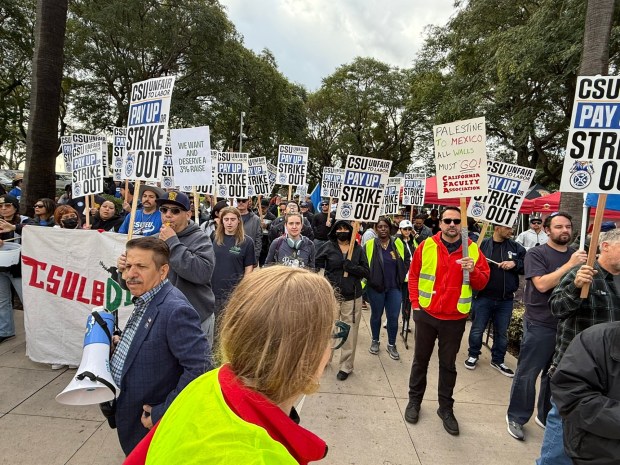 Above, members of the Teamsters Local 2010 picket outside the Cal State headquarters in Long Beach for higher wages and benefits on Nov. 18, 2025. About 1,100 union skilled trades workers with the Teamsters are preparing to strike 22 California State University campuses on Feb. 17-20. (Courtesy of Teamsters Local 2010)