
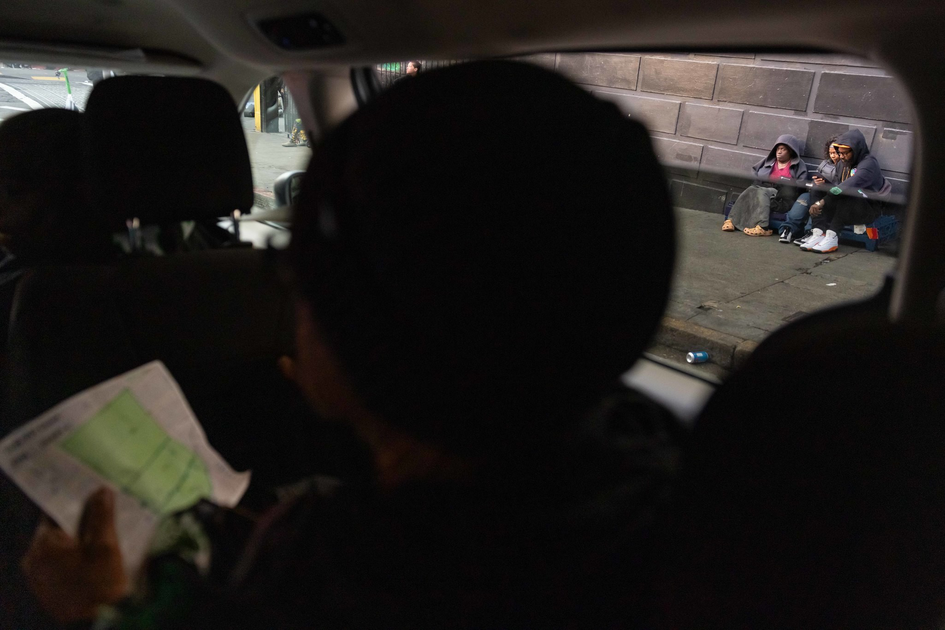
Pants torn and face unshaved, folded over on the stoop of a downtown Starbucks, a man stared at the burning end of his cigarette as a group of volunteers approached him.
“Excuse me, I’m with the city, and we’re conducting a survey of the homeless population,” said Shana Hackney. The man interrupted her.
“I’m not homeless,” he responded, seemingly offended. “I live in an apartment.”
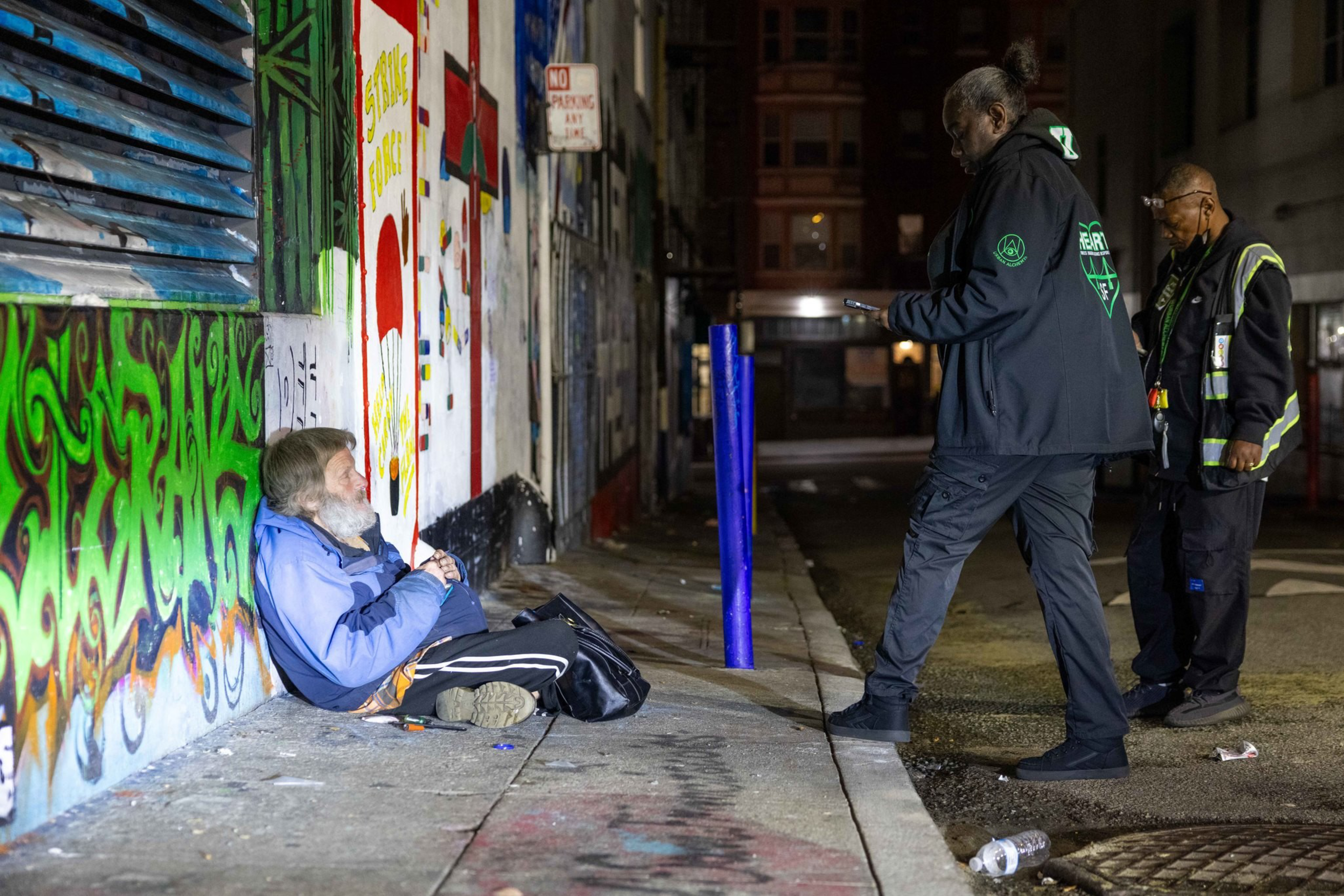 Jonnie William Gibson, who is homeless, talks to volunteers Shana Hackney, center, and Sharon Gambles. | Source: Amanda Andrade-Rhoades/The Standard
Hackney quickly apologized and walked away.
“He’s not homeless,” she yelled to her group as they moved down the block.
The city is required by the federal Department of Housing and Urban Development to conduct a Point-in-Time count every other year. In previous years, the weathered man may have been counted as part of the city’s homeless population. Since the inception of the count in 2005, canvassers in San Francisco have determined whether someone is homeless based solely on their appearance.
But for this year’s homeless census, held early Thursday, the city required that counters speak to every apparently homeless person they came across. This was just one of several changes to the process that officials said could make the count more accurate but could also make it more difficult to compare data from year to year.
Homeless advocates claim the changes were politically motivated and will be used to illegitimately tout progress on the issue. Over the past 20 years, the number of homeless people in San Francisco obtained from these counts has steadily climbed, reaching 8,323 in 2024.
But on Thursday, not everything went as smoothly as the city may have hoped.
Some participants called the 10-hour process chaotic. Many struggled to find their assigned groups, while some didn’t start their routes until 90 minutes after the scheduled start time. Others quit before the count was complete, leaving city officials to finish their work late in the morning.
A controversial change
For some sleeping on the city’s streets, the count served as an unwelcome wakeup call.
One man, draped in a blanket of foil, blinked, half-asleep, as counters attempted to interview him.
“Are you interested in participating in an interview for the Point-in-Time count?” they asked as he lifted his head from the concrete.
He was not. They counted him anyway and moved along.
When city officials announced earlier this month that they were shifting the start time to 5 a.m. from 8 p.m., homeless advocates condemned the new approach. They argued that some homeless people spend mornings sleeping after staying awake all night, while others, particularly those who live in vehicles, may be at work or school. At around 7 a.m., police and Public Works employees often begin their daily sweeps of encampments, dispersing people and making them moving targets for any canvassing operation.
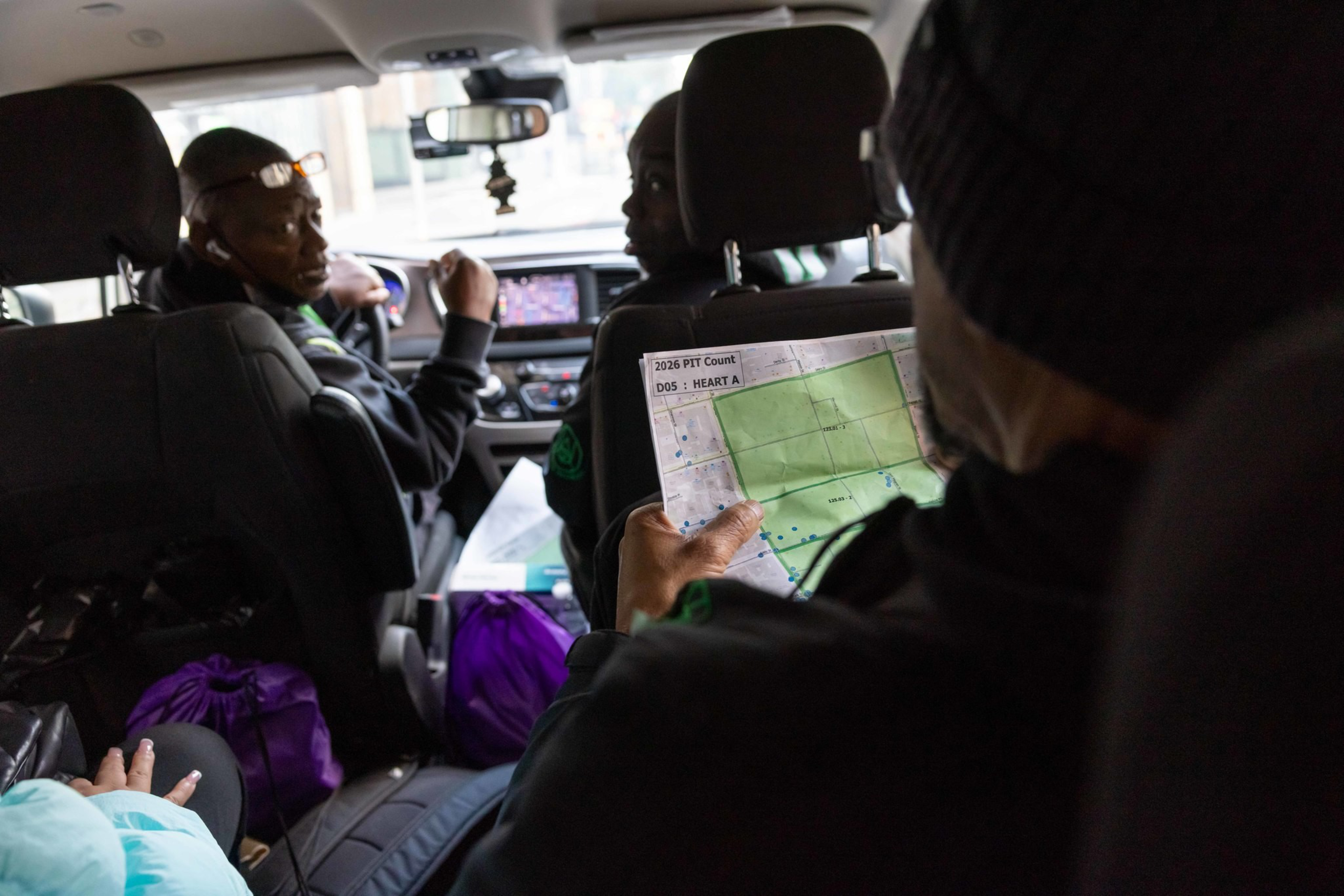
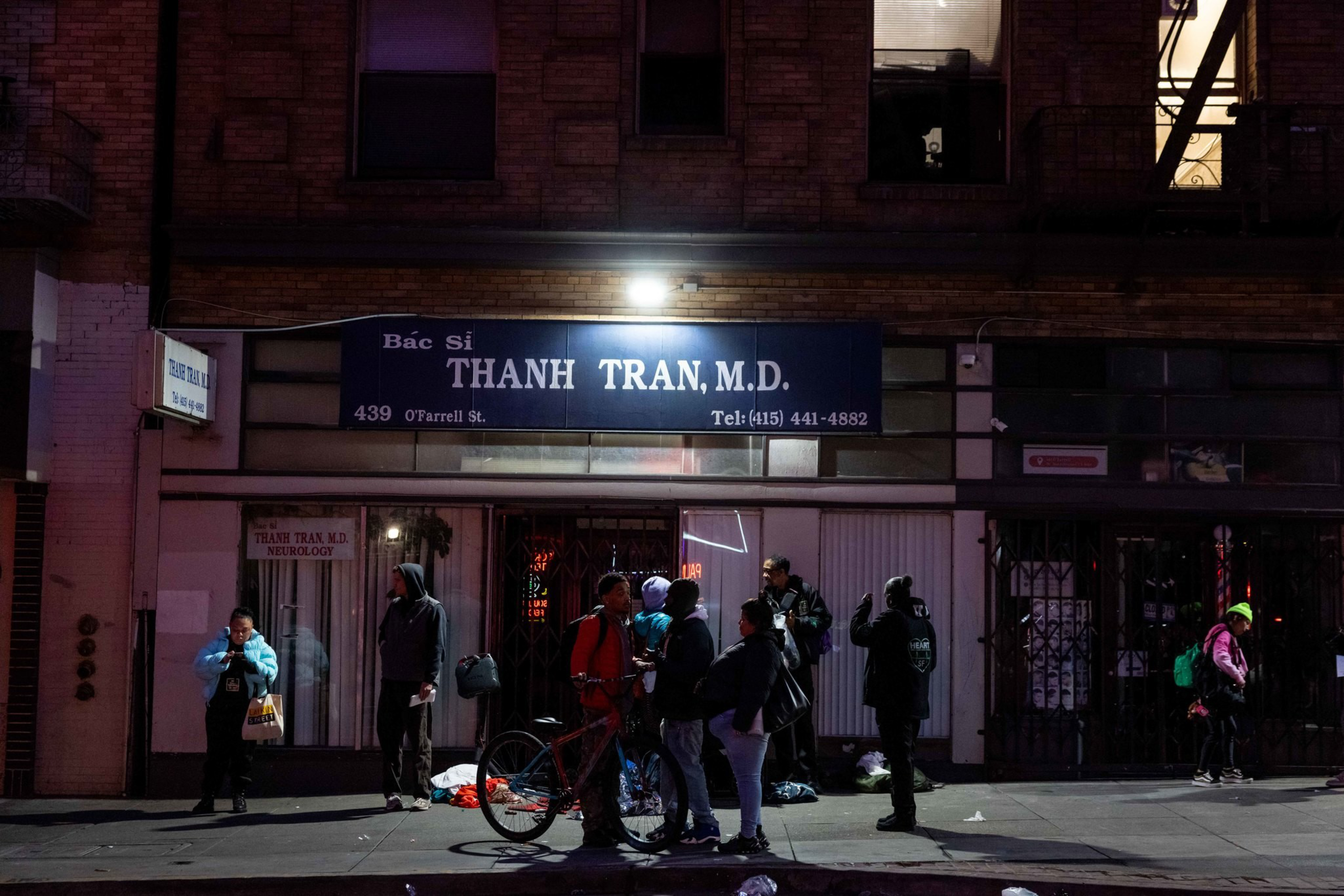
“People move in the early mornings, because that’s when you get those illegal lodging charges,” said Lukas Illa, an organizer for the Coalition on Homelessness. “There’s a very strong likelihood that this [yields] a much bigger undercount than usual.”
Minutes after the man under the foil blanket laid his head back on the concrete, a security guard rousted him from his nest. The man walked across the street and into another counting group’s assigned zone, raising the possibility that he could be counted twice.
An early morning
With a hypodermic needle behind his ear, Andy Acosta peppered the counters with questions.
“Do I get a gift card?” he asked. “What about housing?” The 25-year-old said he’d been living on the streets for 10 years.
 Gambles interviews Andy Acosta about his experiences being homeless.
The counters said they had nothing to offer him, but he agreed to an interview anyway.
After the survey, the counters provided Acosta with a goody bag of crackers, a comb, a tube of toothpaste, and two pairs of socks.
“What is this, my birthday?” he joked.
Canvassers were instructed not to offer resources beyond these simple incentives to the people they counted, as their sole obligation was to conduct the surveys.
But that was easier said than done. Many counters already had relationships with people they encountered on the street. The new interview process slowed the count immensely, as entire groups of canvassers would wait while one conducted a survey, to guarantee no double-counting. Interviews sometimes took more than 15 minutes.
In years past, counters would quietly tally and move on. The newly prescribed conversations were more humanizing, but they also left many of the counted feeling disappointed. Some asked for compensation in exchange for their participation. Others seemed to expect that the survey would come with some offer of assistance.
A woman named Paris confided in the counters about sexual abuse she has faced while living on the streets and in shelters. As the counters walked away from her, a man named Amir shouted from up the block.
“Are you going to get her some help?” Amir pressed them. “She’s been out here for years.”
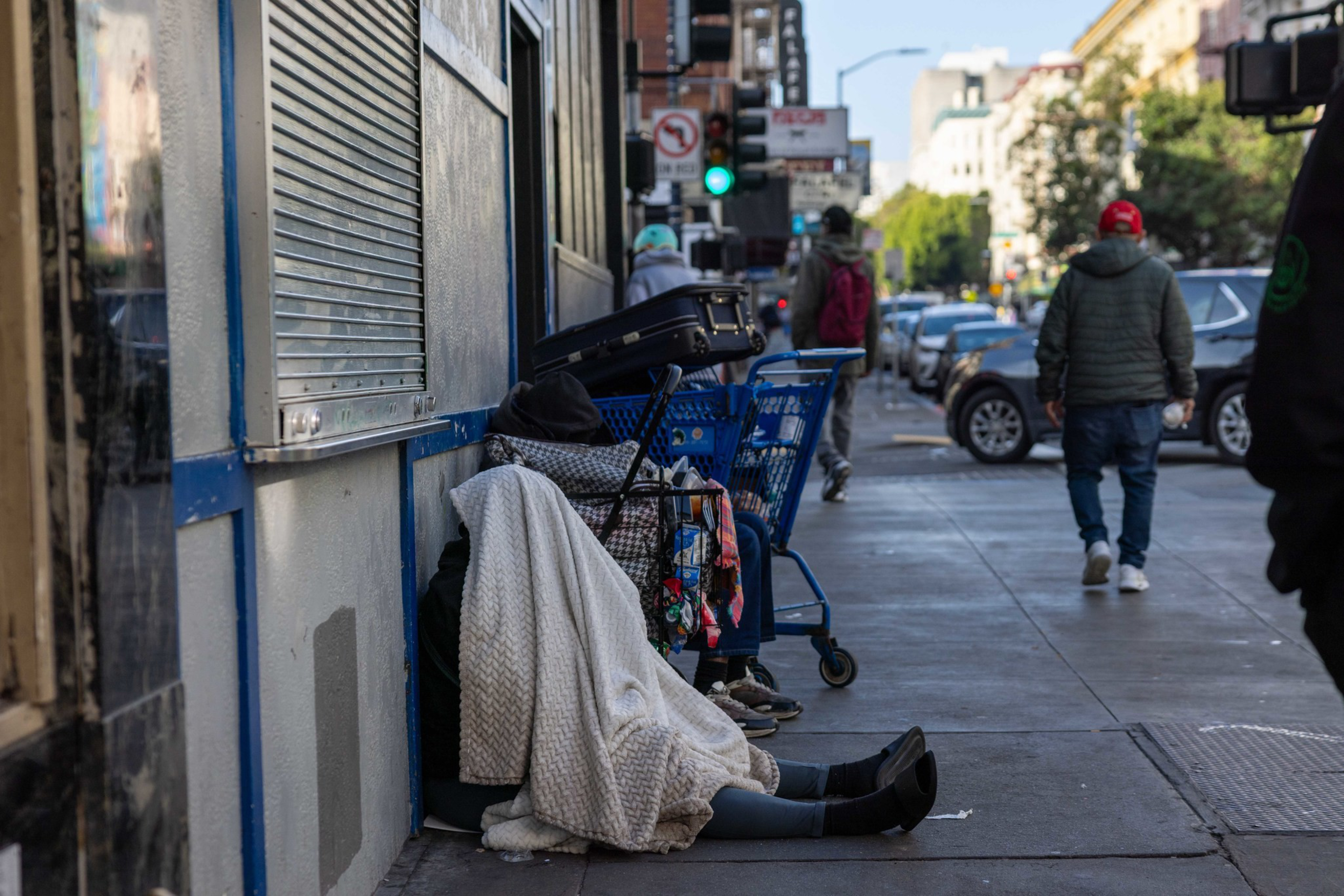 Source: Amanda Andrade-Rhoades/The Standard
The counters told him there was nothing they could do at the moment.
Later, counter Rafaela Ramirez expressed disappointment that she wasn’t able to offer help to the people she counted.
“This is horrible,” she said. “Why don’t we have some way we can go back to them?”
By 9 a.m., the canvassers seemed exhausted. One heard that other groups had already wrapped up. Though they still had at least two more Tenderloin blocks to count, the canvassers returned to the rendezvous and called it a day.