
Santa Ana leaders are considering changing how their Police Oversight Commission works – just as it’s starting to launch reviews after years of delay.
Yet just as the commission ramps up, city staff are highlighting one big issue – funding it.
Those concerns are already triggering protests from activists who worked to support establishing a commission with investigatory powers – who point to costly lawsuit payouts involving the police department as proof of the costs of not doing investigations.
City council members unanimously voted to create the commission days before the 2022 election. Commissioners only looked over their first cases earlier this year – authorizing three probes out of eight complaints reviewed.
They may be the last.
This week, T. Jack Morse Jr. – who serves as executive director for volunteer commissioners – told city council members his current budget restricts just how many cases he can look at.
Morse said a “simple” complaint with two witnesses and one officer can cost around $15,000 to review, and more complex investigations that include multiple interviews and around 10 hours of body worn camera footage cost $40,000 apiece or more.
“Each investigation is duplicative of an IA (Internal Affairs) investigation,” Morse said at the council’s special meeting on Monday night.
Right now, his department has $125,000 per year – capping their work at three complex investigations or around eight simple investigations per year under their current model and budget.
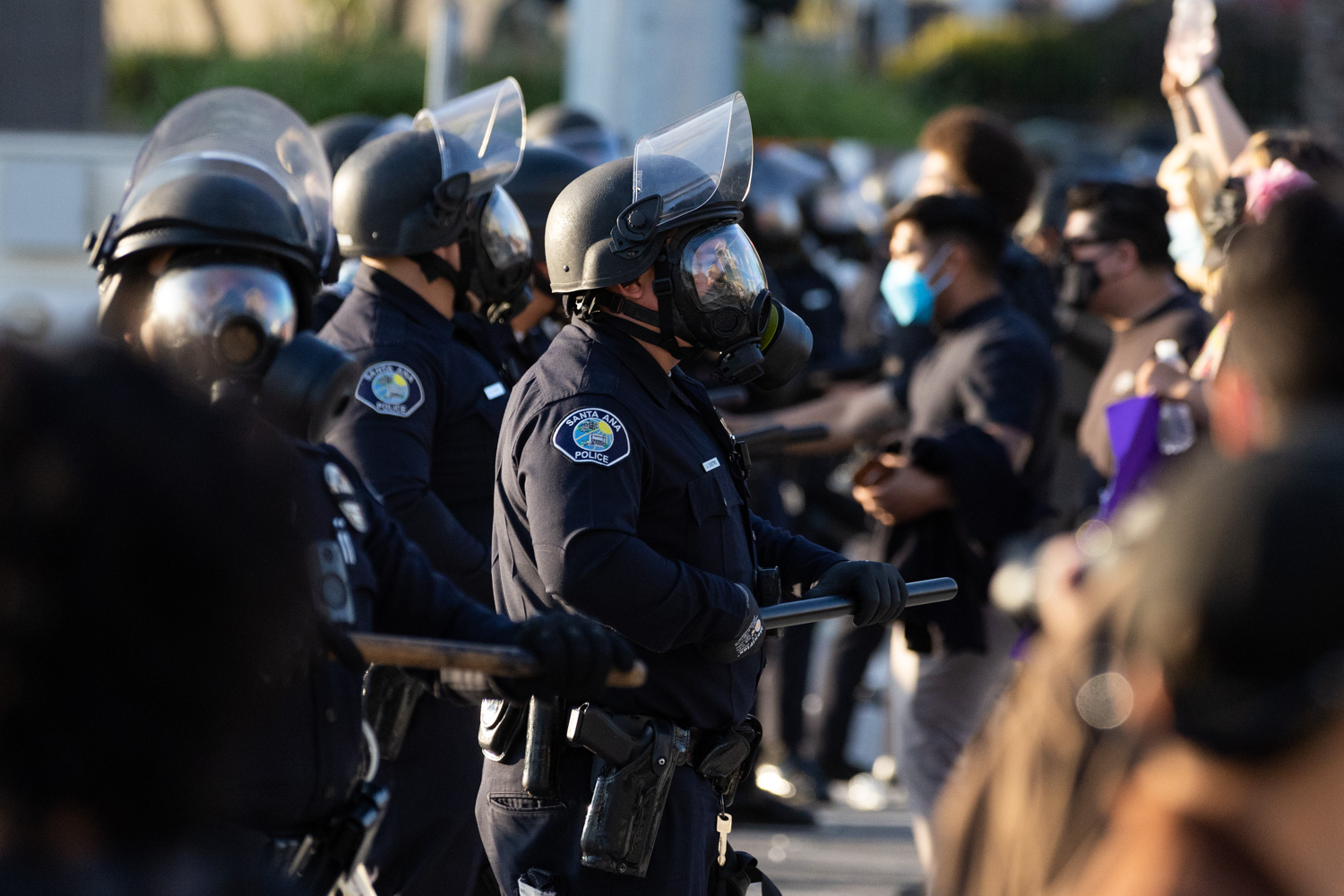
Most recently, City Councilman Benjamin Vasquez is asking his colleagues to greenlight a review of how the police department handled protests last year.
Read: Santana: Were Santa Ana Police Justified in Firing On Peaceful Protesters?
The price tag on reviews has prompted city staff and some council members to question whether it’s better to explore shifting the commission to working on broader audits that don’t focus on specific officers, like studying traffic stops and shootings as a whole rather than on a case by case basis.
“This type of model focuses on changing the culture and preventing misconduct,” Morse said.
The structure would also leave some money left over to do reviews on one or two individual officers’ cases each year.
Councilman Phil Bacerra was one of the strongest proponents of the hybrid model, saying they need to be realistic about what the commission can accomplish.
“You have seven council members that all support police oversight,” Bacerra said. This is not about going after officers and being punitive. This is the long term impact of having a police department that protects the community.
“This is about improving the police department, not abolishing the police.”
Originally, city council members and staff said they wanted to talk about changing the commission’s rules because of concerns about state laws that blocked civilian oversight panels like the commission from reviewing confidential personnel records.
Yet in their staff report, city staff noted they no longer need to make any updates to the rules because state legislators changed rules around the commission’s power to review confidential police records before they got around to talking about it.
“While the Commission is moving forward with the current ordinance, and current state law eliminates the prior legal issues posed regarding confidentiality of records, staff collectively recommends updating the ordinance and establishing an audit model,” wrote Sylvia Vazquez, Deputy City Manager.
The staff also pushed to limit any work the commission does to reviewing use of force and officer involved shootings, which would end other investigations like a recent review of police officer traffic accidents that cost the city over $5 million since 2019.
Read: Pursuit Crashes and Off Duty Police Car Wrecks Cost Santa Ana Millions
Last July, city council members discussed changing the rules so that the commission could only review possible police officer misconduct after the police department completed their own investigation.
Read: Will Santa Ana Neuter its Police Oversight Commission Before its Work Begins?
That led to many of the commenters at Monday night’s city council meeting bringing up concerns that any changes to the commission were an effort to defang it.
“We need to stop playing political games and start acting in good faith,” said Bulmaro Vicente, policy director for nonprofit Chispa, calling the audit model a “step backwards.”
Carlos Perea, who serves on the commission as Councilman Vasquez’s appointee, said he was open to the hybrid model but that the city should leave the commission as it is.
“I’m just here again to state my support for continuing the ordinance as it is,” Perea said. “We just began reviewing complaints and I think it will obstruct, disrupt the work we’ve begun to do.”
Councilman Jonathan Hernandez said it’s the city’s job to oversee the police department, saying that “state sanctioned violence is at heights.”
“There is no other department in the city costing taxpayers more money in liabilities today,” Hernandez said. “We saw our own police department brutalize the public while they were not in compliance with state law for their militarized equipment.”
Mayor Valerie Amezcua and Bacerra, who each received the bulk of their campaign funding and support from the city’s police officer’s union, both insisted changes to the commission were not coming as a result of pressure from the union or the police department.
Amezcua also endorsed members of the commission having to go through more training programs to understand what police officers do.
““When you’re going to investigate police departments or let’s say doctors, you need to know what doctors do and how they do it…it’s the same with police officers,” Amezcua said. “How do our commissioners evaluate cases or make decisions to share with you, Jack (Morse) or the city manager when they don’t know the job?”
Yet City Manager Alvaro Nuñez said some commissioners raised concerns about their safety as well as the amount of time that it would take to complete academy training while also raising concerns that spending so much time with officers could bias them in favor of the police department.
Noah Biesiada is a Voice of OC reporter. Contact him at nbiesiada@voiceofoc.org.
Related