
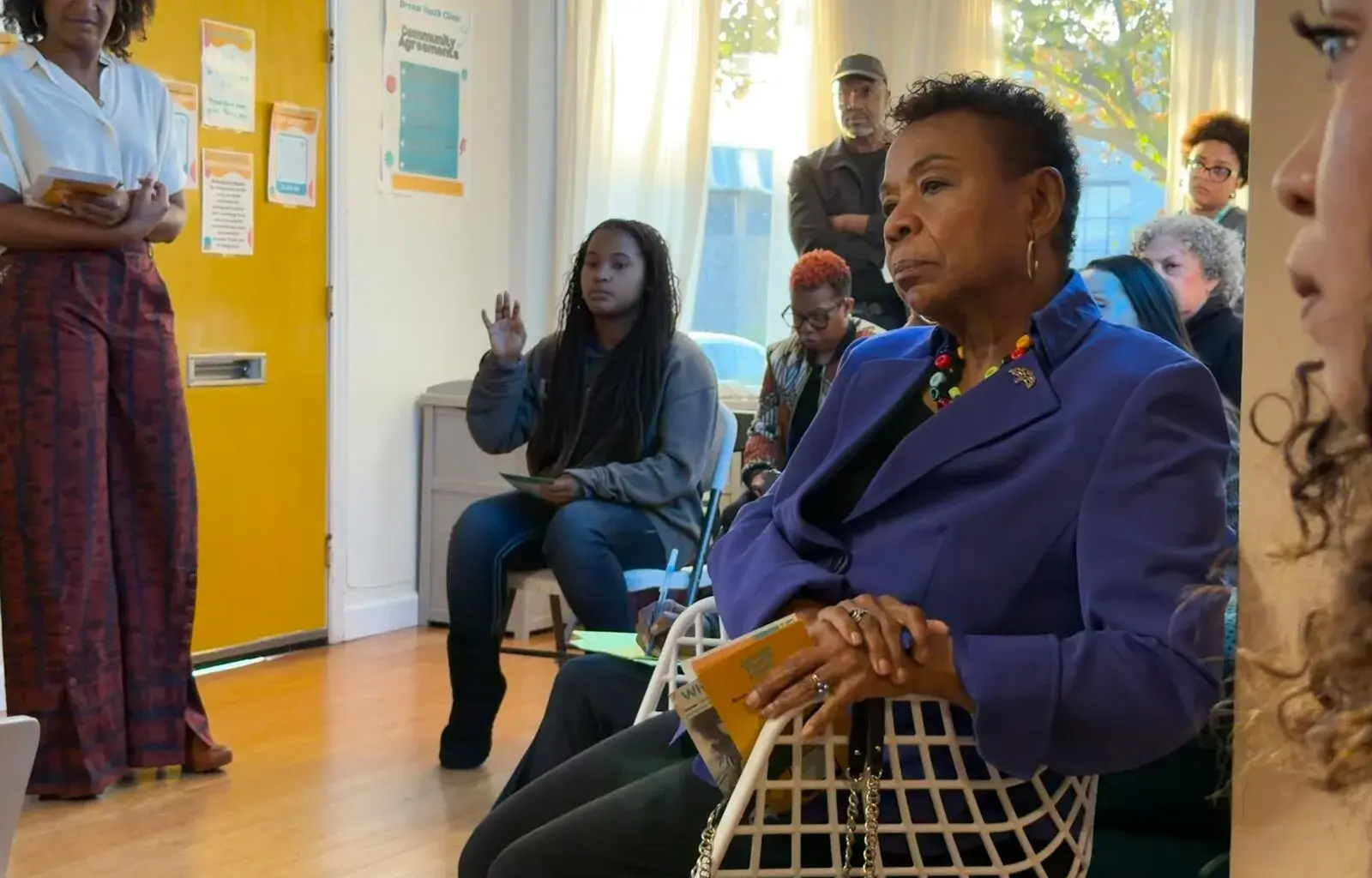
Teens and young adults shared their experiences with sex trafficking in Oakland — and their ideas for solutions — with city and county leaders at a town hall Wednesday afternoon.
Roughly 40 community members and local leaders packed the Dream Youth Clinic’s office near Jack London Square for the event, including Mayor Barbara Lee, Department of Violence Prevention Chief Holly Joshi, Supervisor Nikki Fortunato Bas, and Councilmember Charlene Wang.
“Human trafficking prevention is an important reproductive justice issue and a shared community responsibility,” said LJ, a 17-year-old high school senior. Reproductive justice is a movement started by Black women in the 1990s that advocates for bodily autonomy.
Dr. Aisha Mays, founder and CEO of Dream Youth Clinic, a nonprofit providing free reproductive health services to young people of color and LGBTQ+ youth, said the town hall was the first of its kind in Oakland.
“Our young people are advocating for policy and systems change to put an end to sex trafficking in Oakland and to make our community safer for all of us,” she said.
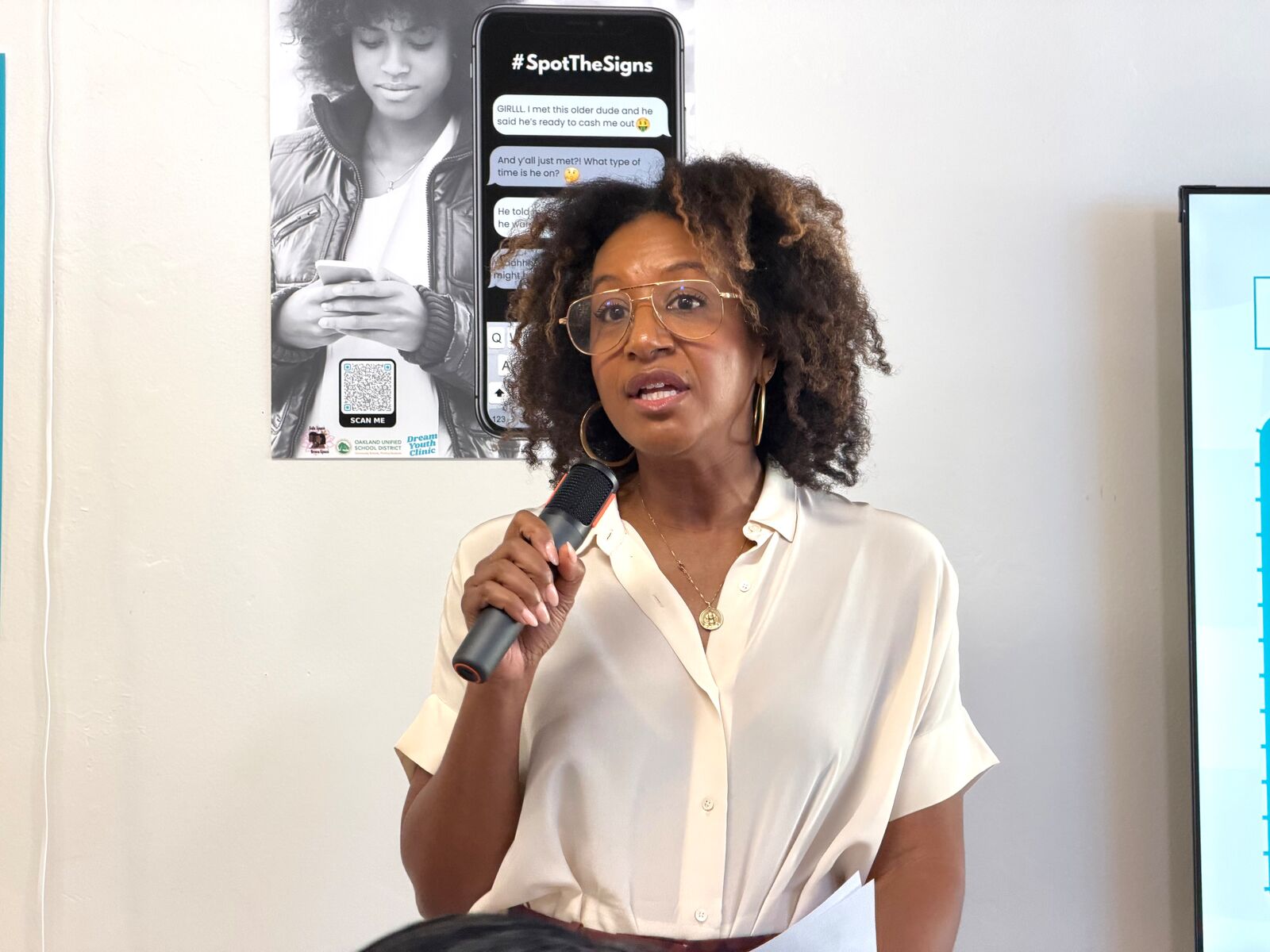 Dr. Aisha Mays, founder and CEO of Dream Youth Clinic, speaks at a youth-led town hall on sex trafficking in Oakland on Wednesday, Jan. 28, 2026. Credit: Roselyn Romero/The Oaklandside
Most of the youth who spoke at the town hall were Black girls and women, reflecting local and national trafficking trends. Commercial sexual exploitation is hard to track since the vast majority of cases go unreported due to fears of retaliation, the stigma surrounding the issue, and other factors. But records show that in Alameda County, Black people make up 61% of human trafficking victims, compared to 15% Latino people and 12% white. And over half of Alameda County human trafficking survivors were foster youth at some point in their lifetime. (Human trafficking includes both sex and labor trafficking.)
“Sex trafficking is a public health issue, and in Oakland, it’s a Black girl health issue,” Mays said.
Oakland Mayor Barbara Lee spoke at the town hall and opened up about the challenges of being a teen mom. “I ended up getting married at 16 because I was pregnant,” she told the youth. “Fortunately, I didn’t end up in circumstances that many of our young girls end up in, but believe me, I had a very difficult teenage and early 20s years.”
Wang, whose district encompasses the stretch of International Boulevard where commercial sex work is most prevalent, recently proposed changes to city law that would levy fines against buyers and exploiters. Those fines would then be used to fund local nonprofits providing services to sex trafficking survivors, such as housing or temporary shelter, legal aid, or job training.
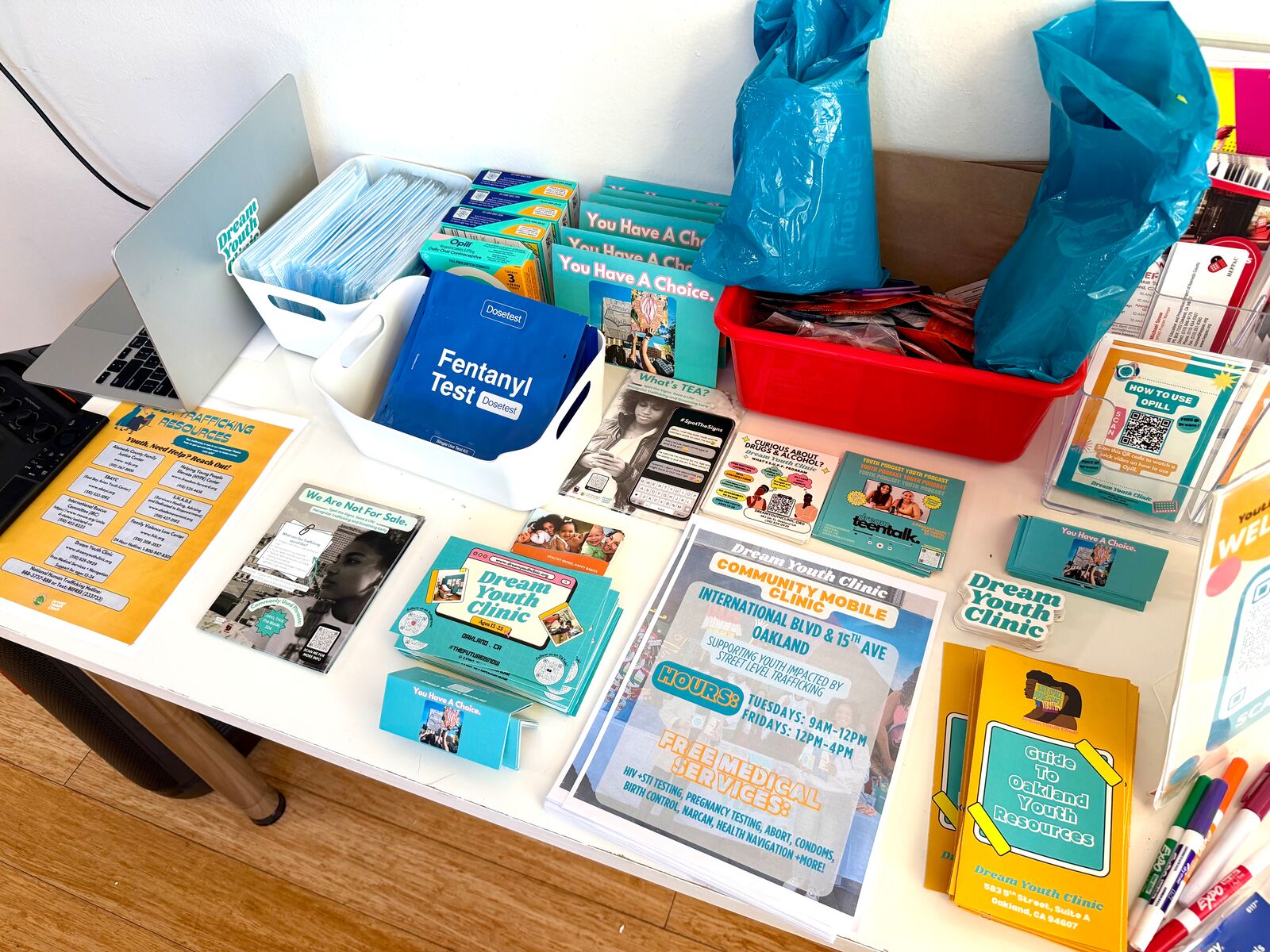 Fentanyl test strips, over-the-counter birth control pills, and other resources are available at the Dream Youth Clinic’s office in Oakland. Credit: Roselyn Romero/The Oaklandside
According to Mays, Dream Youth Clinic recently surveyed 230 Bay Area trafficking survivors ages 25 and under. Seventy percent of them said housing insecurity is a risk factor. Traffickers may promise safety, food, and shelter to vulnerable people, often targeting those in emergency shelters and the foster care system, according to youth at the town hall.
Some of the young people who spoke at the town hall explained that commercial sexual exploitation manifests in different ways. There’s street-level trafficking, which is seen on Oakland streets like International Boulevard and East 12th Street. And trafficking through social media is also becoming increasingly common.
“On Instagram, TikTok, Facebook, so many people will fake their identity to get young girls to meet up with them,” said one of the youth speakers.
Some said they grew up seeing a family member being sexually exploited or exploiting others. “For me, I’ve seen a person in my own house being exploited,” said Emonnie.
Some youth at the town hall asked to be identified only by their first name or initials to protect their privacy.
“I have not myself been sex-trafficked, but I did come from a parent who has been,” said LJ. “Growing up with that, and with her not knowing how to navigate her emotions, I lived in a lot of her fears.”
Exploiters often employ two tactics to lure someone into the sex trade. The “boyfriend pimp,” sometimes referred to as the “Romeo pimp,” gains a person’s trust by treating them nicely or buying them food or clothes, but over time coerces them into trafficking. The “gorilla pimp” typically uses violence or blackmail to force someone into commercial sexual exploitation.
Some of the youth at the town hall said they’ve seen their peers pressured into exploitative situations by friends at school or by a significant other. “They’ll know you’re looking for love and say things you want to hear. It’s like a game,” said Diamond Aaliyah, one of the youth speakers.
Several people noted that sexual exploitation often looks different from how it’s portrayed in movies or shows. Swai Lakai, another town hall participant, said trafficking may take place in “massage places, spas, smoke shops, gas stations, places where you’d least expect it.”
“It’s not always someone scooping you off the street in a white windowless van — it’s the unregulated nervous system, it’s the substance use, it’s the disappearing for long periods of time,” said Sarah Koster, a faculty instructor at Samuel Merritt University who attended the town hall.
Boys may also be groomed by family or friends to normalize sexual exploitation, pointed out NuPhaeya Hassen, a reproductive justice program coordinator for Dream Youth Clinic. “Young men also suffer from human trafficking,” she said. “They may be trained on how to be the aggressor and how to lead a young woman into trafficking, or they may be trafficked themselves.”
Youth want to see more resources for organizations supporting sex trafficking survivors
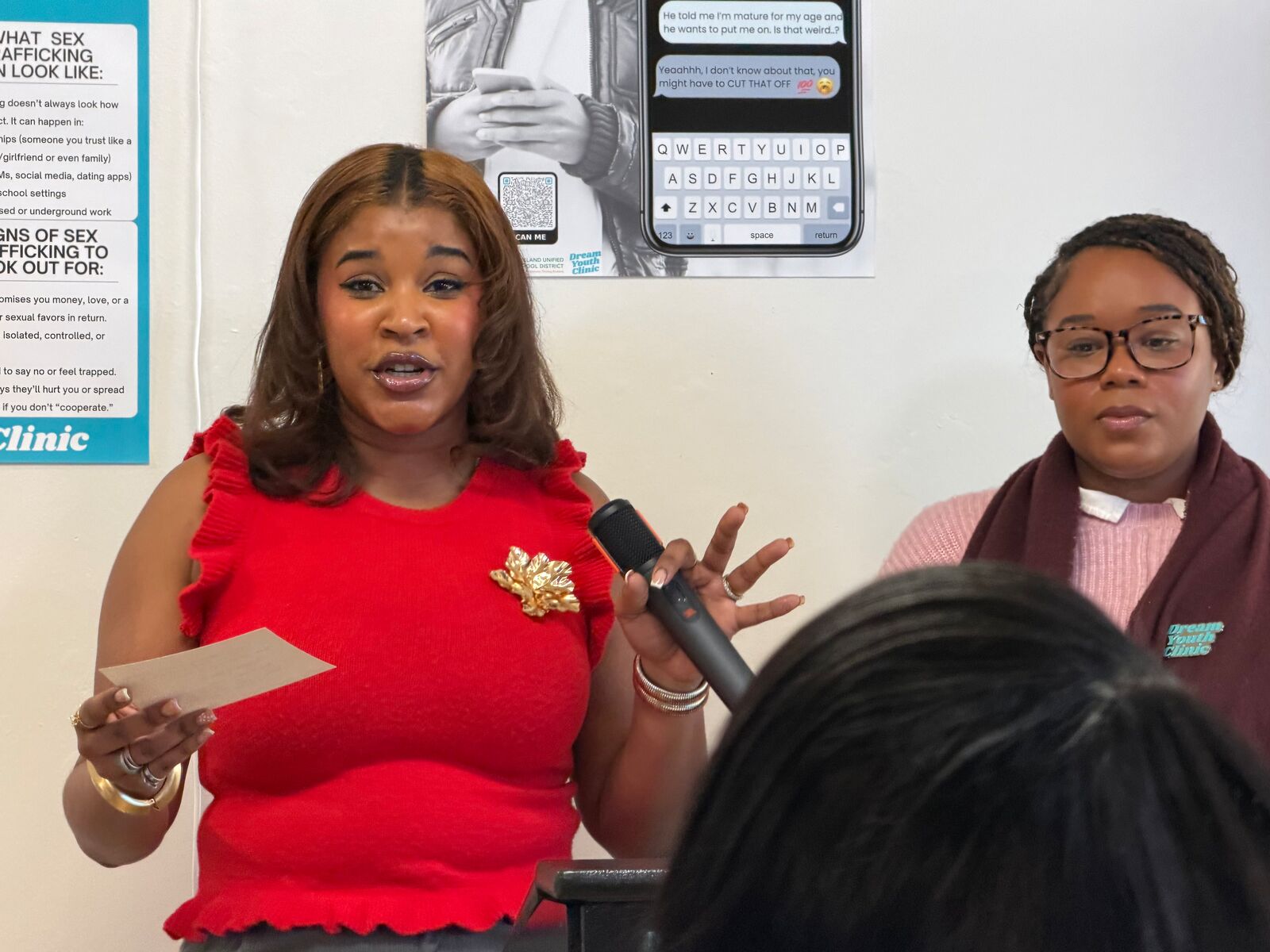 Dream Youth Clinic reproductive justice program coordinators NuPhaeya Hassen, left, and LaKia Williams speak at a youth-led town hall on sex trafficking in Oakland on Wednesday, Jan. 28, 2026. Credit: Roselyn Romero/The Oaklandside
Addressing the city and county leaders in the room, young people said they want to see more funding for local nonprofits providing shelter, jobs, and mental health services to sexually exploited youth, as well as more school-based and after-school programs to prevent trafficking.
Miahjae Turrentine, a youth leader with the Dream Youth Clinic, said she wishes Oakland schools could implement programs or curricula teaching kids how to self-regulate. “Some of them are repeating words and behaviors that their parents have taught them,” she said.
LJ, the high school senior, said she had to “fight” for support while navigating the foster care system, which she said was riddled with long waitlists due to being under-resourced.
“Meetings are so delayed in the system,” said LJ, “and some kids don’t know how to advocate for themselves, especially coming into the system at a young age.”
Swai Lakai said she wants high school sex education classes to include more information on the signs of human trafficking and how to report it. “I feel like this should be required in schools,” she said.
“*” indicates required fields