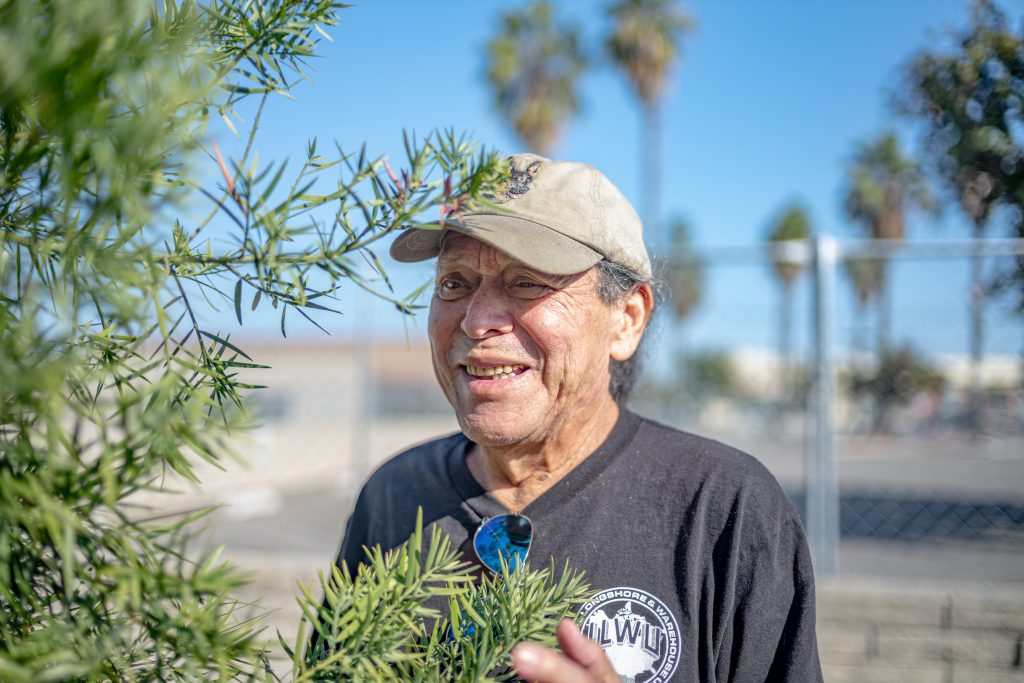
Sal Martinez wears his hair long, pairs a black shirt with light jeans, and walks his California Heights neighborhood carrying jugs of water to feed local trees.
Each week, he stops at trees lining sidewalks and medians that he believes have been overlooked. The soil is often dry, with trash scattered around the base, and Martinez groans as he pours water onto roots he says should already be cared for by the City of Long Beach. Now in his 70s, he says the warning signs were impossible to ignore.
“I just wanted to do a good deed,” Martinez said.
What began as a quiet habit has turned into a weekly routine. Sometimes neighbors join him, hauling buckets and jugs to give trees relief during hot, dry stretches. They work without pay, permits or fanfare, just a shared concern that too many trees are being left behind.
Martinez’s observations reflect gaps acknowledged by the City itself. In an email to the Signal Tribune, Long Beach Public Works said it manages approximately 92,000 street trees within the public right-of-way. However, officials said the department does not know how many of those trees are connected to an irrigation system or how often they’re watered.
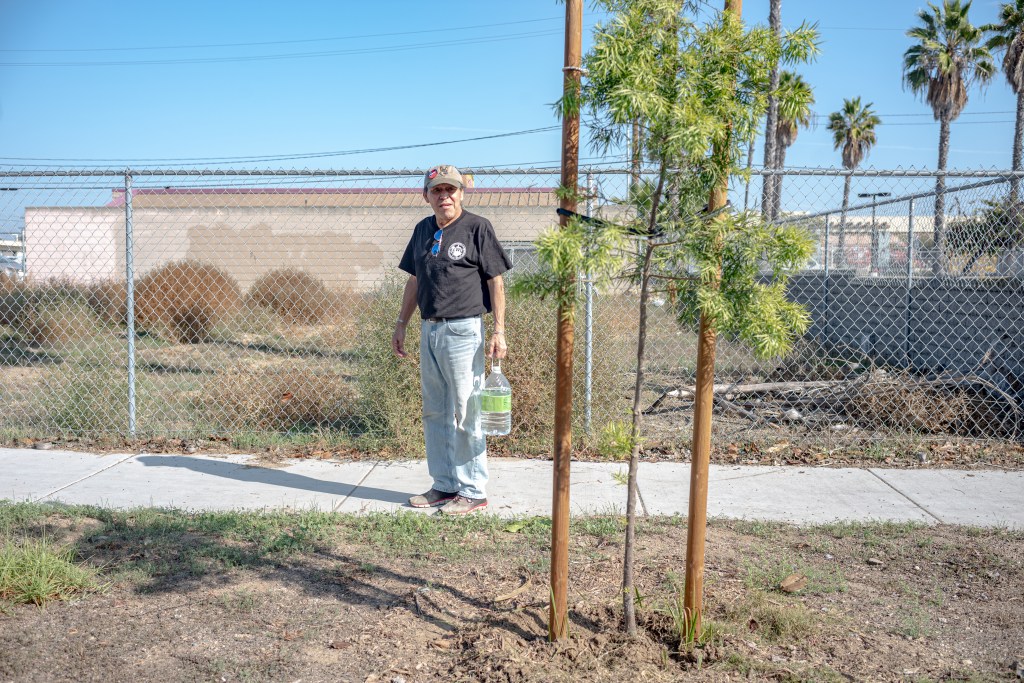 Sal Martinez looks over a newly planted tree that he waters weekly along the street on Nov. 3, 2025. (Justin Enriquez | Signal Tribune)
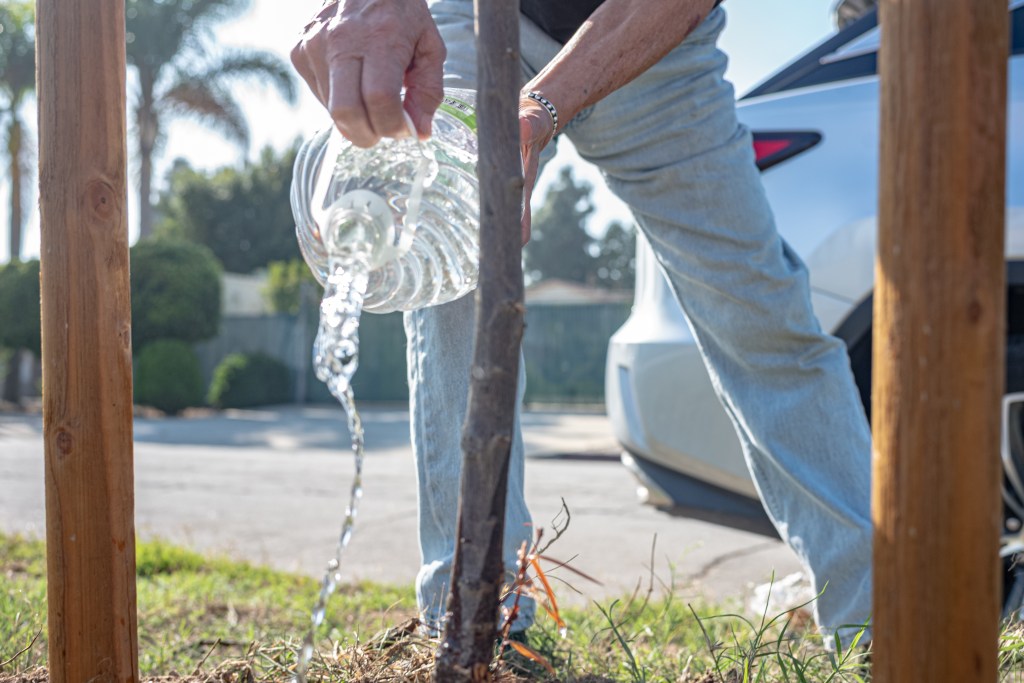 Sal Martinez pours a jug of water over a planted tree in his neighborhood that he says rarely receives water from the City of Long Beach. He waters them weekly as he walks along the street on Nov. 3, 2025. (Justin Enriquez | Signal Tribune)
Public Works also does not track how many trees rely on hand-watering, nor does it maintain data on how frequently those trees are watered or whether schedules vary by species or neighborhood.
For residents like Martinez, the lack of information underscores what he sees as an uneven, reactive approach to tree care rather than a preventative one.
At the same time, the City has expanded its tree-planting efforts in recent years. Over the past five years, Public Works has planted 2,574 trees citywide. That includes 148 trees in fiscal year 2022, 144 in 2023, 745 in 2024, and a sharp increase to 1,200 trees in fiscal year 2025. As of late January 2026, 337 trees have been planted.
Public Works could not provide the Signal Tribune a total cost for those plantings. Officials noted that the majority of tree planting is funded through a combination of grants and other one-time funding sources, rather than the City’s general fund. The department said an increase in those funding sources over the past three years directly correlates with the higher number of trees planted during that period.
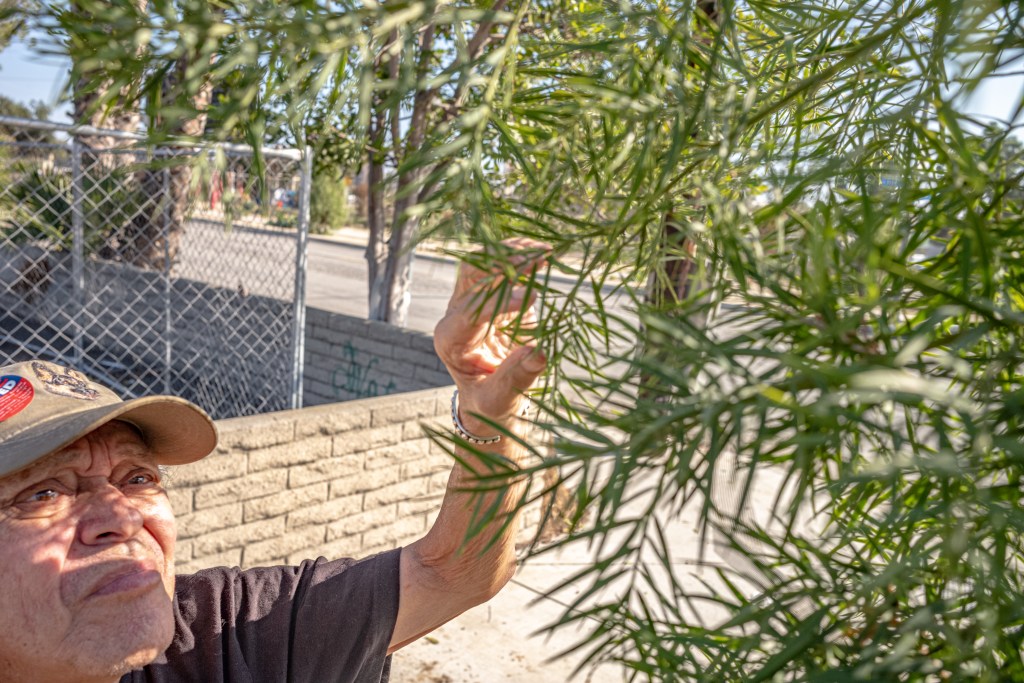 Sal Martinez looks into the leaves of a planted tree he waters weekly on Nov. 3, 2025. (Justin Enriquez | Signal Tribune)
Local arborist Ben Fisher said proper tree maintenance relies on consistent care, including regular pruning, which is the removal of specific branches or plant material to maintain a tree’s health.
“There has to [be] appropriately managed trees, they need to be staffed well,” he said. Fisher said some of the techniques used by the City do not provide adequate care, adding that he believes there are not enough workers to properly maintain trees. While he acknowledged the City’s tree program has improved significantly over past decades, Fisher continues to advocate for additional resources for Long Beach’s trees.
Meanwhile, residents like Martinez question how long the newly-planted trees can survive without consistent care.
The issue extends beyond his block. In parts of North Long Beach, community members have raised similar concerns about trees receiving inadequate water. Dry conditions, combined with aging infrastructure and limited maintenance, can accelerate a tree’s decline, shortening its lifespan and potentially wasting public investment in planting and replacement.
Over the past three to four years, an estimated 1,000 to 1,200 City-managed trees have been removed, according to Public Works. Trees are removed for several reasons, including severe infrastructure damage, declining health, disease, and those uprooted during storms or high winds. The department said it does not have an exact figure for how many trees were removed specifically due to age.
Not all areas face the same challenges. Public Works said all trees along Artesia Boulevard from Harbor Avenue to Downey Avenue are connected to a bubbler irrigation system that delivers water slowly at ground level. Trees along that corridor were planted in 2022 and 2023, and the irrigation system allows water to soak directly into the soil around the roots, reducing runoff and evaporation and providing more consistent watering than what is seen on many residential streets.
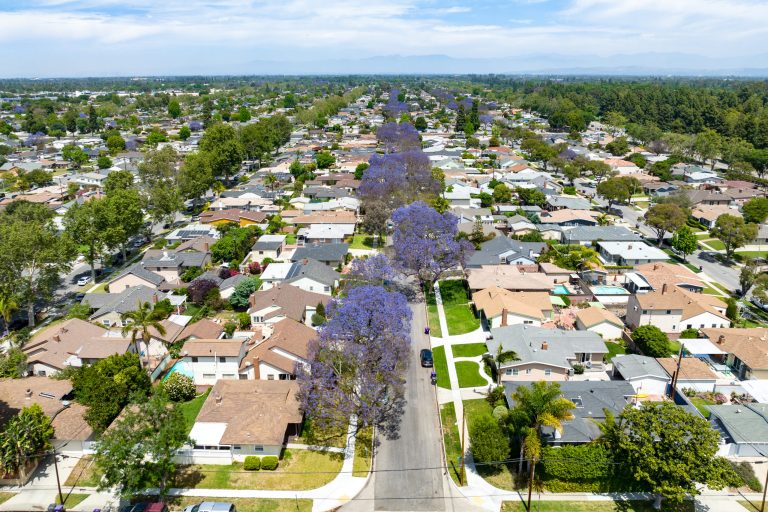
The contrast is visible across the city. Some streets are shaded and green, while others in older neighborhoods sit bare, with dust-filled tree wells. For Martinez, the work is about more than aesthetics.
Street trees contribute to a neighborhood’s “cool factor” and have been found to lower sidewalk temperatures during the summer. Concrete and asphalt are known as “heat-trapping surfaces,” radiating heat back into the air. Strategically planted trees can cool an area up to 10 degrees, according to the Arbor Day Foundation.
As temperatures continue to rise, Martinez says he plans to keep walking, watering and hoping both for the trees and for greater attention to the gaps in how they’re cared for.
Related Posts: