

Councilmember Ken Houston’s proposal to overhaul how Oakland handles homeless camps has generated controversy in part because of warnings that it might jeopardize the city’s eligibility for state funding.
However, the California Interagency Council on Homelessness, or Cal ICH, has now said in a letter that the policy “meets minimum requirements of State guidance.” The City Council will likely take the policy back up in late February.
Cal ICH is a council with representatives from 19 state departments and is responsible for overseeing the implementation of California’s homelessness policies and regulations.
Houston’s Encampment Abatement Policy would significantly alter how Oakland addresses people living in tents and vehicles in the city. Currently, city rules say people must be offered shelter before the city clears an encampment. Houston’s proposal removes that requirement, although following pushback, Houston and co-author Patricia Brooks, a staffer for Council President Kevin Jenkins, toned down the language in a second draft, requiring the city to “make every reasonable effort” to provide shelter.
The policy would also give the city more leeway to tow illegally parked vehicles people are living in.
Houston, who represents deep East Oakland, has maintained that his policy is a forceful but humane and necessary response to a crisis that creates unsafe conditions for Oakland residents. While many people have praised the policy, many more have protested it at City Council meetings, excoriating councilmembers for considering cracking down further on the city’s most vulnerable residents. The city doesn’t have nearly enough shelter beds for the thousands of people who are unhoused in Oakland.
A bumpy road for Houston’s plan
Houston first proposed revisions to the city’s homeless camp rules in September. The policy was debated at a council committee meeting that month. But it was tabled after some committee members — citing Cal ICH’s concerns, and a critical letter from the county — said it needed significant revisions.
Cal ICH had, in August, advised Oakland that state funding requires cities to identify shelter or other places people can sleep before removing them, provide advance notice, and have a clear policy for storing belongings after a camp closure.
Houston revised his proposal, still not requiring the city to offer shelter before clearing an encampment, but saying Oakland should “make every reasonable effort to do so.” In December, the new version of the proposal made its way onto an agenda for a meeting of the full City Council. But the prior day, Dec. 1, a Cal ICH representative had sent Oakland another letter saying there were still problems with the policy.
Marshall wrote that it was still unclear whether the policy met the state threshold. She said there were concerns about how much of the city is deemed off-limits to camping, leaving few places for people to sleep.
In response, Jenkins delayed the council’s discussion of the policy, saying, “I think it’s imperative that we as a city keep funding.”
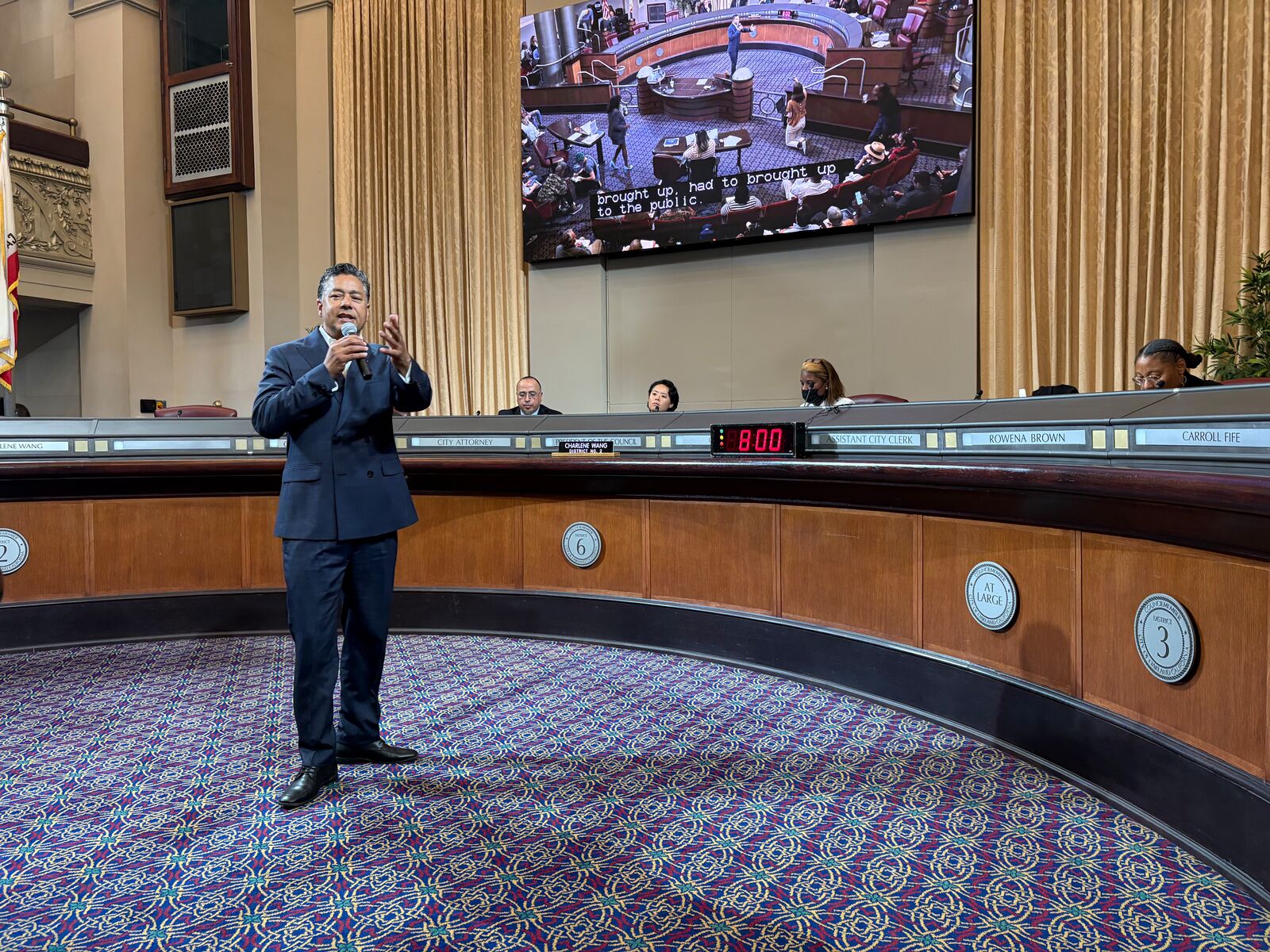 Houston presents his encampment proposal at a committee meeting in September 2025. Credit: Natalie Orenstein/The Oaklandside
Cal ICH ended up meeting with city leaders to talk through the policy. Then on Dec. 24, Marshall sent a new letter that should ease some of their concerns. But she also issued advice that Oakland is “encouraged, but not required, to take into account.”
“While the current draft of the EAP meets the minimum requirements of State guidance, Cal ICH remains concerned about the practical implications of the City’s proposed sensitivity map,” she wrote.
“We strongly encourage the City to consider how persons experiencing homelessness, particularly those with mobility challenges, disabilities, or limited access to transportation, will be supported in moving from high-sensitivity areas to the designated low-sensitivity zones,” Marshall continued. “The operational and safety implications of these transitions warrant deliberate planning before the policy is finalized.”
The division of Oakland into “high-sensitivity” and “low-sensitivity” zones, where encampment sweeps are either prioritized or not, is a holdover from the city’s current policy. But the map has stronger implications under Houston’s policy, because the city wouldn’t be required to offer shelter before closures.
Marshall also said the input Oakland officials have gotten so far from the public is a sign they should do more to work with constituents and be transparent about decisions.
Speaking with The Oaklandside on Thursday, Houston said nothing changed in his proposal between the time of Cal ICH’s uncertainty in early December and its approval letter in late December. He said the agency’s switcharound caused an unnecessary delay in the policy.
“This is disrespectful,” Houston said. “My community is suffering for two more months.”
He also took issue with the phrasing that Oakland’s policy meets the state’s “minimum” requirements: “Either it’s in compliance, or it’s not.”
As for the advice and apprehension around the sensitivity zones, Houston said, “You can have all the concerns you want, I don’t give a rip. I know the streets better than them, I know my community better than them.”
Calling his colleagues “brilliant,” Houston said he’s been meeting with the city administrator and mayor about the proposal, and will take other councilmembers’ opinions into consideration.
“I’m going to hear what they have to say, but I don’t have to change anything,” he said, saying his proposal is based on significant work and his experience with illegal dumping and homelessness. “This is probably one of the hardest lifts the city has seen in decades. They really know I’m trying to make some change.”
“*” indicates required fields