
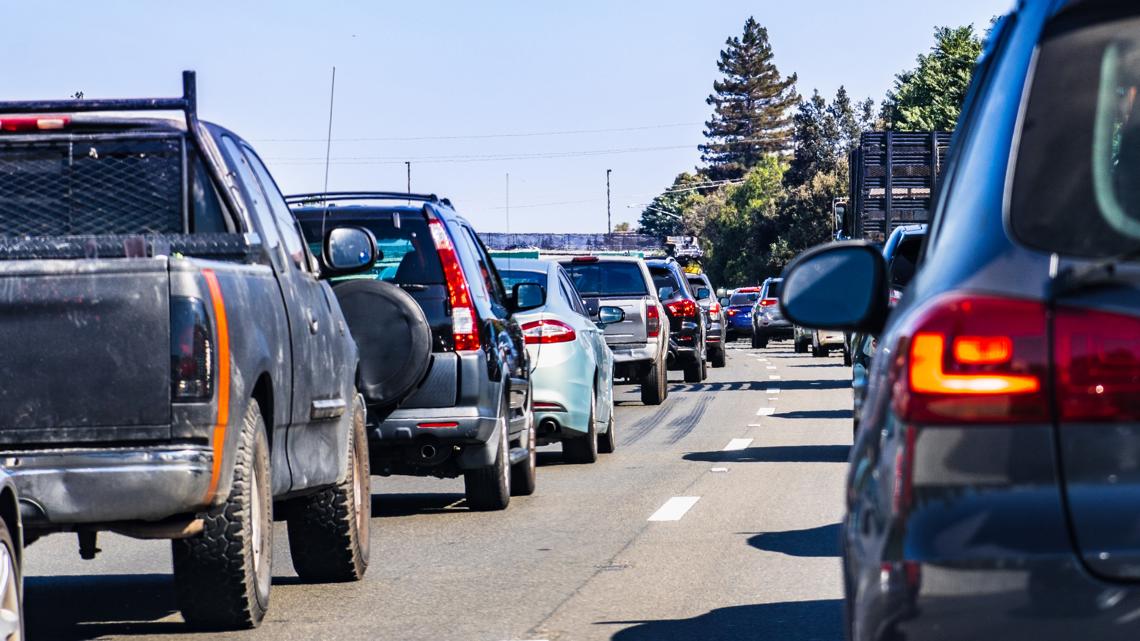
California’s legislature is debating a proposal to study charging drivers by miles driven, shifting from gas taxes.
SACRAMENTO, Calif — A proposal to study charging Californians for how much they drive has roiled state legislative Republicans.
Lawmakers in the Assembly on Thursday moved to direct the California Transportation Commission to prepare a study on the effects of a road charge for delivery to the legislature.
A road charge is a program that imposes a fee based on the number of miles people drive over a specified period.
The state has been running road charge pilot programs since 2016. Last year, a pilot project concluded where mileage rates were set at 2.5 cents per mile for light-duty vehicles, such as cars, and other vehicles weighing less than 10,000 pounds. The rate for heavy-duty vehicles is dependent on their weight.
The gas tax is set at just over 61 cents per gallon, the country’s highest rate, and generates billions in funding for highway and road repairs and public transportation infrastructure projects.
As California transitions to a carbon-emissions-free future, a road charge system is being considered as an alternative to the current gas tax, which is expected to see revenue decline.
According to an analysis by the California Transportation Committee, projected revenue to address transportation needs could decline by $31 billion as people rely less on gasoline and diesel-powered vehicles.
But that potential path toward implementation faced criticism from Republican lawmakers, who argued that a road charge would add another financial burden on residents, particularly those in rural areas and those with longer commutes to work.
“Californians are already getting crushed by the cost of food, housing, power, and gas,” said Assembly Republican Leader Heath Flora in a statement. “We already pay the highest gas taxes in the nation. Now Sacramento is talking about adding a new tax for every mile people drive. Piling on another tax right now shows just how out of touch politicians in Sacramento are with the reality working families face.”
To address the concerns, Assemblymember Wilson said she would work to amend the bill to specifically require the report to protect people from being double-charged by both the gas tax and road charge.
She emphasizes that her bill does not create a new charge; it only asks the advisory committee to compile research and other information on what a potential implementation would look like in a report for the legislature to review.
“It is unfortunate that the Republican Caucus has chosen to continue to contribute to this divided, hyperpartisan era by completely lying and mischaracterizing the bill to be something that it is not. As is clear from any honest reading of the bill and my statement on the Floor, AB 1421 simply requires the California Transportation Commission to continue studying transportation funding models and to report back to the Legislature with a research-driven analysis that can help guide future decisions,” said Assemblywoman Lori D. Wilson (D-Suisun City) in a statement.
Other states have also begun examining the innovative funding structure. In 2023, Hawaii became the first state to implement the program by law for electric vehicle drivers to pay by 2028.
The proposal has been sent to the California State Senate.
WATCH MORE: Can California’s governor race deliver crime reform and lower power bills?
ABC10: Watch, Download, Read