
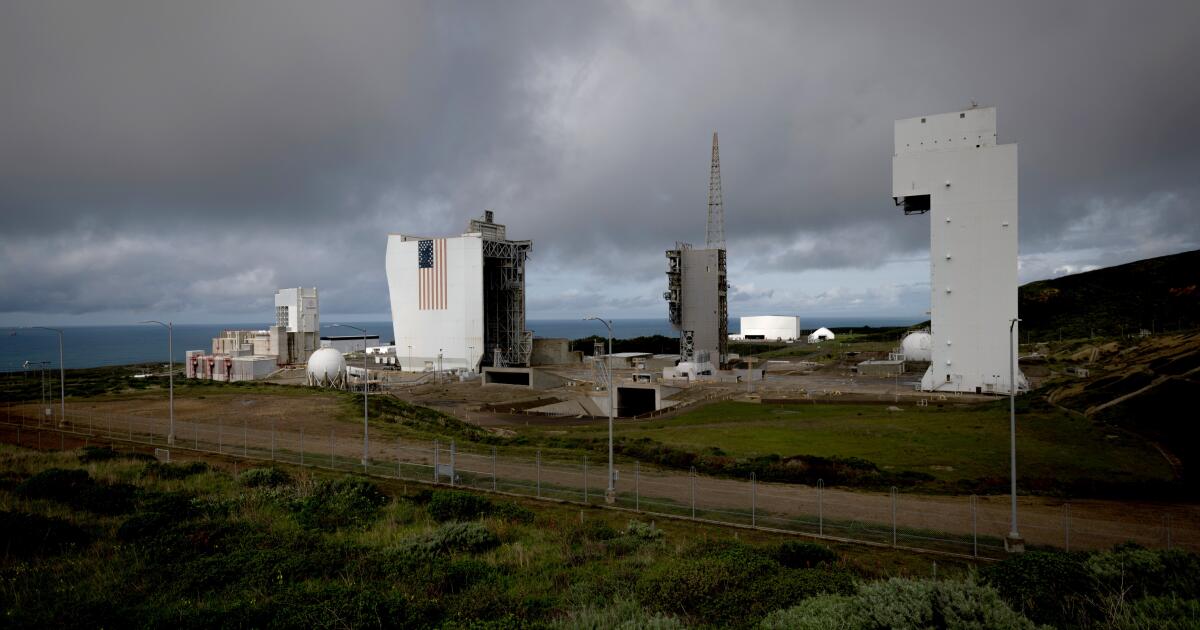
The rolling grasslands and rocky beaches of Vandenberg Space Force Base, home to more than a dozen at-risk species, easily could pass for a peaceful nature preserve — but that’s an illusion.
The nearly 100,000-acre base was a testing ground in the 1960s for early-generation ballistic missiles, and today it’s a launch site for satellites, classified missions and other payloads key to a new type of war: one fought far above the Earth.
This new era has been marked by a sharp jump in flights from the Santa Barbara County military facility that started in 2021 when SpaceX began sending into orbit Starlink internet satellites the military considers critical for national security.
Now Vandenberg is aiming higher with its Spaceport of the Future initiative. The agency is making plans for a nearly $900-million makeover of the aging base with roads, buildings, launchpads and other facilities to handle an anticipated surge in launches.
Seventy-one rockets blasted off last year, most of them by SpaceX. One hundred or more could take off this year, possibly making it the busiest space port in the world.
“We’re in the beginnings of the second space race. That’s what you’re seeing,” said U.S. Space Force Col. James Horne III, base commander, whose office is decorated with nearly two dozen models of rockets flown from Vandenberg.
Not everyone is happy about the base’s big plans.
While local development officials are eager to capitalize on the expansion, the blasts from the takeoffs and subsequent sonic booms experienced south of the base have stirred up controversy — scaring wildlife, rattling nerves and sparking conflicts with environmentalists, state officials and residents for whom the first space race is a distant memory.
“If I am upstairs and my door is slightly cracked, the boom can slam my door and we are 100-plus miles away,” said Mikayla Shocks, a Camarillo homeowner. “One time I thought a car hit the house, because it’s that loud.”
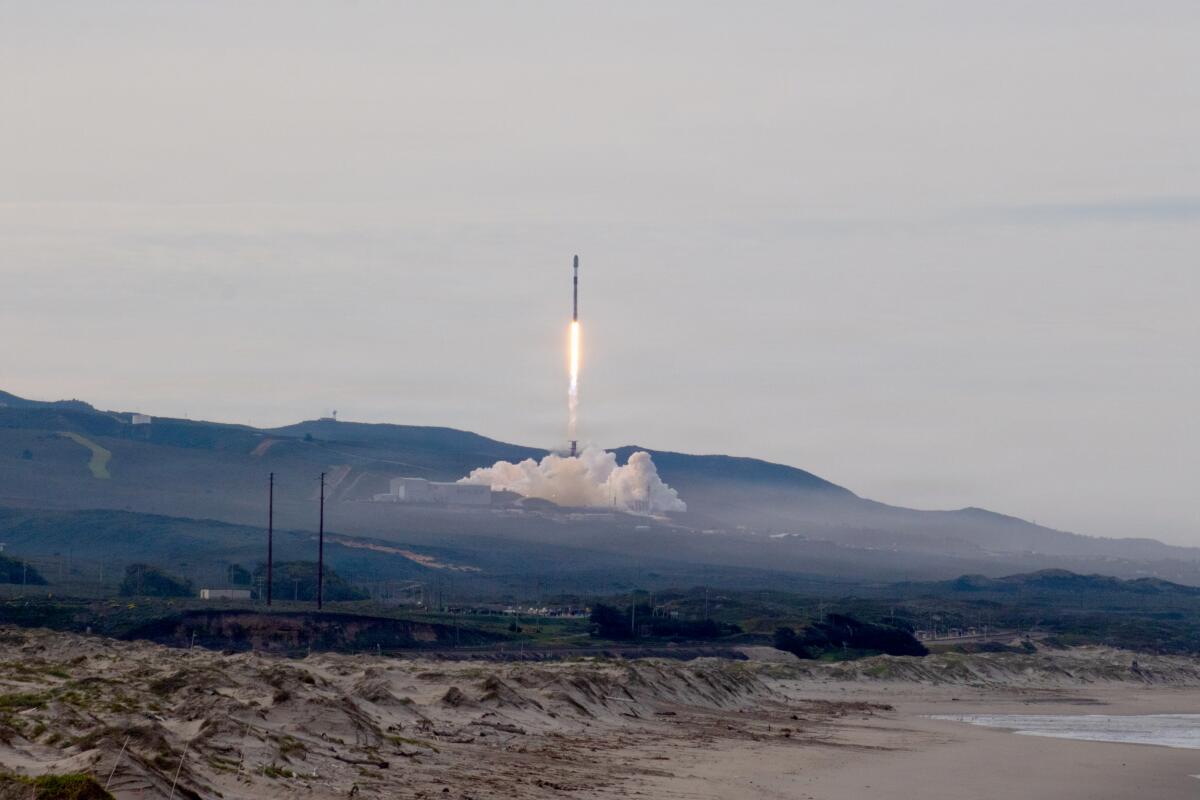
A Falcon 9 rocket carrying a Starlink satellite launches from Vandenberg Space Force Base on Jan. 25. The mission marked the fifth launch from the base this month.
(2nd Lt. Andrew Taller/U.S. Space Force)
The community pushback has grown as the number of launches has steadily increased from just seven in 2021, with SpaceX accounting for the vast majority of additional flights.
SpaceX has been blasting its reliable workhorse Falcon 9 rocket off from its complex on the southern part of the base, and received approval to launch its bigger Falcon Heavy rockets from another pad nearby.
The Falcon Heavy straps three Falcon 9 rocket cores together and has 27 liftoff engines compared with nine for the smaller rocket.
More concerning to critics is a decision by the Space Force in December to invite rocket companies to build and operate a “super heavy” launchpad on the base.
Marco Caceres, an aerospace analyst at Teal Group, expects SpaceX will have interest in using the pad to launch Starship, which is the largest rocket ever built and is being tested in Texas.
A version of the rocket is expected to be used by NASA to land Americans back on the moon, while SpaceX Chief Executive Elon Musk wants to colonize Mars with it. But he also has talked about how it will launch next-generation Starlink satellites.
The company, which moved to Texas but maintains large operations in Hawthorne, did not return messages seeking comment.
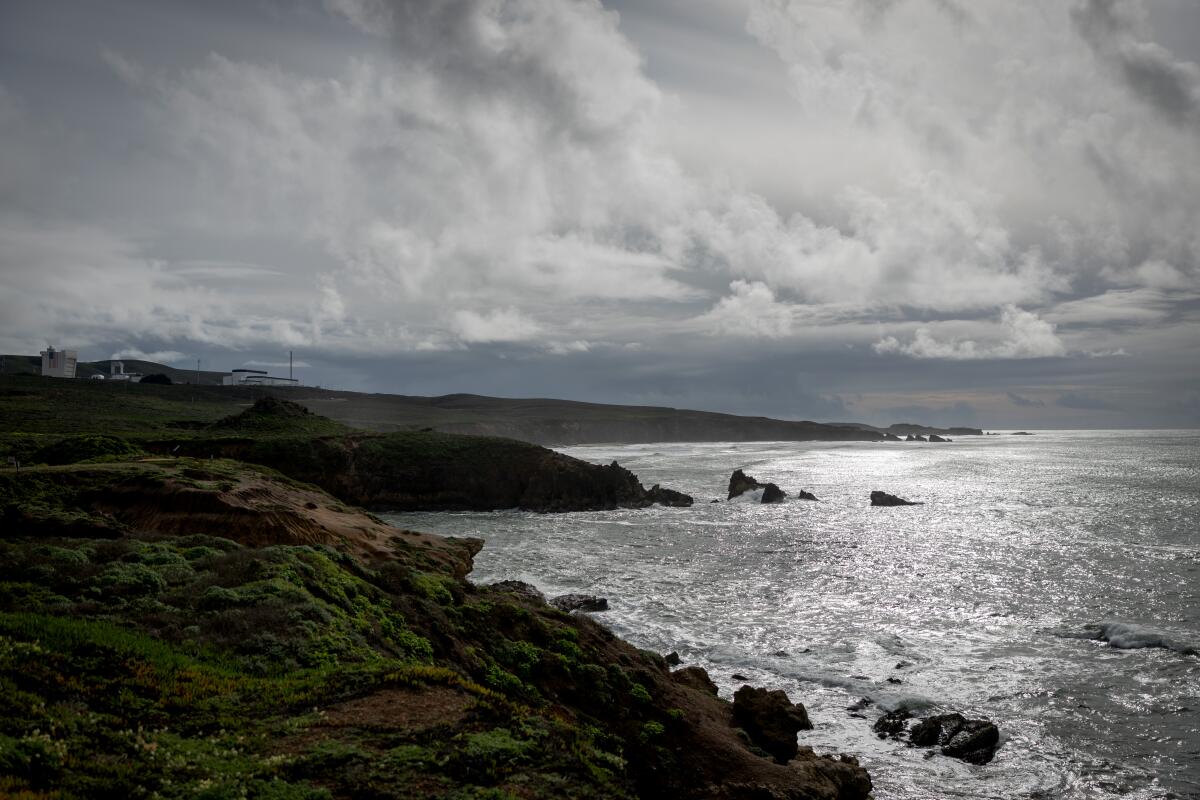
The southern coastline of Vandenberg Space Force Base.
(Eric Thayer/Los Angeles Times)
The surge in demand for rocket launches at Vandenberg has been fueled by big shifts in the defense industry, which has pivoted to drones, hypersonic weapons and critical communications satellites. President Trump in May announced his $175-billion “Golden Dome” initiative for a satellite missile defense system to protect the U.S. from attacks on land, sea and space.
The Space Force also is trying to leverage technology developed by commercial companies for defense applications — so called dual-use technologies, with Starlink a prime example.
The changes are helping to spur a revival of the defense and aerospace industries in Southern California, which include standouts Anduril Industries, an autonomous weapons maker in Costa Mesa that has plans to invest $1 billion in a Long Beach campus, and K2 Space, a maker of satellite platforms in Torrance.
The Falcon 9 is the preferred rocket to send these systems into space, with its reusable booster that can land back on its pad. It offers low-cost flights that carry multiple payloads from different customers.
Varda Space Industries, an El Segundo company developing pharmaceuticals in space that also is testing military hypersonic reentry technology, has flown five missions from Vandenberg and booked more.
Key to the endeavor is communications, which is where Starlink fits in.
“Everything feeds off the internet,” Caceres said. “Everything is based on instantaneous communications, speed and covering every inch of the planet.”
Starlink satellites launched from the base are put into an orbit around the poles. That requires the Falcon 9 to fly closer to the coast than past base flights, causing sonic booms in Santa Barbara, Ventura and other Southern California communities.
(The satellites also are put into low-Earth orbit from the Space Force’s other launch site: the Cape Canaveral Space Force Station in Florida, allowing the network to cover the globe.)
Space Force officials acknowledge that they didn’t expect the Falcon flights to cause such a ruckus, even as the population of Santa Barbara and Ventura counties roughly doubled to nearly 1.3 million since the early 1970s, when the base was busy. The agency says it has begun measuring the impact of the flights.
“Some of my preconceived ideas about these booms were simply wrong — that’s why data gathering is so important,” Brigham Young physics professor Kent Gee said in an an email. He is studying the issue for the Space Force along with researchers at Cal State Bakersfield.
The researchers found that the most intense booms are heard from Santa Barbara to Oxnard and miles inland — especially in the spring and fall when upper-level winds carry the sound onshore, with somewhat fewer booms heard in the winter and very few in the summer.
“We know so much more about these booms and their drivers than a year ago this time,” Gee said.
The base is now launching fewer rockets at night and also deploying more monitoring stations in communities such as Ojai to better capture the impact. However, flights still occur during sleeping hours to achieve certain orbits.
“Physics gets a vote in every launch,” Horne said. “Sometimes we have to.”
A more direct effect of the flights is to the abundant wildlife on the vast base, only a fraction of which is developed and abuts nature preserves. Those inhabiting the area include the at-risk buckwheat blue butterfly, the western spadefoot toad and the western snowy plover shorebird, as well as several marine mammals.
“This is the last refuge for a lot of our species,” acknowledges Darryl York, a wildlife biologist for the Space Force at Vandenberg.
Studies have shown that seals and other marine mammals can flee into the water during launches, which can cause injuries or lead them to abandon their colonies. Birds and other land wildlife are flushed from their nests too.
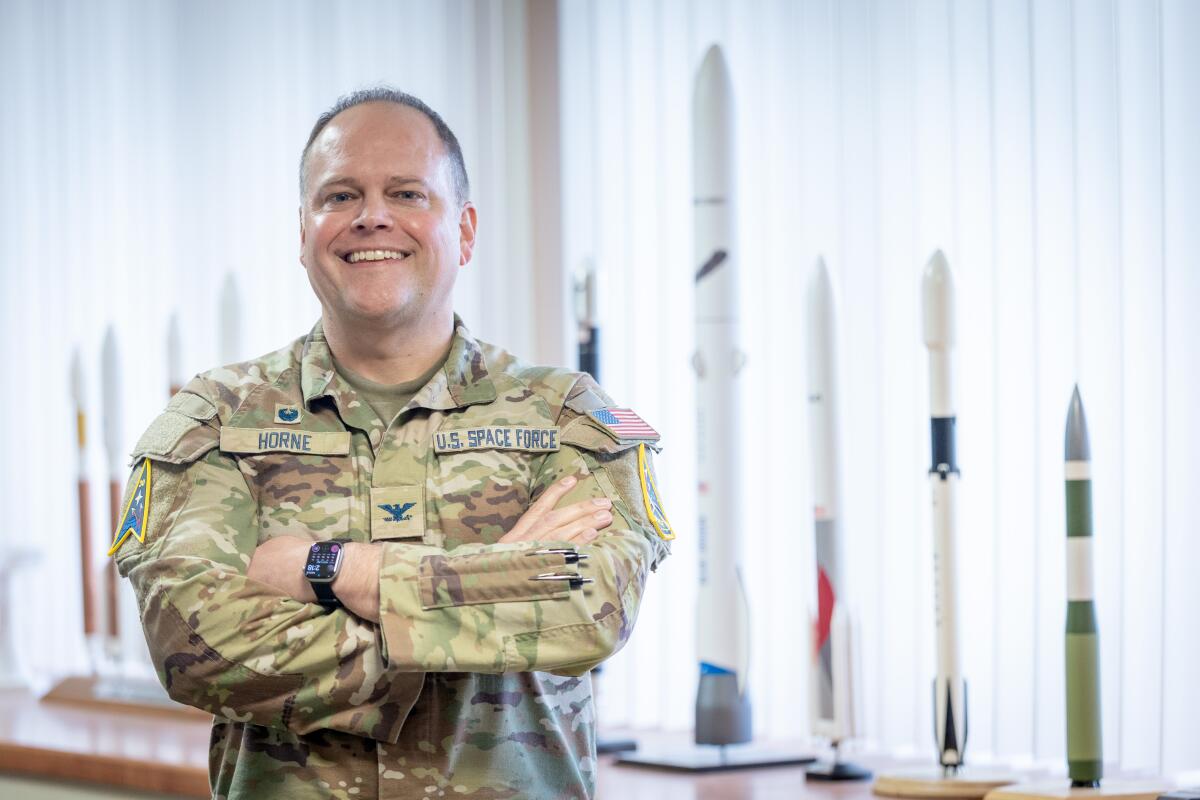
Col. James T. Horne III, commander of Vandenberg Space Force Base in his office.
(Eric Thayer/Los Angeles Times)
Studies are being conducted, but environmental groups such as the Gaviota Coast Conservancy asked the Space Force to slow down the pace of new launches to better understand their cumulative impact — including when SpaceX’s reusable boosters return back to the base under thrust.
The Space Force in October signed off on an environmental impact statement under the National Environmental Policy Act, which governs federal land, for up to 95 Falcon 9 and five Falcon Heavy launches annually. It requires the agency to take measures to lessen the impacts and conduct additional studies.
That has failed to mollify environmentalists.
“The approach of just moving forward and doing the evaluations later means that we could have irretrievable loss of wildlife in their habitats that isn’t easily replaceable elsewhere,” said Ana Citrin, legal and policy director for the conservancy, a nonprofit dedicated to protecting the region’s coastline.
The Space Force also is at loggerheads with the California Coastal Commission, which enforces the California Coastal Act governing land use along the coast. In 2024 the commission rejected a plan to have SpaceX launch up to 50 times annually, prompting a lawsuit by the company. Then in August it rejected another request by the company to increase its annual launches even more and fly the Falcon Heavy for the first time.
SpaceX launches national security and other payloads from the base, but the commission argues that the majority of the launches serve to advance Musk’s internet satellite business and therefore it has authority over the flights, as well as any monitoring and mitigation measures.
Space Force officials disagree and are moving ahead with their plans.
“Those Starlink launches that we’re launching from here directly contribute to warfighter capability,” Horne said.
Spaceport of the future
What is clear is the number of flights is bound to increase.
Horne said the military has been preparing for a higher cadence of flights with tours of major airports and seaports that handle large volumes of people and goods quickly.
“We’re essentially overhauling everything we do to think more like that sort of a mindset,” he said.
Among the plans are upgrades to the base’s rail service and harbor, alternatives to hauling up rockets to the base via nearby winding roads. The base also is setting aside a development zone for companies it hopes will locate there.
Economic development officials in Santa Barbara and San Luis Obispo counties seized on the prospect to attract more businesses to the region, foster innovation and develop the workforce for the new employment opportunities.
“What that means for us on the Central Coast is that it is probably a once-in-a generation opportunity to really grow,” said Melissa James, chief executive of REACH, a San Luis Obispo-based economic development nonprofit that just received a state grant to fund its efforts.
SpaceX is not the only launch services company operating from Vandenberg.
Firefly Aerospace, a Texas company, is launching a small rocket from the base. Phantom Space, an Arizona startup, has approval to launch there. The United Launch Alliance last sent up a rocket in 2022 but developed a new rocket called the Vulcan and is upgrading its pad for future flights.
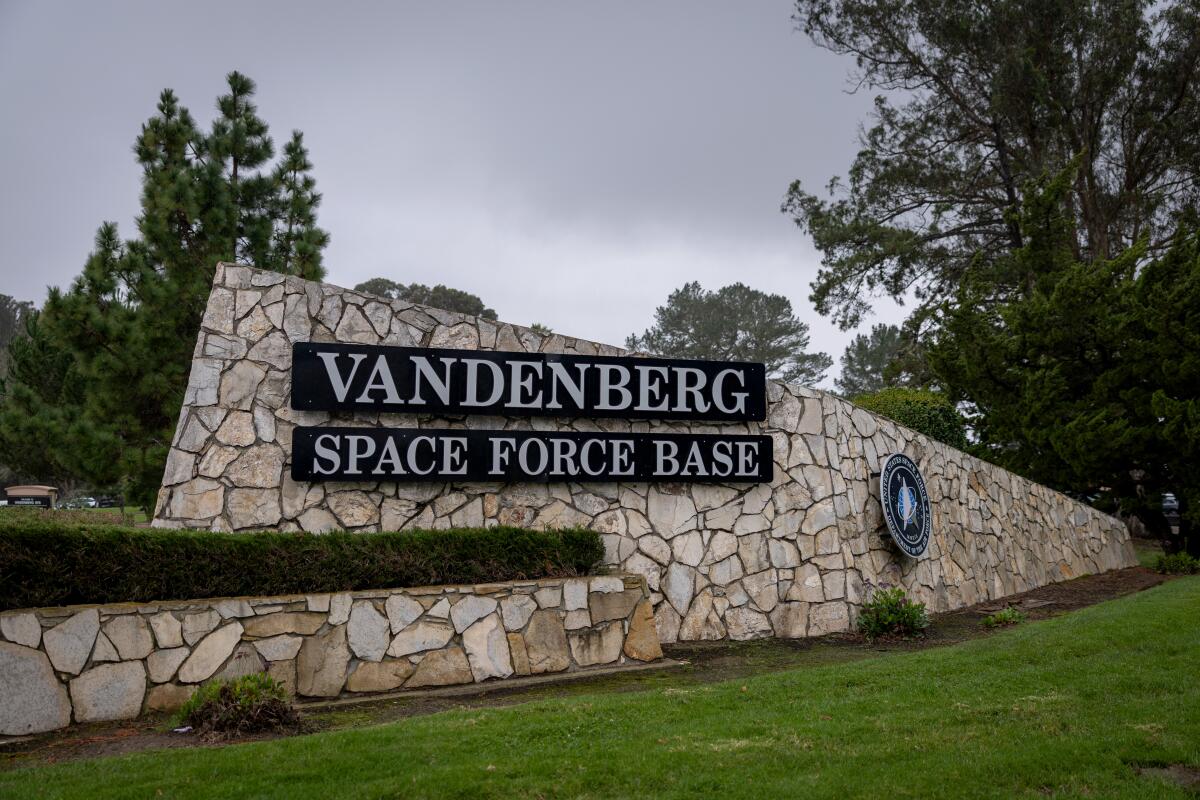
Vandenberg Space Force Base is planning on expanding dramatically.
(Eric Thayer/Los Angeles Times)
Other fledgling rocket companies that could make use of the base include Relativity Space in Long Beach and Jeff Bezos’ Blue Origin, a potential rival to SpaceX in Kent, Wash.
The big question is who might develop and operate a new super heavy launchpad on Vandenberg. Blue Origin is developing the New Glenn rocket, the largest variant of which has not yet launched.
Musk’s Starship is much further along. It has completed 11 test flights, the last few of which have gone well. But some prior flights did not, including a January 2025 rocket that broke apart 8 minutes after liftoff, raining debris onto Caribbean islands and disrupting air traffic.
The giant rocket, which stands 403 foot tall and has roughly 10 times the thrust of a Falcon 9, also would be expected to have a bigger sonic boom — something almost certain to rile up downrange residents even more.
“To use an analogy, a sonic boom is similar to a boat’s wake,” Gee said. “A larger boat usually creates a taller wake than a smaller boat.”