
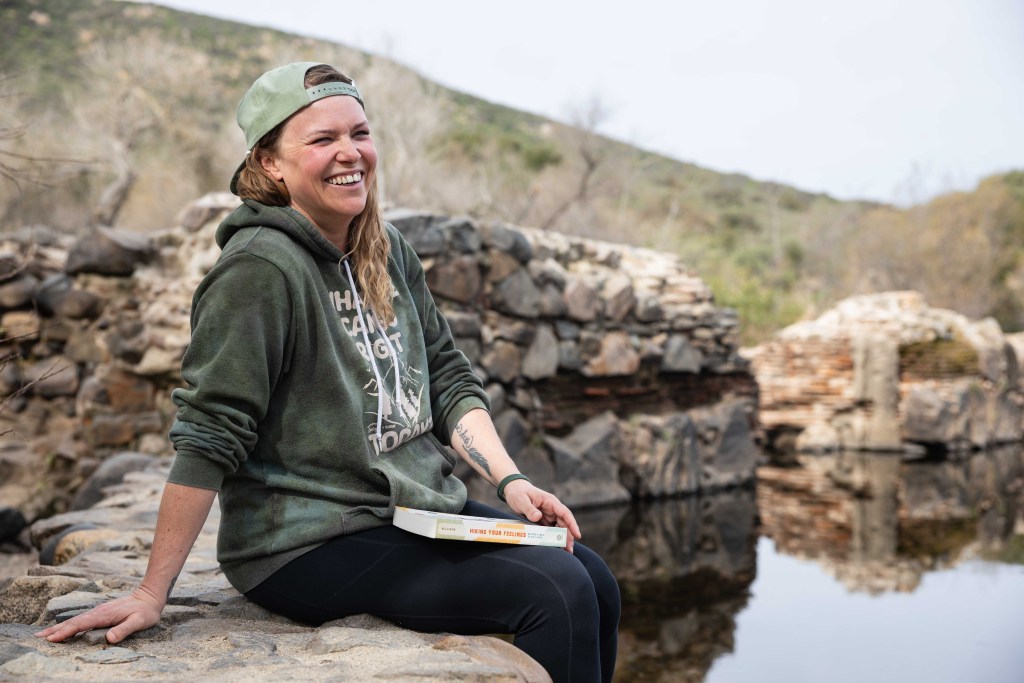
It was 2018 and Sydney Williams had just quit two jobs and recently been diagnosed with Type 2 diabetes when she decided to literally take a hike up Cushi-pi (Stonewall Peak). She wasn’t sure what to do next in her life, just that what she had been doing wasn’t working. When she got to the top of the peak, she expected the reward of a gorgeous view — it was May and totally cloudy.
“When it was cloudy and there wasn’t a view to take my attention, I turned inward because I found myself feeling really calm at the summit of that peak. I was curious as to why I was calm because I’d just quit two jobs in the span of five months, I was a newly diagnosed and now uninsured person living with diabetes — I’ve freaked out way more about way less, so why do I feel like I’m at the end of a yoga class right now?” she said with a laugh. “Before diabetes, I would eat my feelings, just jump into a pint of Ben and Jerry’s. I might drink my feelings and polish off a bottle of wine after work because I was stressed out. To be a good diabetes patient, I couldn’t do those things, so I was like, ‘I guess I’m hiking my feelings. What a cool shift in coping mechanisms.’”
That shift led to the eventual creation of Hiking My Feelings, a nonprofit providing a combination of online and in-person programming to support mental, physical, spiritual, and environmental health by connecting people with nature and each other. Part of her journey with her husband, Barry, included selling everything they owned and driving their 1998 Chevy high-top van, Ruby, across the country where she spoke at 60 REI store locations to talk about how hiking the Trans-Catalina Trail for her birthday in 2018 helped her heal her body and mind. She wrote and self-published her first book on the road, spoke at universities, put everything on credit cards, and hosted hikes in every town they stopped in during that first year. They had hosted more than 140 events across the country that first year before the pandemic forced them to figure out how to pivot online. They started what they called their “virtual campfires” with musical performances, guest interviews, and adapting their workshops and retreats via Zoom. In 2021, they organized their Take a Hike Diabetes campaign, logging more than 54,000 miles for diabetes awareness, prevention, and management. This year, they’re launching their Reciprocity Rx initiative, bringing in care providers of all kinds—health care, social workers, therapists, physicians, nurses—to introduce them to Hiking My Feelings programming and how to incorporate it into the health care system. Since founding the organization, they’ve hosted more than 500 events around the country, volunteering thousands of hours on public land, including their work with Sequoia National Park supporting a meadow restoration project to remove invasive species.
“It’s just been an absolute dream,” says Williams, 40, who lives in Julian with her husband, when they aren’t on the road. “Honestly, I have to pinch myself that I get to do this every day.”
Q: Tell us about how your birthday hike on Catalina Island in 2018 helped form Hiking My Feelings.
A: That trip on Catalina was actually my second attempt at the trail. I had tried it in 2016 and I could not finish it; I was just not in enough of a physical state to be able to complete the adventure, so I had some unfinished business. When I went back in 2018, I had lost 60 pounds, I was hiking regularly, I felt incredible and strong and confident in my body, so I was really curious about the emotional benefits that might be available to me because I already knew the trail. That trip really put what Hiking My Feelings is now, and what it’s grown to be, into context. In the absence of podcasts and audio books and TV and drinking and eating, and all the things, it was just me, what I actually needed to survive strapped to my back, and the sounds of nature and the landscapes that I was walking through on Catalina Island. It was on that trail where I was able to find the missing puzzle piece for my personal story; I was really curious about why I started eating and drinking my feelings to begin with. On that trip, I discovered that I hadn’t told anybody about the sexual assault I endured in college. I carried that by myself for 11 years. Once I told my husband, that kind of opened the door to healing and understanding. Because I didn’t tell anybody, that’s where those coping mechanisms came from. Over the course of the five days on that island, I had the opportunity to really walk with my pain that I hadn’t processed, and figure out what hiking was doing for me. When I got done with that trail, the first point of contact that I made wasn’t my friends or family, it was the Catalina Island Conservancy. I asked them how I could help. This trail has now changed my life twice, so how can I help protect it? How can I help promote it? How can I help ensure that people all over the world know that these kinds of healing opportunities are available here?
What I love about Julian…
What I love about living in Julian is just open views for days. I love just having room. I feel everything intensely, and I have lots of ideas and a wild imagination, so to be out here and have this much space gives my feelings room to breathe, and gives my ideas room to breathe, and that is what just absolutely fills me up. If I had to pick one place for the rest of my life, it would be literally anywhere here in San Diego.
Q: Your organization also has a commitment to social responsibility, to make your spaces inclusive and equitable, with no tolerance for harm, including racism, misogyny, fatphobia, homophobia, ableism, and other forms of bigotry and discrimination. Why was it important to you to make this part of your healing work?
A: Why isn’t the rest of the world like this? For me, it’s non-negotiable. Where this really came into focus, for me, was in researching the prevalence of diabetes in America. I was looking at the breakdown of the prevalence of diabetes by race, and then I was thinking about my own experience and if my unresolved, unprocessed trauma was what led to the behaviors that contributed to my diabetes diagnosis, then are we having these conversations about how trauma impacts disease? If we look at the breakout of diabetes by race, Native Americans are at the top, followed by Black and Hispanic, Asian, and then White and other. If you think about colonization, slavery, when you start connecting the dots, it’s undeniable what we’re seeing. So, if you don’t have access to these spaces, then you won’t ever have the opportunity to heal in this way. The biggest part of what we do is showing people that these spaces even exist, and then making sure that when the people get here, that they feel safe, seen, and supported.
It’s really important because when we’re talking about land and ecosystems and ecological knowledge, what we’ve gained from our partners and from different indigenous communities is invaluable. To me, it’s been the biggest journey of discovery, and has really kind of radicalized me. So much of what I’ve learned through the different people that we’ve been able to partner with, and the different organizations that we’ve worked with, point out just how much we didn’t know, and just goes to show how deeply disconnected we are from the living world. If we think about our disconnection from the planet, it really is the root cause of so much of what we suffer with. I’m not saying that what we do is a replacement for Western medicine; it absolutely is not. Hugging a tree cannot remove a tumor from your body, I’m not saying that; but it is a very important and, I would argue, a deep responsibility of our care providers to start thinking about patient health as it pertains to planetary health because that was my journey. I went from diabetes patient to somebody who volunteers thousands of hours of her time every year for these places and connecting as many people as I can to these places.
Q: What do you think younger Sydney would think about Hiking My Feelings and where you are today?
A: Nobody’s ever asked me that. That is such a kind question for little Sydney. I think she’d be so proud. I know she would be because this is exactly what I needed, and this is the entire reason I have put everything on the line for this organization. I didn’t have somebody to look up to who was speaking out about what they had been through in this way. I didn’t have a connection to the outdoors in this way. Little Sydney would be so psyched. One of the biggest things for what we’re doing right now, just coming out of a really great year and into one that feels like fairly uncertain times, is making sure that this is accessible to little girls like Sydney because little girls like Sydney didn’t have access to this. Financially, my parents wouldn’t have been able to send me to a program like this. Talk therapy isn’t for everybody, nor is that always accessible, right? What we’re really focusing on really trying to meet the moment where we are not going to discontinue offering the our in-person, immersive, all-inclusive events, but really finding what are these lower cost, barriers to entry type of things. If you can’t come on a program with us, you could download one of our guided journals and then take yourself out to one of those landscapes and have that experience for yourself, or with your family or your friends. If you guys are on a healing journey, let’s continuously tinker and figure out how can we make this accessible to the people that need it most and who don’t have access to alternative methods of healing because that’s the sweet spot. Can we educate, introduce, and support people through what it looks like to reconnect with nature?
Q: Where are some of your favorite places to hike, both in San Diego and elsewhere? Why are they your favorites?
A: I’ve got to give it up for Mission Trails Regional Park. They are doing the most to make it as accessible as possible to as many people as possible. They host free hikes every week, guided with their with their staff, to learn about the place. They have a special place in my heart because that’s where I was training for the Trans Catalina Trail in 2018. There’s a whole chapter in my book about the hikes I did in Mission Trails Regional Park, also Cushi-pi out here in Stonewall Peak. El Capitan, that big guy on the side of the I-8, just looming in the distance as you’re driving east because at the right time of day, the sunshine on the face of that is just magical. Also, Sunset Cliffs. That places has handled some of my most transformational breakdown, breakthrough kind of moments. Some of the most important conversations I’ve had have been sitting on those cliffs, watching the sunset.
Outside of here, I’m a sucker for a big old mountain range and the Sierra is my second home. I love those mountains so, so much. I’m also a real big sucker for Glacier (National Park); those mountains are different. We’ve got we’ve got some friends from the Blackfeet Nation up there, and we had the opportunity to do a programming exchange with them last summer on their Indigenous storytelling hikes on their ancestral territory. There is nothing like hiking with somebody whose people have been in that area for 17,000 years; the level of knowledge, the reverence for the landscape, the story is just next Level connection. Honestly, I haven’t met a landscape I don’t love.
Q: What is the best advice you’ve ever received?
A: Probably my parents telling me I could be anything I wanted to be, and believing it. That’s led to a lot of heartbreak because I’m not a pop star, not an award-winning actress (laughs). Also, an earworm that I got recently was “We can agonize or we can organize,” and I love that. I spend a lot of time in both. I think of my life, my work, my purpose, my drive as a Venn diagram, and our work, my life, my purpose, is squarely in the middle of agonizing and organizing.
Q: What is one thing people would be surprised to find out about you?
A: I was a competitive skydiver for four years, and I’m terrified of heights.
Q: Please describe your ideal San Diego weekend.
A: We’re waking up and we’re going to go hike anywhere. Let’s say it’s Stonewall Peak, we’re going to get up early because I want to watch the sunrise at the top of Cushi-pi. Then, we’re going to scoot on over to Fathom Bistro, Bait, and Tackle and have the Loco Moco for breakfast. If you haven’t been there and you call yourself a San Diegan, you’re not. That place is legit. Then maybe go paddle boarding in Mission Bay, and paddle around over and catch whatever show is playing at Humphreys from the water.