
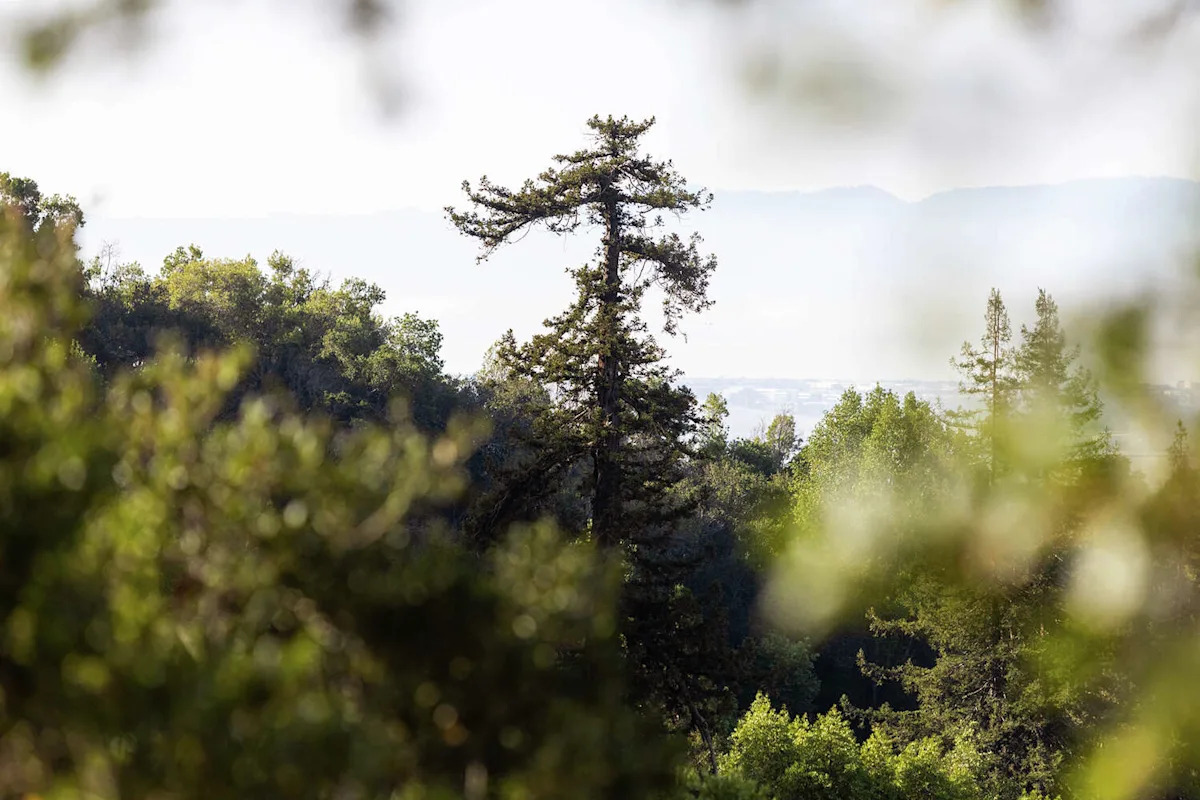
If you didn’t know any better, you might look out over the forested valley at the edge of the Oakland hills and fail to notice Old Survivor among its fellow redwoods. It’s a bit taller than the others, though, and certainly scragglier. The branches at its crown are cartoonishly crooked; up close, its trunk is covered in burls. This is partially what saved its life.
Old Survivor is the name given to the last remaining old-growth redwood tree in Oakland, a nearly 500-year-old wonder that overlooks the East Bay from the top of Leona Heights Park. Old growth redwoods are mature trees that are typically centuries old – the oldest known coast redwood has been around for over 2,000 years.
In the 19th century, when Oakland was still known for gargantuan redwoods that were being razed to build a burgeoning San Francisco, Old Survivor was somehow left untouched.
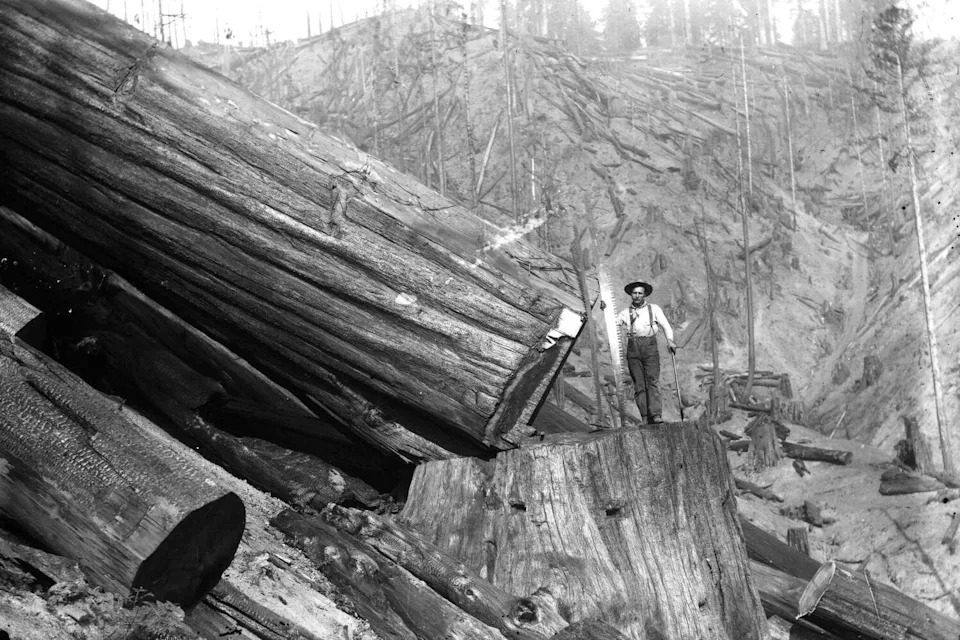
Oakland’s ancient redwood trees were quickly decimated in order to build San Francisco and its surrounding cities. (Fair Use via Swanlund-Baker Collection/Humboldt State University Library)
According to Deborah Zierten, senior manager of education at Save the Redwoods League, the tree’s location probably played a role in its survival. Old Survivor grows out of a boulder on the edge of a steep slope, and harvesting its massive trunk and schlepping it down the hills would have presented a challenge to loggers, who used teams of oxen to drag felled trees to flatter land. Old Survivor’s longevity, Zierten said, can also be credited to its less-than-perfect appearance.
“It’s a little bit gnarly and bumpy,” Zierten said. “Aesthetically, it probably wasn’t that useful for the type of lumber they wanted to use.”
Compared to the trees that once surrounded it, the 93-foot-tall Old Survivor is runtish. Oakland’s redwoods once stretched over 300 feet tall and 30 feet wide – some were so tall that sailors used them as “navigation trees” when guiding ships across the bay. British naval officer Frederick Beechey wrote in an 1826 log that these trees were “too conspicuous to be overlooked,” and therefore could be used to avoid treacherous rocks submerged underwater, according to East Bay Regional Park District spokesperson Jen Vanya.
“The distance from the sailors’ ships to these trees was 16 miles, which attests to their size,” Vanya said.
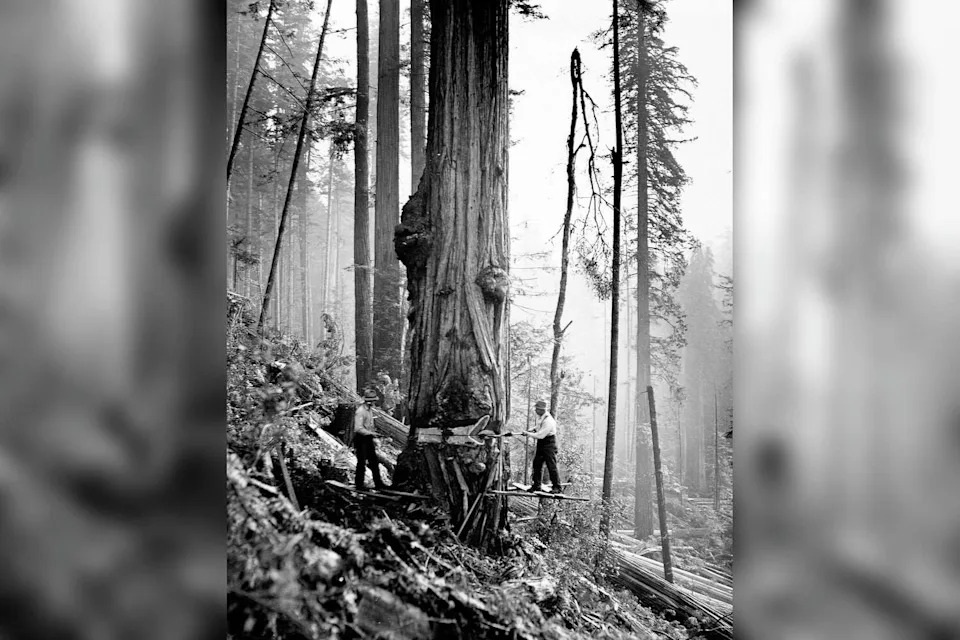
Loggers drive wedges into a large redwood tree in Humboldt County, Calif. | (Getty Images)
The navigation trees were logged by 1855, when San Francisco was exploding into a booming Gold Rush city. By then, logging camps had cropped up throughout the East Bay hills, and Oakland’s ancient trees were quickly decimated in order to build San Francisco and its surrounding cities. The trees were logged even further after 1906, when they were used during post-earthquake rebuilding efforts. The second-growth forest that covers the Oakland Hills today is the result of extensive conservation efforts that took place in the early 20th century and now protect the area from any further logging.
According to Zierten, Old Survivor was rediscovered in 1969 by Oakland park naturalist Paul Covel. At the time, a count of its core rings determined that it was between 415 and 420 years old.
No longer at risk of logging, Old Survivor and its fellow redwoods now face a newer threat: climate change. Due to modern fire suppression tactics, there’s been an increase in the frequency and intensity of wildfires in and around redwood forests, Zierten said. While the redwoods themselves are fire-resistant, many of the trees around them are not, and their destruction hampers the biodiversity that helps redwood trees thrive. Local agencies are implementing new forest management plans in order to help counteract this, Zierten added.
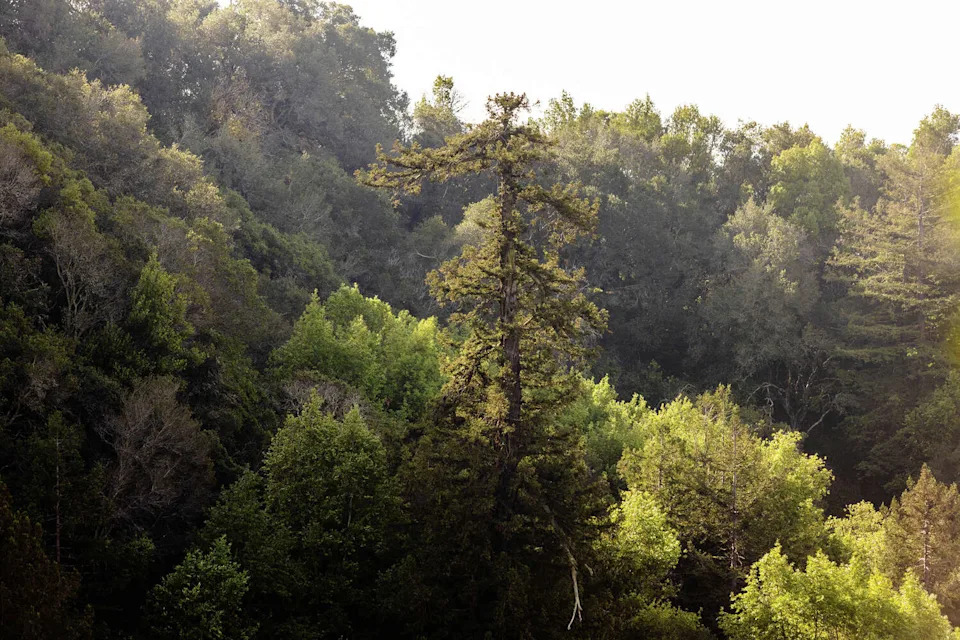
Old Survivor is the last remaining old-growth redwood tree in Oakland, as seen from the top of Leona Heights Park. (Douglas Zimmerman/SFGATE)
The tree now sits on property that belongs to the city of Oakland. According to Vanya, there are no direct trails to its trunk, and its exact location isn’t disclosed in order to prevent the destruction of its surrounding habitat. But visitors can get a clear view of the top of the tree from the sidewalk on Campus Drive, across the street from Carl B. Munck Elementary School.
“The tree is such a symbol and a remembrance of the amazing trees that were part of the East Bay hills, and how incredible they once were,” Zierten said.
BEST OF SFGATE
Central Coast | ‘Doomsday fish’: Once-in-a-lifetime sea creature encountered in Monterey Bay
Technology| A Calif. teen trusted ChatGPT for drug advice. He died from an overdose.
Central Coast| He gifted Calif. one of its largest city parks. Then he shot his wife.
Culture | Tragedy cut Sublime’s fame short. Now the singer’s son has the mic.
Get SFGATE’s top stories sent to your inbox by signing up for The Daily newsletter here.
This article originally published at Oakland’s last old-growth redwood is a gnarled, twisted icon.