
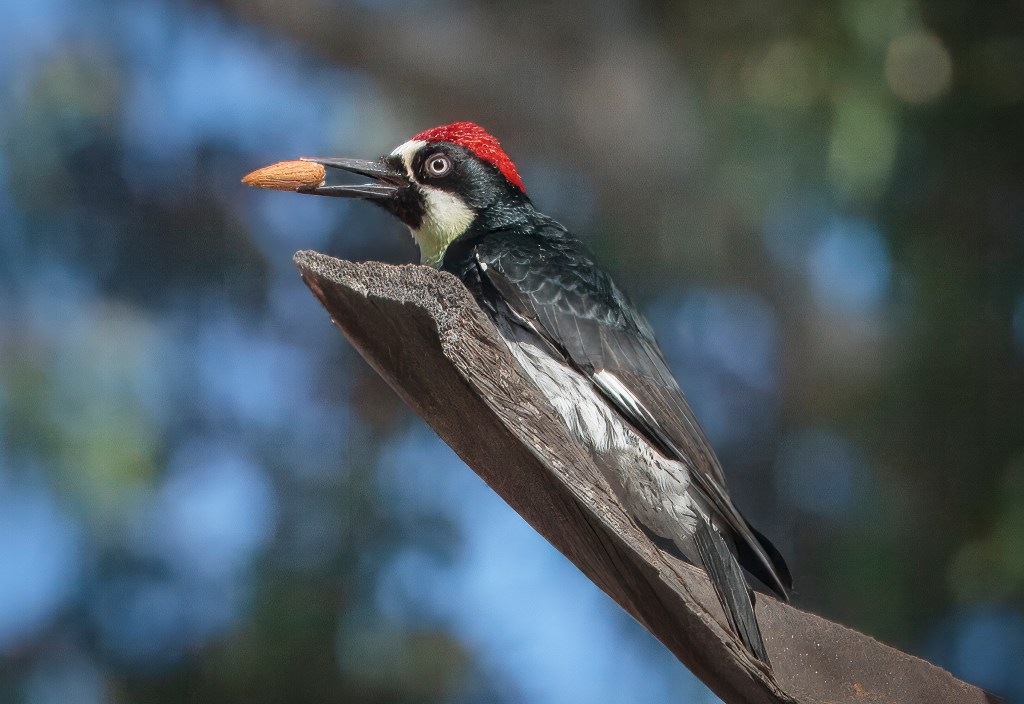
For just a moment I had no idea what was happening.
It was warm for a winter day, and I was enjoying the peace and quiet as I meandered through withered summer grass at the edge of the dense woods of pine, cedar and oaks.
Winters are a quieter time in the woods, as many birds migrate to more comfortable and abundant places until spring.
Suddenly, the peacefulness turned into total chaos as noise and motion erupted around me.
I froze in place.
It’s an old habit from frequent encounters with rattlesnakes who are kind enough to sound off if you get too close. They don’t like being bothered and have no interest in confrontation, so stopping for a moment allows you to determine where the buzztail is and safely move away.
But this wasn’t a rattlesnake, it was a cacophony of shrieks, screams, scolds, whistles and the flapping of wings as a clan of acorn woodpeckers exploded into flight.
Looking around, I realized I had stumbled onto a cedar tree where these very social and industrious birds store acorns as a winter food supply.
Most likely I had disturbed their communal food gathering efforts and that had surprised them as much as they did me.
But the acorn woodpecker is a resident bird that prefers to remain here and has developed a unique process of gathering and storing acorns to sustain the clan until the next crop is produced.
If you have spent much time in our local woodlands, you have likely encountered acorn woodpeckers.
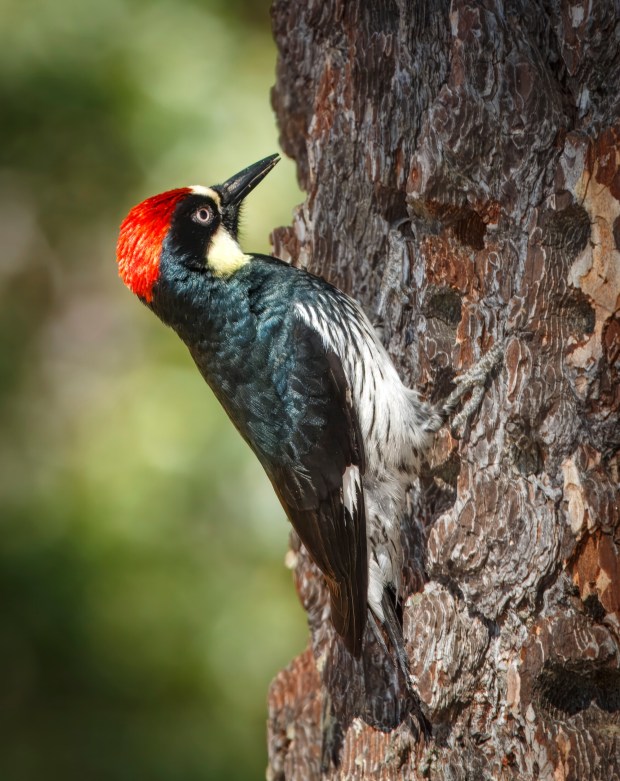 A male acorn woodpecker. (Ernie Cowan / For The San Diego Union-Tribune)
Often referred to as clown birds, they are easy to identify because of the bold black feathers, white chest and wing patches, white rings around their eyes and a bright red cap. The white eye rings always make them look surprised.
Males have a larger red cap that connects to a white forehead patch, while females have a smaller cap with a black patch visible above the white forehead.
A quick glance at an ebird.org species map shows this bird is found here from coastal areas to the county’s highest elevations, with the greatest concentrations in inland oak woodlands and mountain forests.
Their range extends along a narrow band from Oregon to Mexico and from eastern Arizona into New Mexico and south through the mountains of Mexico into South America.
The acorn woodpecker is fun to watch, and when you see one, you know there will be more nearby.
Sit quietly at a campsite in Palomar Mountain, Mount Laguna or Cuyamaca where these birds are used to people, and they will soon ignore your presence and go about their business which is all about working together.
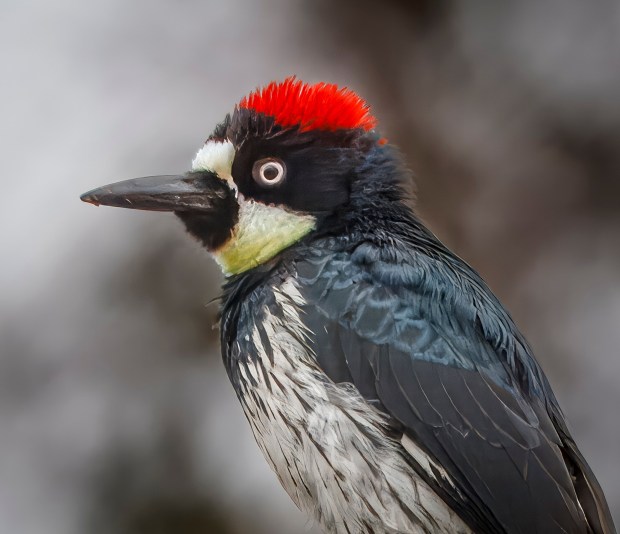 A female acorn woodpecker. (Ernie Cowan / For The San Diego Union-Tribune)
While their coloration makes them easy to spot, they are also quite vocal when going about their business.
Their most distinctive call is a repeated “waka-waka” that serves as a greeting or an alert of an intruder.
This woodpecker has a wide vocabulary of other sounds, including screams if being captured by predators, an elevated alarm call often given when predator hawks are near or rapidly drumming on dead hollow limbs during territorial disputes or to attract mates.
Because they don’t migrate, food gathering for winter survival is a cooperative focus of their daily activity in late summer and early fall when oak trees produce acorns.
And, while acorns are a primary food source for these birds, they will also feed on insects, lizards, small birds and bats.
The acorn woodpecker’s social structure, known as clans, consists of a dozen or more birds that will include breeding pairs and nonbreeding helpers, but during peak acorn season they will all focus on food gathering and storage within their established territory.
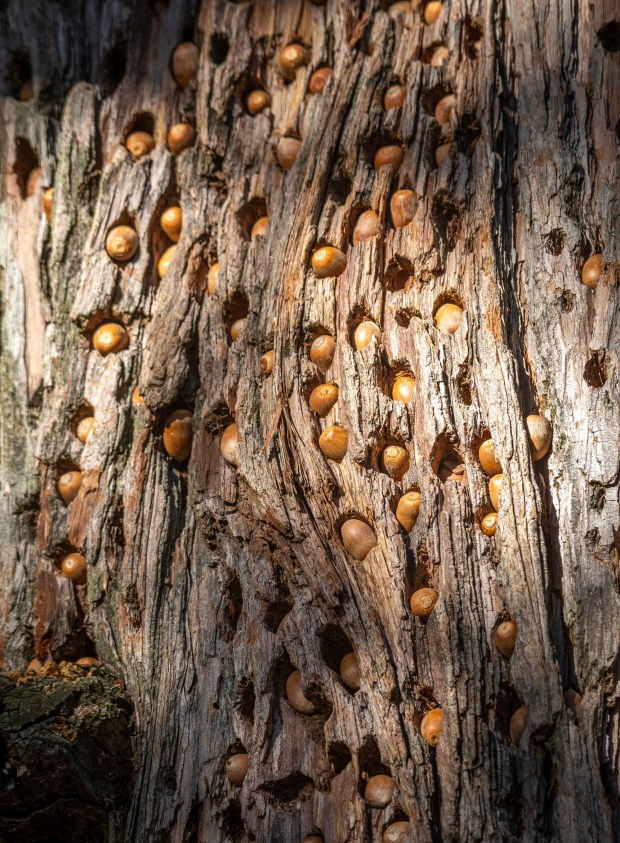 A granary tree where acorn woodpeckers have stored acorns. (Ernie Cowan / For The San Diego Union-Tribune)
That process involves collecting acorns and then pecking small holes in trees where they are stored for winter use.
Known as a granary tree, the same tree is often used year after year and may contain upward of 50,000 acorns. Some trees have been used for acorn storage for more than a century by generations of woodpeckers.
I am aware of several granary trees in Palomar Mountain that have been used for more than 50 years.
The tight social group of woodpeckers defend these trees from predators, and they may mob ground squirrels or crows attempting to raid their food supply.
Nesting is also a communal activity of the acorn woodpecker, beginning in April when nest holes are drilled into large trees, generally near a granary tree.
The wood chips created during excavation are used as nesting material in the bottom of the cavity.
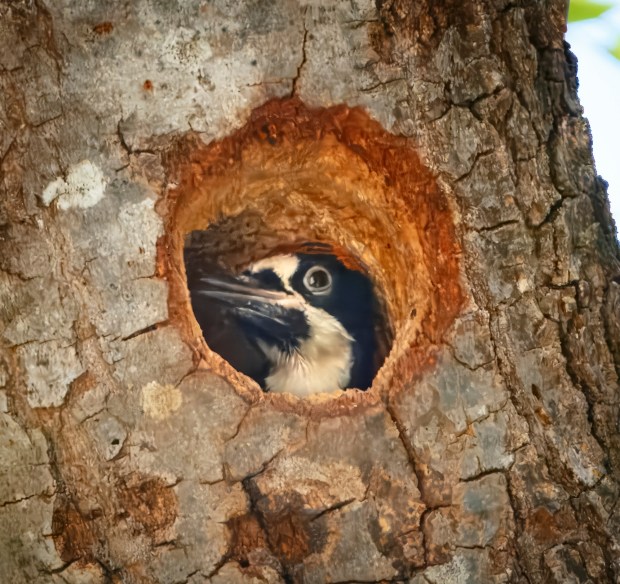 An acorn woodpecker chick peeking out of a nest hole. (Ernie Cowan / For The San Diego Union-Tribune)
When out in the spring or early summer woods, look for these roughly 2-inch nest holes and if you sit quietly for a while, you may enjoy views of parent birds bringing food or youngsters peeking at the outside world.
Once eggs hatch, all members of the clan are involved in feeding chicks with acorns, insects and sap.
The social groups, unique coloration and noisy habits make the acorn woodpecker one of our more interesting and easier to find forest neighbors.
Summer or winter, they bring a joyful energy to our woodlands.
Cowan is a freelance columnist. Email ernie@packtrain.com or visit erniecowan.substack.com.