
Tim Greimel’s term as Pontiac’s mayor is over. He dropped his re-election bid a year ago, opting instead to run for the 10th congressional district vacated by Republican John James, who is running for governor.
Pontiac’s new mayor, Mike McGuinness, was sworn in on Jan. 1.
Greimel’s record and legacy includes some victories, some defeats, and many things left undone.
As a mayoral candidate, he promised to reduce blight, improve health services for Black residents, create more affordable housing and improve existing housing stock using ordinances and code enforcement.
He promised to fix a broken process for approving recreational marijuana permits, to build a youth recreation center and revive Pontiac’s struggling downtown.
His four years as Pontiac’s mayor started with great enthusiasm and clear obstacles. The legacy of his predecessor overshadowed early efforts. His alignment with the city council crumbled over disrupted project timelines and an exodus of department heads.
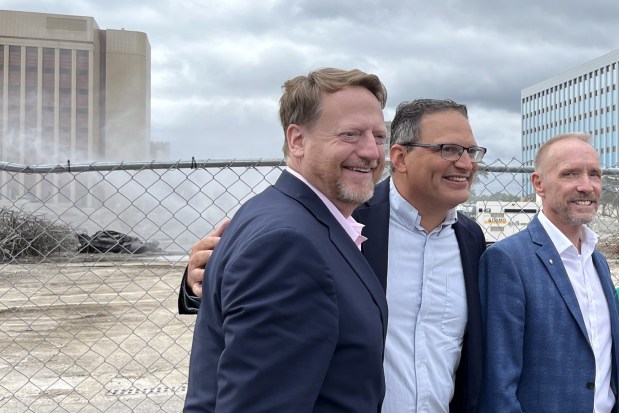 Pontiac Mayor Tim Greimel posed for a photo a the Phoenix Center demolition site with Oakland County Commission Chair Dave Woodward and County Executive Dave Coulter on Aug. 21, 2025. (Peg McNichol/MediaNews Group)
Greimel had several early successes despite continued community distrust remains over the city’s earlier financial mismanagement.
Wins
Independent annual audits of the city’s finances have shown a growing general fund balance for each of Greimel’s four years in office.
The city’s credit ranks rose from its 2011 CCC junk-bond rating by S&P Global Ranking to a record-high AA- in 2025, a sign the city is financially stable and a relatively good credit risk. For context, Pontiac did not qualify for an S&P ranking after 2011. Oakland County holds a AAA, the highest rank.
“That’s really important, considering the very chaotic state when we entered office,” Greimel said.
Community leaders in Pontiac react to Tim Greimel’s decision to not run for reelection
In 2024, Greimel made good on a promise to resume city management of annual federal community block development grant funds after years of county management, an estimated $1 million. The move meant more money for the community, because the city no longer pays the county a 20% administration fee. The city’s 2025 CDBG spending plan included $600,000 for new park restrooms; $433,685 for affordable housing and administration; $200,000 for home rehabilitation; $237,345 for program administration; $176,974 for demolishing dilapidated homes and $172,407 for public service activities.
Greimel promised to create an African-American Health Commission to partner with other groups to promote education and treatment for health risks that disproportionately affect people of color, such as COVID-19, heart disease and infant mortality.
The commission never materialized, but the city made individual health-education efforts. One is the recent partnership with the county, Oakland Livingston Human Service Agency (OLHSA) and the non-profit Rx Kids, a joint program of Michigan State University’s Pediatric Public Health Initiative and University of Michigan’s Poverty Solutions.
The city allocated $500,000 in opioid settlement money to establish its local Rx Kids. This program is open to expectant Pontiac mothers and infants born on or after May 1, 2025. Eligible expectant mothers receive up to $1,500 during pregnancy and babies receive $500 a month for their first six months to offset the loss of income and increased cost of living for the family.
A home-repair program established in June 2023 offered up to $25,000 per qualifying household. The program was flooded with applications. So far, the city has funded 100 home repairs paid for with $3 million from the ARPA money.
The city launched a downpayment assistance program to help renters become homeowners with grants of up to $20,000, because fewer than 45% of the city’s homes are owner-occupied.
Rebuilding
Staff cuts by emergency managers gutted the city staff and reduced its responsiveness and effectiveness.
“Broadly, the city was still ravaged from emergency management and were very bare-bones operations,” he said, noting that ordinance enforcement, parks and recreation, and public works were particularly hard hit.
Greimel expanded the city’s payroll from barely 30 – about one person for every 2,100 residents – to more than 100. One of the most-noticeable changes transformed a skeleton code enforcement team to a 15-member office with a manager.
The city’s backlog of blight-court cases was shifted to the district court, where they could be handled on a rolling basis instead of the twice-a-month schedule the city had previously maintained.
He restarted the parks and recreation department and hired a director, Alex Zegarzewski in January 2023, who left in September 2024. Tarrance Price succeeded him in January 2024 and was replaced earlier this month by a McGuinness appointee, Robert Burch, Ferndale’s parks and recreation director.
For 15 years, the DPW rented a building and made do with aging vehicles, many of which were replaced over the last four years. In 2025, the city paid $12 million for the 410,000-square-foot former Central High School at 300 W. Huron St. The building has garage and warehouse space. After renovations, other city departments may move there.
“City government is a functioning entity,” Greimel said.
CHALLENGES
Clouds of suspicion
While tackling an ambitious to-do list, Greimel addressed a cloud of suspicion over former Mayor Deirdre Waterman’s administration.
An external forensic financial audit showed Waterman allegedly misused an estimated $1.6 million dollars, including by making handwritten changes to contracts, paying for two state-of-the-city events in one year and using a city charge card for a personal trip to New York City. She has denied any wrongdoing.
The city turned the audit and other documentation over to local, state and federal law enforcement but it’s unclear if anything has been done with the information. The sheriff’s office cannot investigate these types of municipal cases and the Michigan State Police said they weren’t investigating Waterman’s administration. The FBI has not acknowledged The Oakland Press’ request for comment on the matter, but reports from The Detroit News indicate the federal agency may be investigating.
“We don’t have any control over what law enforcement does,” Greimel said, when asked if his administration had done enough to assure residents that he was taking the matter seriously.
Leadership
Greimel fired the city’s finance director, Darin Carrington, who had allowed disbursements for some of Waterman’s spending, even though the city council had not approved them. Greimel and the council agreed to institute financial controls to prevent future misspending.
But the turnover didn’t stop there.
Over the last two years of his term, every department head had resigned. Greimel said a number of directors left because the city couldn’t pay competitively in a demanding market. The turnover was costly. The city paid GovHRUSA.com $48,000 to find new directors.
“We lost a couple we would have preferred to keep,” he said, adding that new pay rates helped with recruitment.
He said he adopted an approach of “coach ‘em up or coach ‘em out” because the city needed to have high-quality employees. Among the departures:
• Alexandra Borngesser built the city’s grants and philanthropy department but left in Feb. 2024 to become director of economic development and fundraising at Wayne State University and TechTown. In 2023, she applied for $100 million in grants for the city, with a goal of obtaining 25% of that. Pontiac was approved for more than double Borngesser’s goal: nearly $52 million. She unsuccessfully sought a pay increase, which Greimel denied. He cast his first-ever veto of a council resolution that would have given her a $7,000 raise. Borngesser later said she took the WSU job for the opportunities there. She was succeeded by Lisa Campbell in June 2025. Campbell remains in her role.
CDBG 101: Pontiac plans to resume managing federal funds
• DPW Director Al Cooley Jr. left the city in October 2023 for a public services director position with Grand Blanc Township. In Pontiac, he was responsible for maintenance of street lights, roads, buildings, parking lots, sidewalks, and forestry management, signage, waste collection and special assessment petitions. Mark Ragsdale replaced him in June 2024 and left in February 2025. Larry Sirls, appointed to the role in March 2025, remains.
• City engineer Abdul Siddiqui left in May 2022 for a job with Michigan’s transportation department and later accepted a job with the City of Southfield. The city hired Waterford-based DLZ Corp. and continues using the firm.
• Human resources director Angela Benitez, hired in May 2023, was fired in September 2023. Melinda Durakovic was hired in November 2023 via GOVHRUSA.com. Benitez successfully sued the city and in 2024 was awarded a $33,583.33 settlement.
• Rachel Loughrin, hired in September 2022 as community development director, managed building safety, planning and zoning, economic development and code enforcement offices. She left in October 2025. In February 2025 she fired building official Bruce Eck after the two engaged in a screaming match at city hall over building inspection files. His wrongful discharge lawsuit against the city remains underway.
• Planning manager Mark Yandrick, hired in November 2022, left for a similar job in Ypsilanti Township in June 2025. The city hired Amy Bavin in September 2025.
• Deputy Mayor Khalfani Stephens applied for city manager jobs in Berkley, Royal Oak and Troy but ultimately remained in Pontiac, where he is now a senior project leader in the strategic partnerships department. He will implement grant-funded initiatives in a timely manner, according to McGuinness.
• Finance director Timothy Sadowski, appointed in March 2023, left in February 2024. He managed the city’s fiscal health including audits and oversaw tax and utility bills, cash receipts, accounts payable and payroll. Dee Ann Irby, former long-time finance director for Troy, agreed to take the job in October 2024 but tendered her resignation less than three weeks later. The city then hired Ernst & Young in 2024 to oversee spending the city’s $37.7 million in American Rescue Plan Act money and other matters. It was a rocky transition.
Red tape fouls finances for Pontiac contractors
Marijuana
The city faced a series of lawsuits from marijuana entrepreneurs who challenged the city’s ranking process for applicants. Only now are recreational cannabis dispensaries preparing to open, years after Pontiac residents voted to approve recreational sales. Some industry experts and critics say it’s too little, too late as the cannabis retailers struggle with market saturation and declining prices and revenue.
By the end of his term, Greimel said, all the recreational licenses had been issued and most of the lawsuits had been resolved.
Rubicon sued the city in 2023 and lost in the U.S. Eastern District Court in Michigan in July but has an ongoing appeal at the U.S. Sixth Circuit Court of Appeals. The court’s next filing date is Feb. 27.
One grow operation, Botanical Greens at 1651 E. Highwood Boulevard, has been producing medical marijuana since 2024. In December the planning commission approved the company’s request to grow recreational marijuana. Greimel said he expects retail operations to open this year.
Crime
In general, violent crime in Pontiac followed the national downward trend. The city had 16 homicides in 2021 and four in 2025.
After a March 2022 drive-by shooting that killed 7-year-old Ariah Jackson, Greimel appointed a 20-member task force and urged the council to approve a Flock surveillance camera contract and approve a contract with the violence-intervention program Ceasefire. At the same time, the sheriff’s office initiated a mental-health co-responder program to de-escalate calls involving people with mental illnesses.
The Rev. Martin Luther King Jr. Boulevard bridge
Some issues were well out of Greimel’s control, despite his promises. A July 2022 MDOT inspection found significant decay on the Martin Luther King Jr. Boulevard bridge, which daily carried an estimated 11,000 vehicles over a railroad crossing, Greimel ordered the bridge and road closed until repairs could be evaluated. Initially, he promised the bridge would be replaced by the end of 2024, a timeline he had to extend more than once.
Pontiac: MLK Jr. Boulevard bridge needs $9m fix
“(It) takes a long time to get projects through planning, financing, designing and engineering. What I’ve learned is that things take time. They never happen as quickly as people like,” he said.
The bridge replacement will cost nearly $15 million, which will be paid using a $10 million state grant and a nearly $4 million federal grant. Greimel credits State Sen. Jeremy Moss and State Rep. Brenda Carter for securing the $10 million grant and U.S. Rep. Haley Stevens for the $4 million federal grant.
Demolition on the bridge started in late 2025 and should be done early this year.
MLK Jr. Bridge replacement in Pontiac delayed
Phoenix Center
Another important demolition: The Phoenix Center. The four-story parking garage topped by an outdoor concert venue hadn’t been used since August 2011. The decaying venue had become a haven for vagrants.
In April 2022, Greimel said city officials wanted to be strategic in considering the Phoenix Center’s future. He talked about plans for signature downtown events that would create a “vibrant place where everyone feels welcome.”
Pontiac’s Phoenix Center legal battles end once more with $19.2M deal closed
The city was still smarting after an eight-year legal fight with developers over the Phoenix Center’s fate and the adjoining office buildings at 51111 Woodward Ave. and Ottawa Towers II, a vacant office building at 31 E. Judson St. known collectively as the Ottawa Towers. The lawsuit ended with a $19.2 million deal in which the city bought the two buildings and immediately sold them for $7.4 million to an investment group. At the end of the legal wrangling, the city was left with more than $5 million in debt over the decaying Phoenix Center.
Greimel is largely credited with involving Oakland County officials in the site’s future. In 2023, county officials agreed to pay $50 million, which included $10 million in American Rescue Plan Act dollars, for the Ottawa Towers, four vacant lots and to assume the Phoenix Center parking garage lease.
In all, the county took on nearly 12 downtown acres with plans to move an estimated 700 county employees to the city. The county is investing an estimated $175 million for renovations.
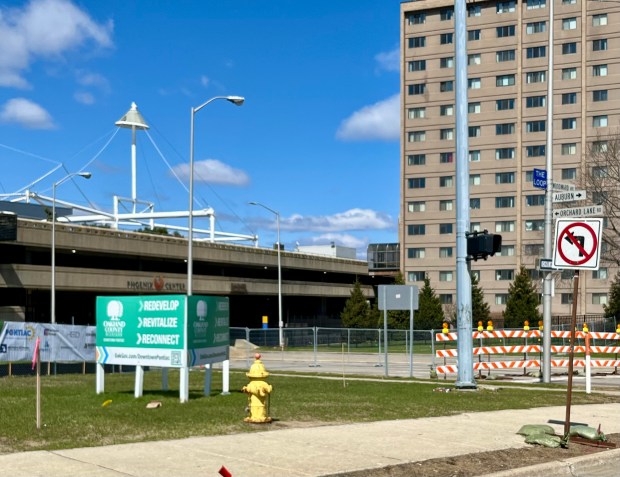 Westbound Orchard Lake Road closed between the north- and southbound lanes of Woodward Avenue in advance of the Phoenix Center demolition in Pontiac. (Peg McNichol/MediaNews Group)
The Phoenix Center, too ruined to be repaired, was demolished, opening up North Saginaw Street and possibilities for further downtown revival.
Some of the space where the Phoenix Center stood will be transformed into a city park – the size of which involved some wrangling between city and county officials. New parking garages are planned as city and county officials work to attract residential, retail and hotel developers to use some of the other space.
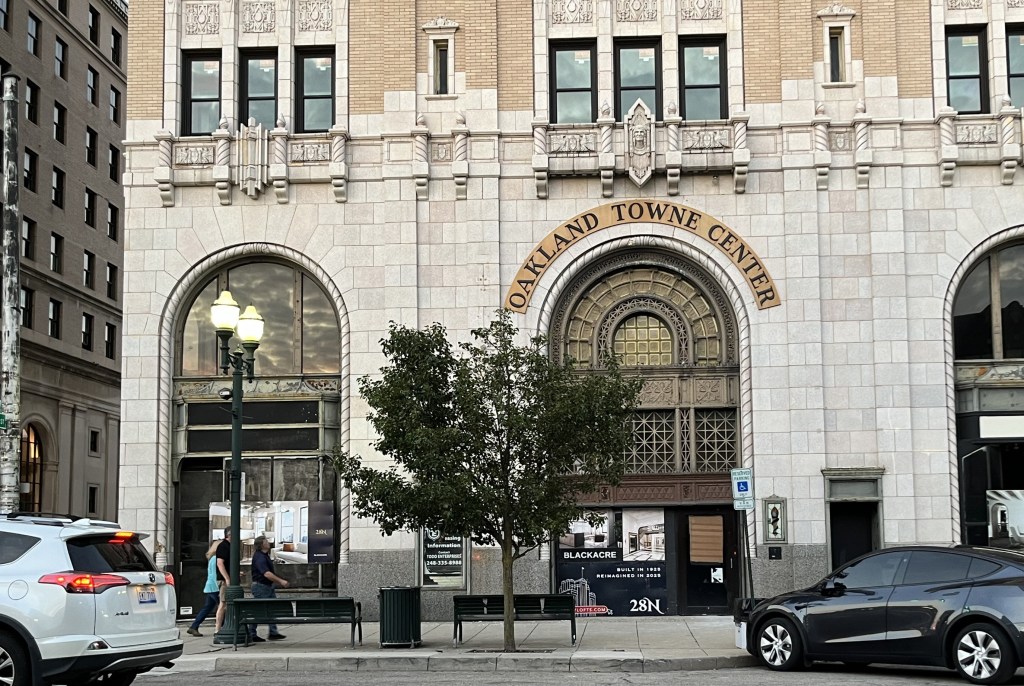
Saginaw Street is anchored to the north by the former Pontiac State Bank, a 15-story Art Deco building being renovated to hold more than 100 loft apartments and four floors of retail and office space, now called the Oakland Towne Center.
Parks
Other city-county partnerships included revamping city parks. The Water Resources Commission’s infrastructure renovation at the 63-acre Galloway Lake Park included upgrading the parking lot and replacing a deteriorating deck overlooking the lake.
The county’s parks and recreation department partnered with the city to renovate and upgrade the 77-acre Hawthorne Park, which was renamed Pontiac Oaks Park, and expanded with a partnership between the county and the school district to expand the park by 19 acres.
At the same time, residents wanted robust youth recreation programs and a replacement for the four community centers closed by the emergency managers.
Youth recreation
Greimel started offering youth recreation in temporary locations. After-school and summer programs quickly filled up, attracting nearly 3,000 children in the first year. He pushed the council to buy the long-empty former McCarroll Elementary School at 191 N. Glenwood Ave. across the street from Oakland Park, which includes the city’s new state-of-the-art skatepark.
The city bought the McCarroll school property for $355,000 in April 2023. McCarroll was demolished in 2024. The new youth center’s foundation was completed in November. Greimel said he expects the building to open in early 2027.
Pontiac to purchase former McCarroll School
The $38 million youth recreation center design includes options for a pool and splash pad in the future. Greimel said he’d like older residents to use the building when children are in school.
“On balance, we have seen tremendous progress in the city,” Greimel said. “I won’t be around as mayor to see the ribbon cuttings but I’m very pleased we’ve been able to get so many initiatives and projects off the ground. The city will be well served.”
Housing
The city is experiencing a minor housing boom, with single-family homes rising in formerly vacant lots and a host of multifamily projects underway:
• Renovation of the long-vacant Casa del Rey, an historic apartment building on the city’s west side
• Transformation of 28 N. Saginaw Street from a 15-story former bank headquarters, now a mixed-use building with ground-floor retails shops and 114 loft-style apartments
• Three affordable housing projects by Lighthouse: Auburn Place, which will offer 54 brand-new rental units, with 12 townhomes nearby; and Beacon Place, a renovation of 28 apartments at 101 Mechanic St., on the city’s south side
• Seminole Apartments at 94 Dwight St., has been approved for renovations
He helped secure nearly $80 million in state tax incentives for projects, including what he called transformational brownfield redevelopment.
Critics
The arc of Greimel’s time in office started with a unified and supportive council but over time devolved over frustrations with delays in replacing the Rev. Martin Luther King Jr. Boulevard bridge, repairs to the city’s two senior centers and ARPA-funded programs, among others.
A years-long lawsuit involving the city and its retirees created even more conflict. The effective issue is a $400-per-month gap between what retirees felt they were owed for healthcare costs and what they were being paid. The ongoing case remains in federal court, with a 3 p.m. hearing Tuesday, Feb. 17 before U.S. Eastern District Judge David M. Lawson.
The ongoing lawsuit infuriated now-former Councilwoman Melanie Rutherford, who often mentioned the case during public meetings and named city retirees who died waiting for the settlement.
“I wanted to believe that Tim Greimel truly loved the city and that he was not a carpet bagger,” she said last year. “I’m not saddened that he is leaving. I’m saddened that he ever came here.”
The council pressed Greimel for a clear plan on “bolstering leadership for many crucial departments,” McGuinness said.
 Downtown Pontiac at night, 2025. (Peg McNichol/MediaNews Group)
The council also passed resolutions telling the administration to share progress on every step of big projects like the bridge demolition and replacement at every council meeting and online.
“There has not been consistent and thorough communications on (the bridge) project,” McGuinness told The Oakland Press last year. Residents, McGuinness said, didn’t understand why the Phoenix Center demolition happened so quickly while nothing had happened to the bridge.
Greimel said most people don’t realize how long it takes to launch a major project because much of the process isn’t visible.
McGuiness said regular updates using the city’s various print, online and video channels would eliminate or at least reduce residents’ concerns, It’s a practice he adopted since taking office on Jan. 1.
Beyond Pontiac
In April, Greimel announced he would run for Congress.
 Tim Greimel (Courtesy, Tim Greimel for Congress)
District 10 includes Rochester and Rochester Hills in Oakland County, and southern Macomb County.
Greimel anticipates a busy congressional campaign. He’ll face fellow Democrats Tripp Adams, Eric Chung, Christina Hines and Brian Jaye in the Aug. 4 primary. The filing deadline for the primary is April 21, so more candidates could appear on the ballot.
Republicans who’ve declared or expressed interest in the District 10 seat so far include state Rep. Joe Aragona, Macomb County assistant prosecutor Robert Lulgjuraj of Sterling Heights, former U.S. Rep. Mike Bishop of Rochester and former state Rep. Rocky Raczkowski of Troy, who has made three unsuccessful U.S. Senate runs. In November, military veteran and Rochester Hills resident Michael Bouchard Jr., son of Oakland County Sheriff Mike Bouchard, joined the race.
Greimel moved to a Pontiac apartment before running for the mayoral seat. He said he plans to leave the city to find a home in District 10.