
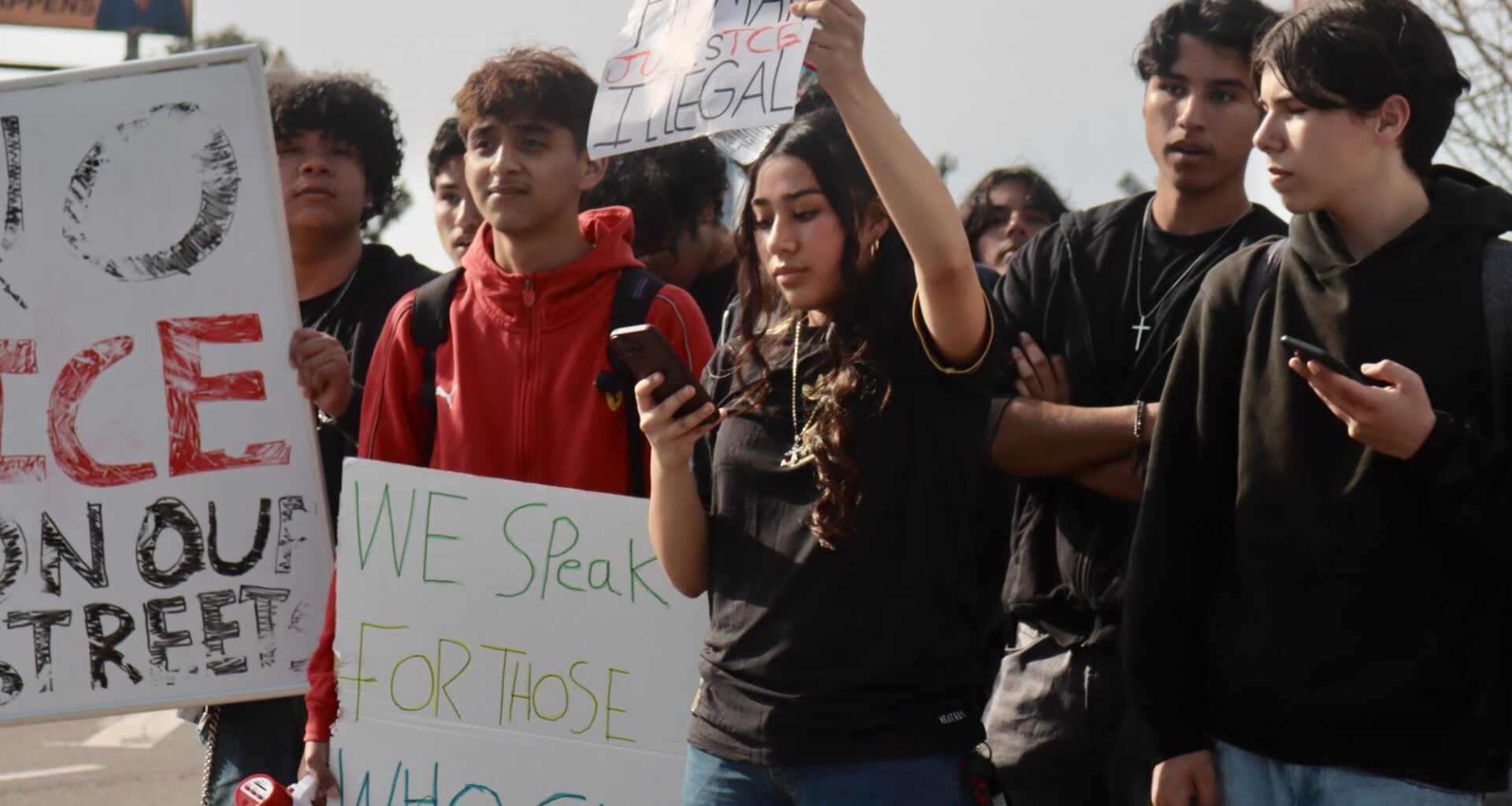
Recent actions from Immigration and Customs Enforcement (ICE) in Minnesota, including the fatal shootings of civilians Renee Good and Alex Pretti, have sparked nationwide protests, prompting students across the country to organize demonstrations and raise concerns about safety, accountability, and the impact of immigration enforcement on school campuses.
Notably, organizers called for a nationwide strike on Friday, urging people to refrain from shopping and attending work or school and instead participate in demonstrations. Across the Bay Area, high school students joined the strike by walking out of their classes to protest.
One of the first demonstrations in the East Bay occurred Wednesday when students from the San Lorenzo Unified School District organized a walkout. Some students from KIPP King Collegiate High School, Castro Valley High School, and Chabot College also attended.
Hundreds of students walked out of their classes and gathered at the intersection of Hesperian Boulevard and Lewelling Boulevard, where they rallied with signs and chants on traffic islands and street corners. The large group then marched to San Lorenzo High School, where the protest continued.
 San Lorenzo High School students driving down Lewelling Boulevard waving a Mexican flag. (Chris McNicholas)
Some students drove along Lewelling Boulevard while waving Latin American flags from their vehicles, while others stood in front of the school holding signs and encouraging passing drivers to honk in solidarity.
“We are here to spread awareness [and] to show the public that we are not scared. We are the future for America,” said Alex Perez, a Chabot College freshman and walkout co-organizer whose cousin attends Arroyo High School.
Alameda County educators believe national immigration enforcement has heightened fear among students, even as California law requires public universities to take specific steps when ICE activity is confirmed. Under California’s Safe Act (SP 98), all public institutions of higher education are required to notify students, faculty, staff, and community members of confirmed ICE presence on campus and to provide support for individuals affected by immigration enforcement actions.
Dr. Earl Aguilera, an award-winning teacher educator at Cal State East Bay whose work focuses on digital media literacies and critical pedagogy, emphasizes the importance of institutional transparency and accountability. According to Dr. Aguilera, uncertainty about universities complying with SP 98 can raise fear among students.
“It is really important for Cal State East Bay, and for the CSU system overall, to understand these expectations and what universities are doing to meet them. If the campus community is not satisfied with those efforts, it only continues to contribute to the culture of fear and uncertainty that many students and families are facing right now,” he said.
The nationwide protests following the Minnesota news highlight the growing role of youth advocacy in response to immigration enforcement. Students are increasingly engaging in demonstrations, walkouts, and public discourse, signaling that immigration enforcement is not only a national issue but also one that directly affects campus climate and student well-being.
Despite Alameda County’s immigrant-friendly reputation, Dr. Aguilera noted that fear can persist because federal agencies operate independently of local protections. He explained that agencies such as ICE and the Department of Homeland Security have demonstrated a willingness to act regardless of local laws, which undermines trust in legal systems meant to protect immigrant communities.
“As important as it is to have local legal systems that support immigrant communities, it is equally important to remember that only the people can save the people,” Dr. Aguilera said, referencing the phrase “solo el pueblo salva el pueblo.”
He emphasized the role of community-based rapid response networks and local organizations in providing support when institutional protections fall short.
Dr. Aguilera also addressed the responsibility educators have during periods of heightened immigration enforcement. He stated that students’ ability to learn depends on their sense of physical and psychological safety, noting that fear and uncertainty can significantly disrupt the classroom environment.
“If students do not feel a sense of safety and security, it is impossible to learn in a meaningful way,” Dr. Aguilera said.
Dr. Aguilera believes that students need visible support from their educators in order to feel safe in school. He noted that while levels of involvement may vary among educators, students need reassurance that faculty members are willing to stand with them amid the ongoing immigration crackdown.
He emphasized, “From educators, I think students need the commitment. That educators are going to have their backs, no matter what happens, given these current immigration policies and immigration raids.”
 A San Lorenzo High School student holding a sign during the Jan. 28 walkout and protest. (Chris McNicholas)