
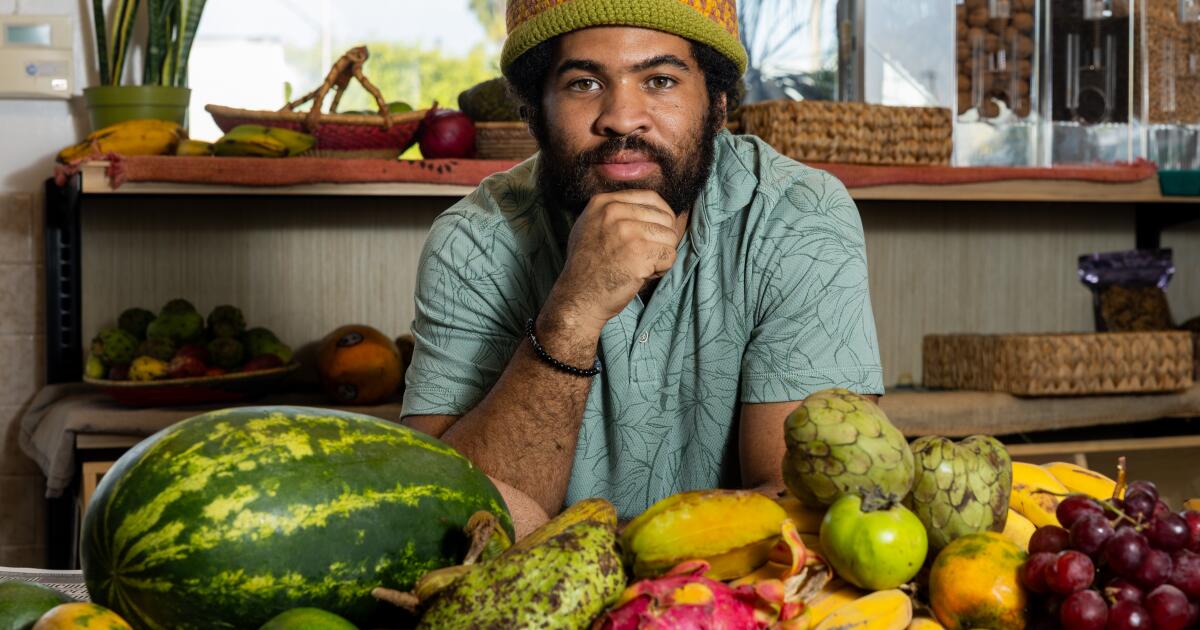
On a breezy January afternoon, dozens of watermelon lined the back of the strip mall at the corner of West 77th Street and Crenshaw Boulevard in Hyde Park. The striped green orbs were splayed over the asphalt, a verdant glimpse of the summer season in the middle of winter.
To get them there, Imani Diggs drove a total of 43 hours from Los Angeles to Florida, and back. It’s a trip he made four times over the course of the month, each time returning with thousands of pounds of watermelon.
“I made a connection with some Black farmers out in Florida in December, and I drove there to pick up the watermelons,” he said. “Just so people can continue their fruit fasts and stuff like that. People were telling me ‘I’m 10 days deep into a fruit fast and you’re saving my life right now.’”
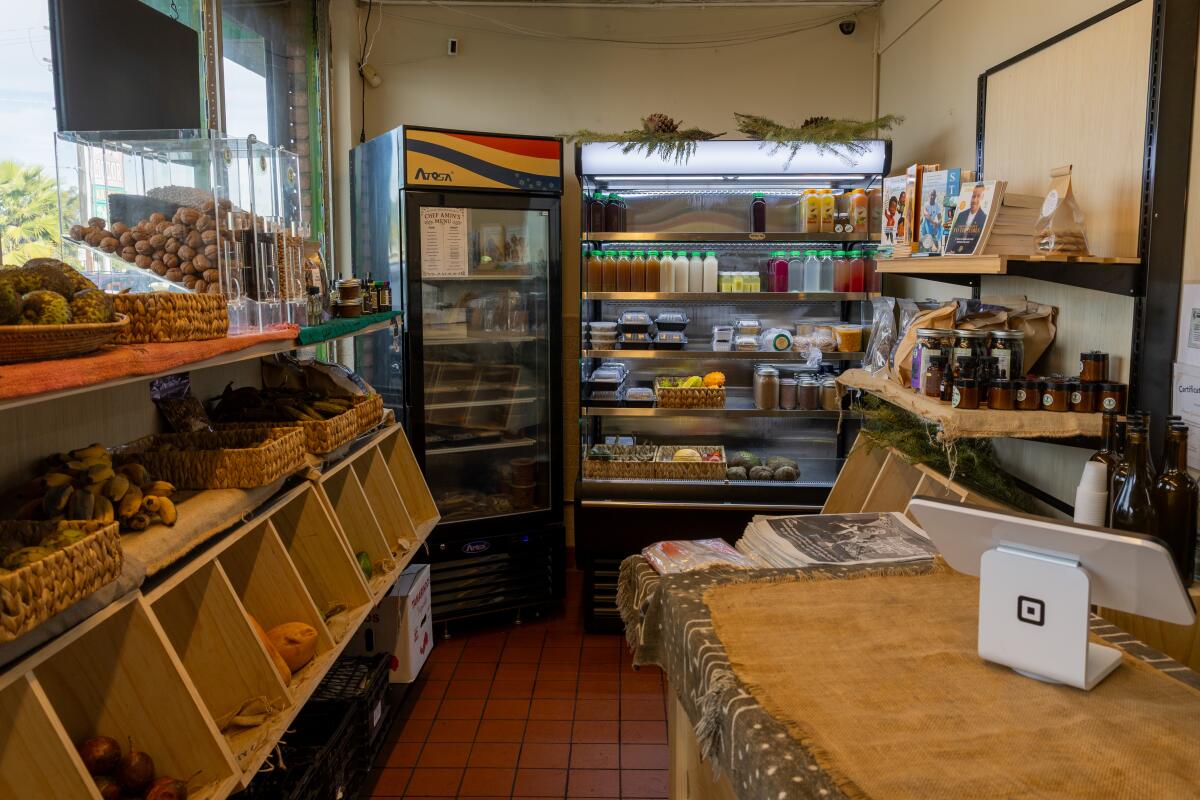
Produce, juices and other merchandise are on sale inside of the Crenshaw Food Hub.
(Ronaldo Bolanos / Los Angeles Times)
Diggs drives around the country, picking up seeded watermelons from farms in one state and selling them in another. He’s sourcing watermelons from farmers in Florida, Mexico and Houston. Over the last couple of years, he’s delivered watermelon to Las Vegas, and all over California, including Richmond, Woodland Hills and Orange County. Now, he’s selling watermelons, juice and other produce from his first storefront, called Imani Gardens, inside the Crenshaw Food Hub.
The new food hub has taken over the space formerly occupied by Kathy’s Kitchen. Kathy Alston opened her tiny juice shop in 2020, selling produce and making juice from whatever she sourced from farmers markets around the city. Her lemon, ginger and turmeric juice was sunshine in a bottle. Her celery, lime and ginger elixir turned me into a green juice person. But after five years in the space, Alston made the difficult decision to close.
“I always had a dream of just bringing healthier food options to the community,” she said. “I started Kathy’s Kitchen to realize that dream, and I did all I could do.”
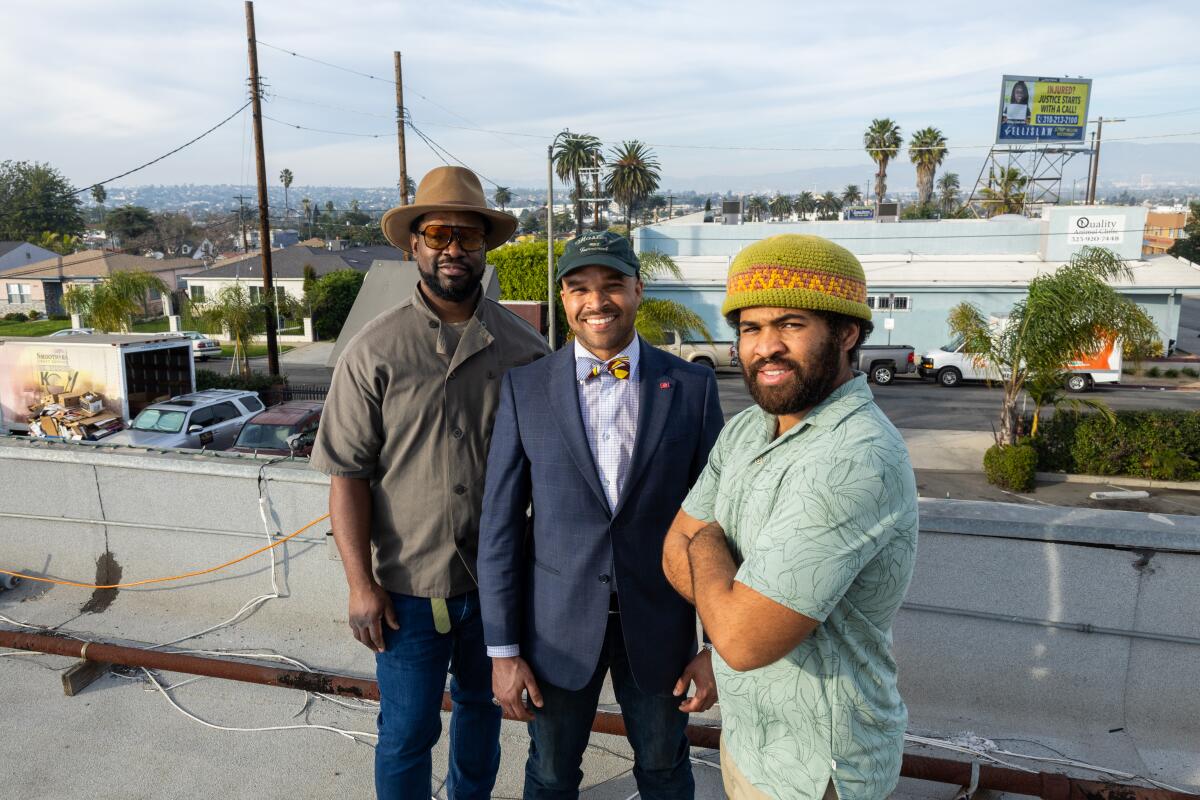
Chef Amin Muhammad, left, Adam X and Imani Diggs stand on the roof of the Crenshaw Food Hub.
(Ronaldo Bolanos / Los Angeles Times)
Now, Diggs and his partners Adam X and Compton Community Garden director TemuAsyr Martin Bey are continuing Alston’s dream, but on a much grander scale.
Diggs and X spent the last couple of years hosting produce pop-ups together in Leimert Park.
“We had plans for transitioning into a bricks-and-mortar,” said X. “We caught wind that Kathy was going out of business and I called her and was like don’t do that. Let’s figure out a way to make this work.”
The plan was to take over the Kathy’s Kitchen‘s lease and transition the space into a food hub. Imani Gardens would act as the anchor tenant, with a permanent market complete with fresh juices and other groceries in the front, and multiple food entrepreneurs who could operate out of the kitchen.
“The idea is to have a place in the community to come get some groceries in a food desert,” X said.
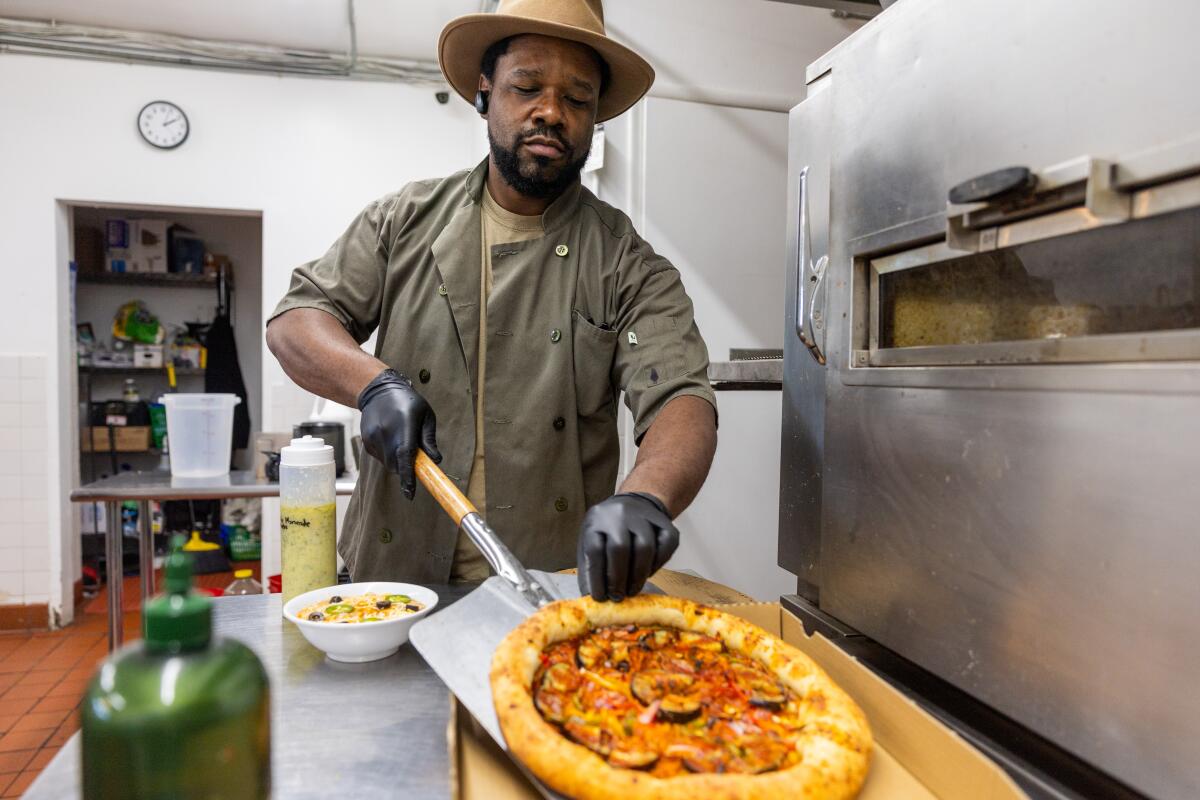
Muhammad places a vegan zucchini pizza into a pizza box at the Crenshaw Food Hub.
(Ronaldo Bolanos/Los Angeles Times)
At the moment, there are two resident chefs operating out of the food hub. The first is Amin Muhammad, who grew up in a nearby apartment complex. Raised a vegetarian, he and his friends used to catch the bus to Beverly Hills to get eggplant pizza from Mulberry Street Pizza. Now, he’s making a vegan eggplant pizza of his own, with shredded banana squash in place of cheese.
“It’s not that there aren’t places to eat, but there isn’t quality food anywhere,” Muhammad said. “When Adam told me where this was, and I told my mom and my brother, they were like that’s right in the neighborhood. It’s a part of my roots, so I had to come be a part of it.”
Visitors can purchase Muhammad’s pizzas, navy bean soup, bean pie and a handful of other prepared dishes from a small freezer in the grocery section of the store.
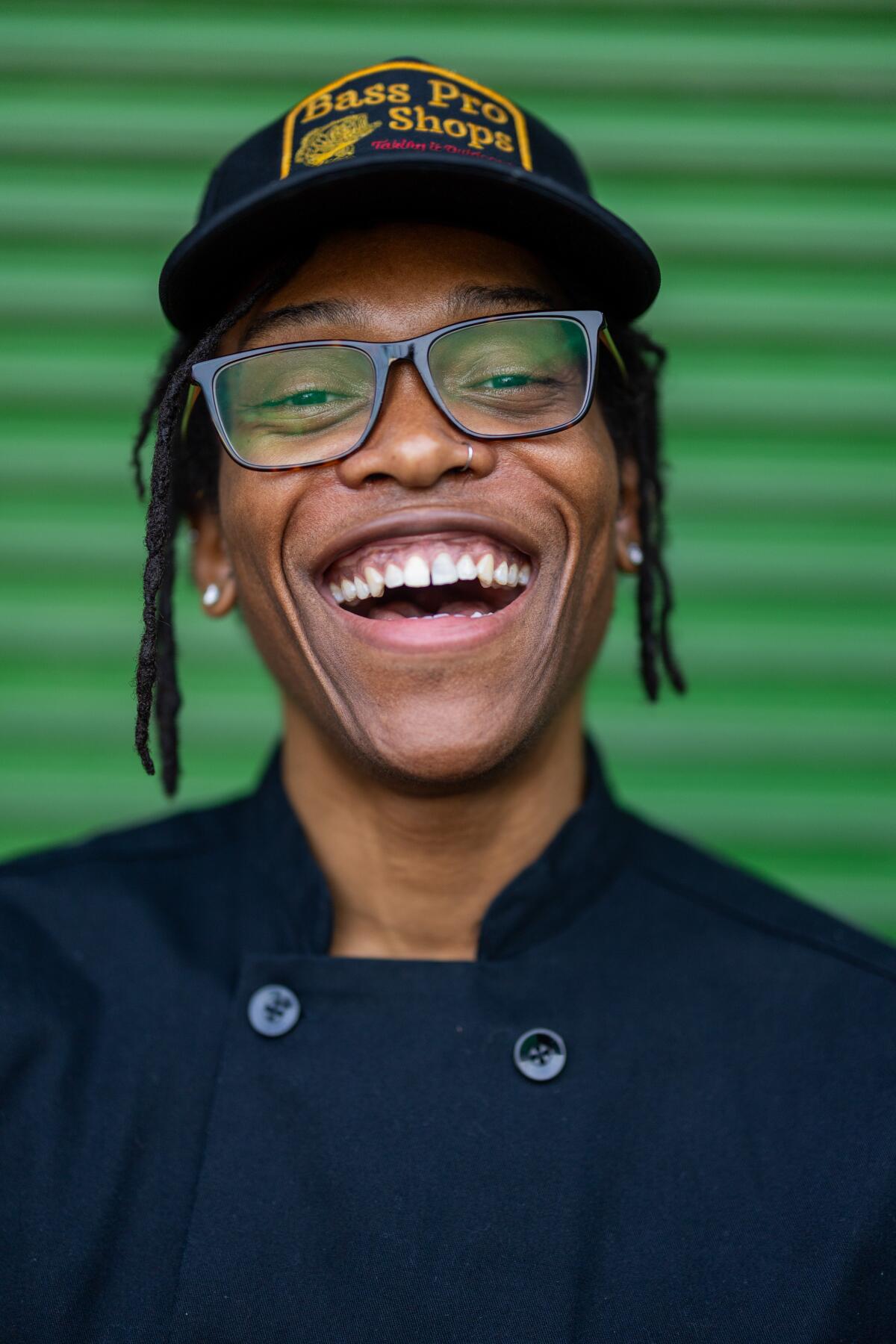
Wolf Collins, the chef behind alkaline vegan food operation Electric Wok, outside of the Crenshaw Food Hub.
(Ronaldo Bolanos / Los Angeles Times)
Also in the kitchen is Wolf Collins, who runs a pop-up called Electric Wok. He specializes in alkaline vegan food, and stocks the Imani Gardens fridge with grab-and-go sandwiches and stir-fried quinoa. When he’s in the kitchen, and Diggs is able to source soursop, Collins makes what he calls his soursop fish sandwich.
“It was just kind of an experiment but it has gone ridiculously viral on TikTok and Instagram,” Collins said.
He breads unripe soursop in a mixture of chickpea flour and spelt bread crumbs then fries it until golden brown. He dresses the soursop filet with alkaline pickles, alkaline garlic aioli, alkaline habanero sauce and red onion on sourdough spelt bread. The fruit takes on a tender, meaty texture, similar to a filet of white fish.
Collins is also making burro fries, turning the green, stubby fruit into crispy wedges with fluffy centers.
The hub, market and chefs are just one arm of a healthful food supply and distribution operation X, Bey and Diggs are planning to scale and bring to other inner cities around the country.
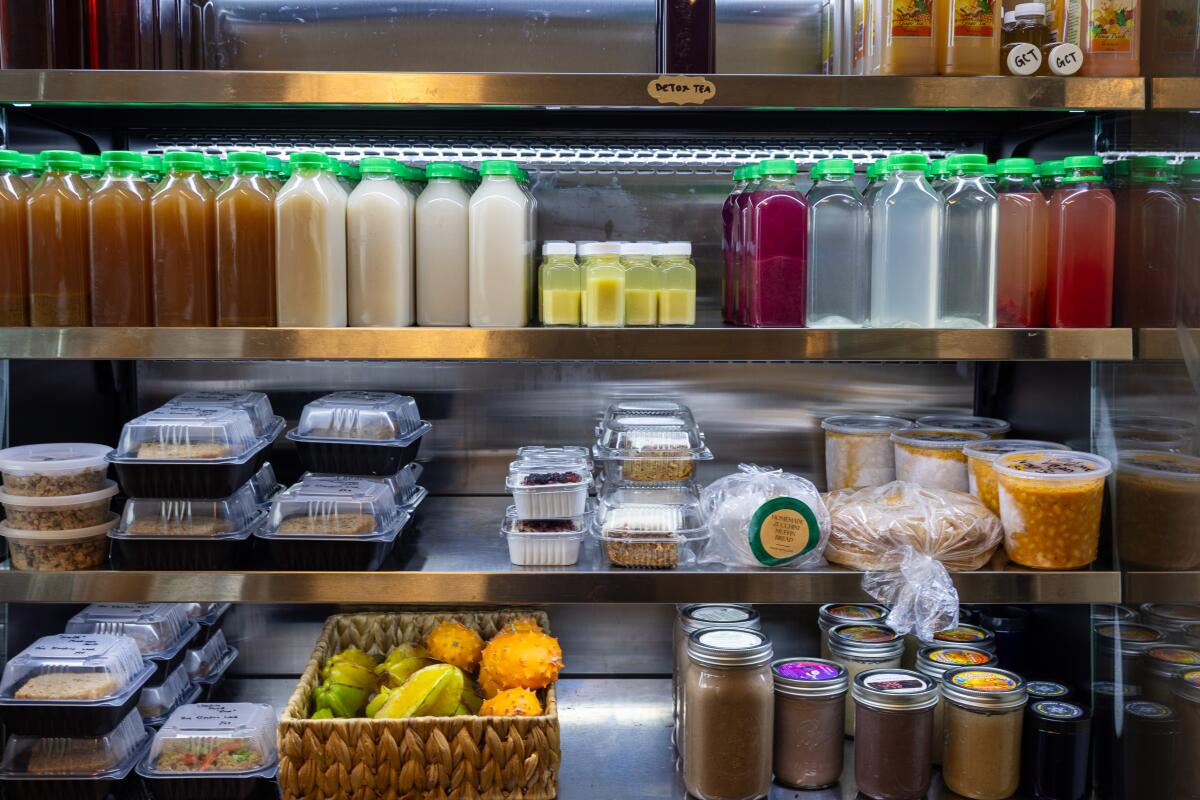
Pressed juices and other food items in a refrigerator for sale at the Crenshaw Food Hub.
(Ronaldo Bolanos/Los Angeles Times)
“We establish markets for Black farmers, manufacture nutrient-dense food products and distribute fresh, culturally relevant foods to eradicate food deserts and uplift our communities,” reads the food hub’s mission statement. “By prioritizing Black food sovereignty and cooperative economics, we revitalize farming and expand access to healthy foods to boost the longevity of man.”
X and Bey are behind Asyrs Bridge, a farming advisory services firm that strives to create equitable access to the agricultural industry.
In the early 1900s, Black farmers accounted for roughly 14% of farmers in America. As of 2022, that number has dropped to less than 2%.
X is using his background in business and finance along with Bey’s position on the California Department of Food and Agriculture BIPOC advisory board committee to advocate for state resources to build infrastructure for Black farmers and food distributors.
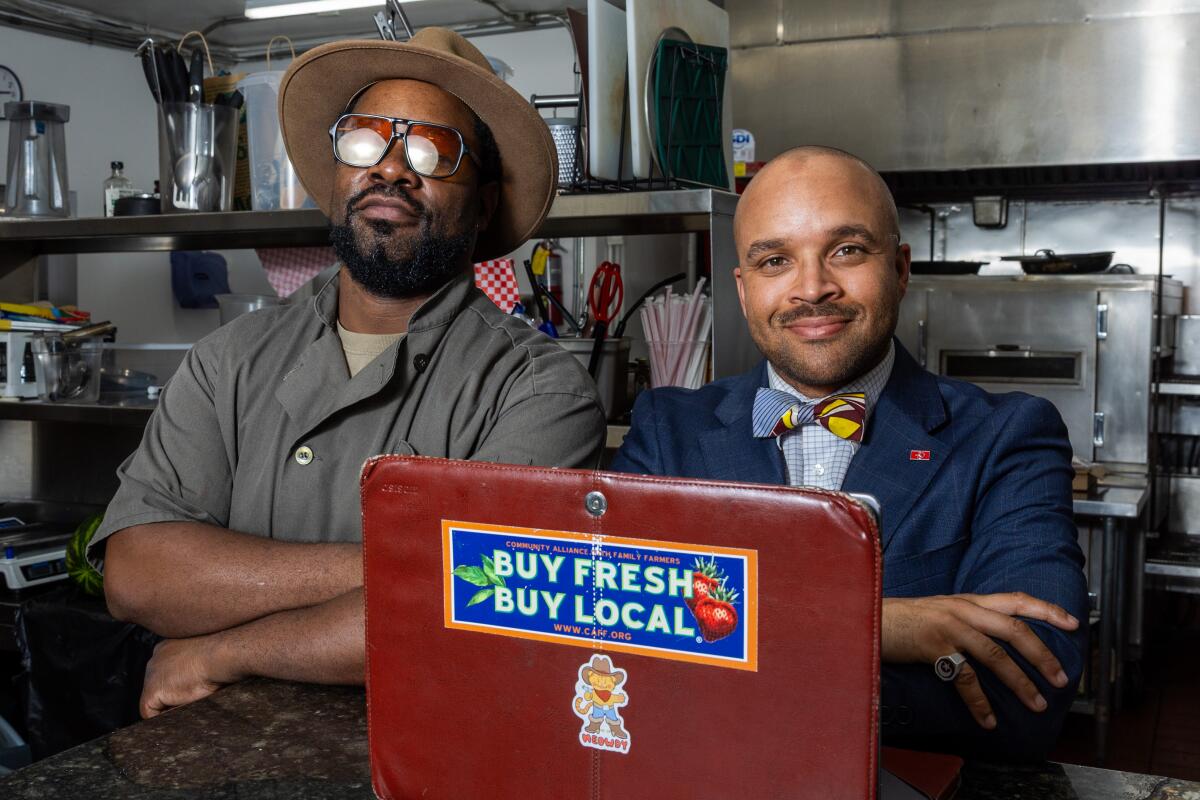
Muhammad, left, and X stand inside of the Crenshaw Food Hub.
(Ronaldo Bolanos / Los Angeles Times)
The two were able to help secure $1.25 million to fund the Ujamaa Farmer Collective, an organization whose mission is to help BIPOC farmers secure land and resources. It’s named for the Swahili word for “extended family.” In 2024, the collective was able to purchase a 22-acre parcel of land outside of Woodland.
“The goal is to eventually start farms so we are sourcing our own food,” X said. “It’s going to take years. We are building a prototype that can be duplicated so that we can be the solution to our own problem, mainly that we don’t eat healthy.”
The next step is to purchase the building that houses the Crenshaw Food Hub.
“We could actually build the whole food system and be our own solution to food deserts,” X said. “Now we want to buy the building so we can own the farm, own the building and own the whole supply chain.”
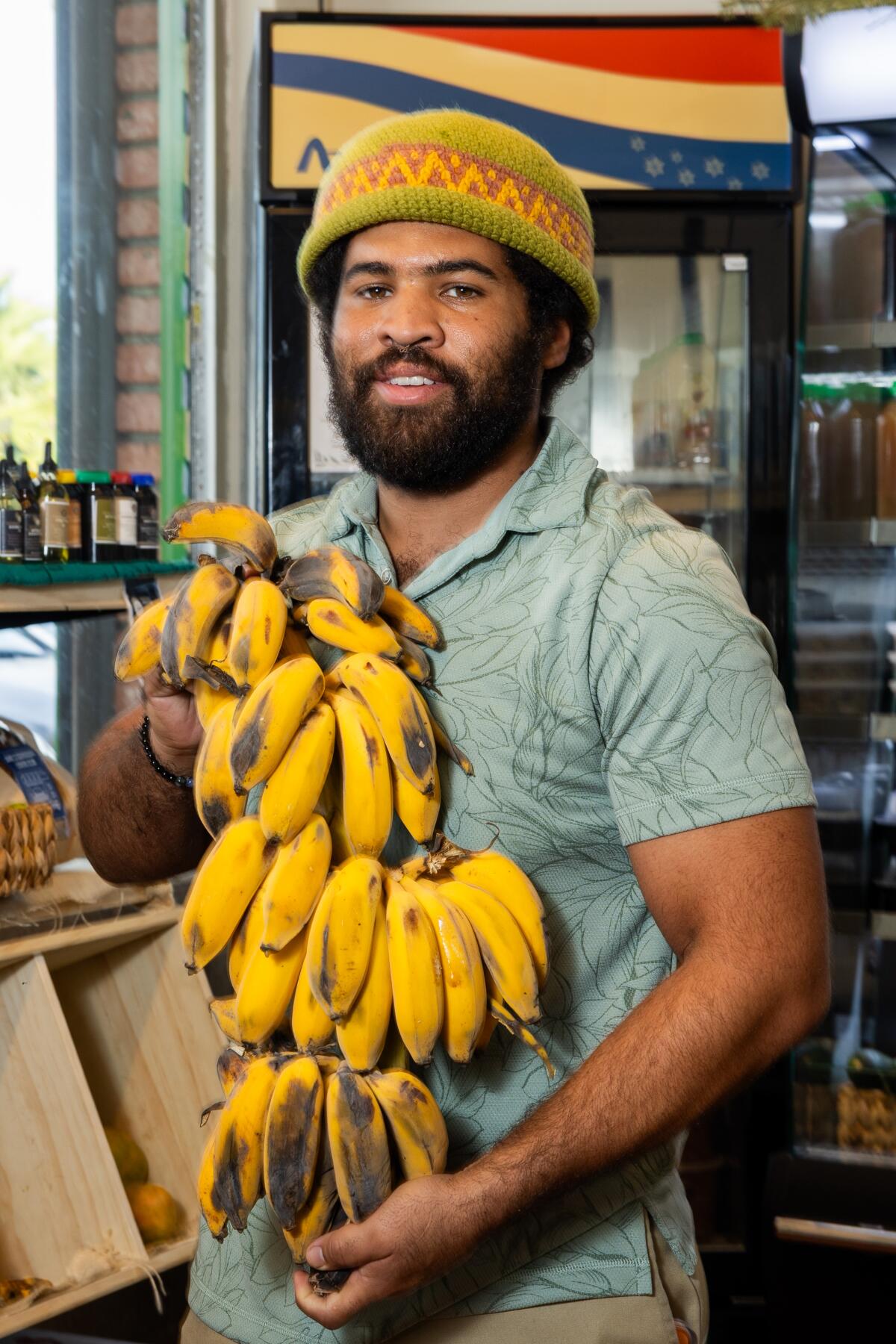
Diggs, of Imani Gardens, displays some fresh produce inside the food hub.
(Ronaldo Bolanos / Los Angeles Times)
Diggs is sourcing produce for the market from a network of about 10 farms from San Diego to Sacramento, including WeGrow Farms, an urban farm in West Sacramento. Recently there was soursop, black sapote, dragon fruit, Indian mangoes, chirimoya and granadilla on his shelves. He also curates a selection of pantry goods like honey, sea moss fruit roll-ups and coconut dates.
Though he hasn’t stopped traveling to host his seeded watermelon pop-ups, he’s grateful for the permanent space and the regular business hours.
“It feels good,” he said. “It allows the community to have more access to us and that’s the big thing. We need more spaces like this.”
The Crenshaw Food Hub
Find Imani Gardens, Electric Wok and Amin Muhammad at