
By Yousef Baig, CalMatters
This commentary was originally published by CalMatters. Sign up for their newsletters.
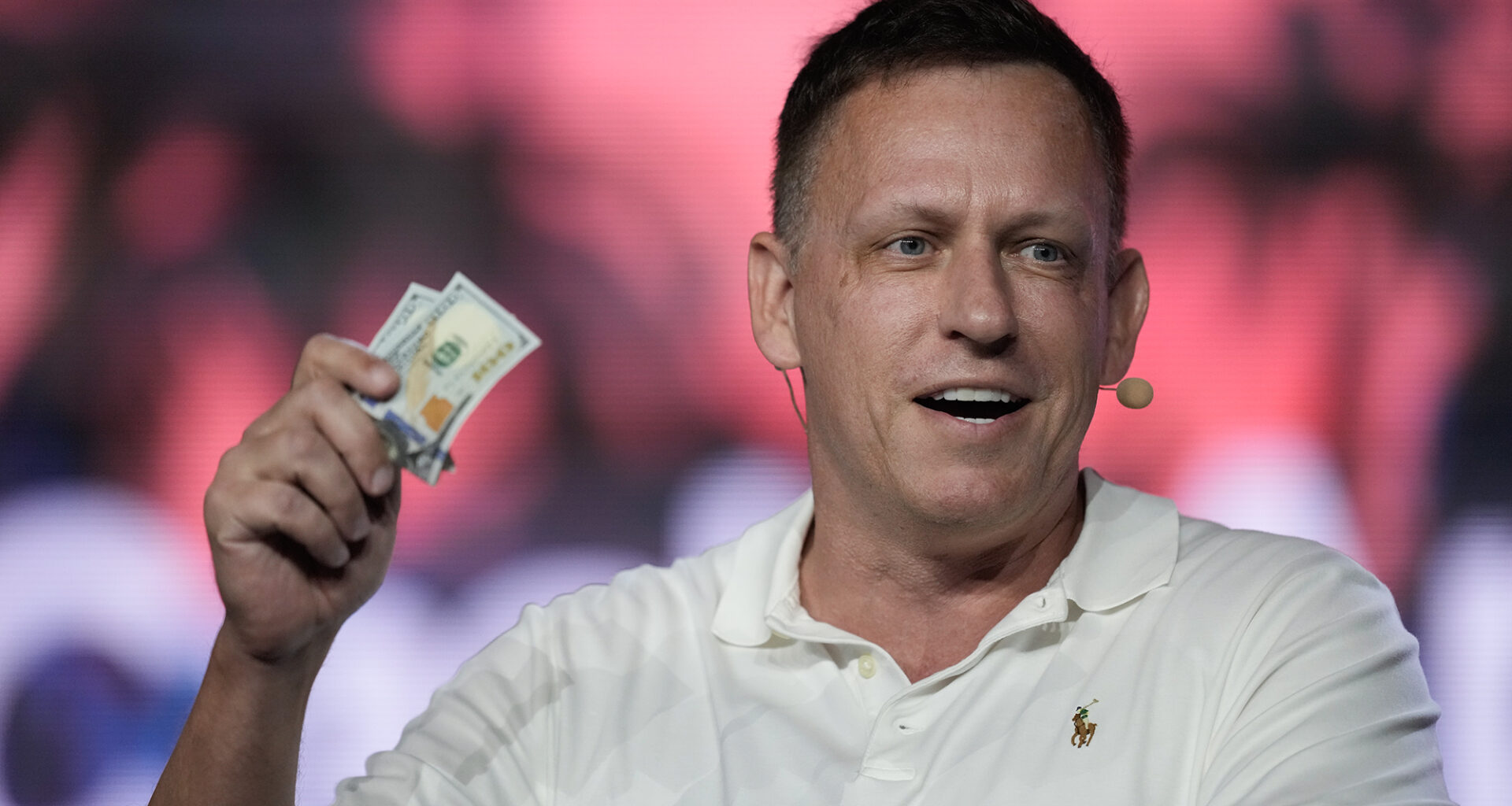
It’s hard to conjure up much sympathy for billionaires Peter Thiel and Google founders Larry Page and Sergey Brin, who all decamped for other states and left a dust cloud of headlines in their wake, warning that a possible wealth tax would scare off more tech moguls like them, dooming California.
Maybe you’ve heard that one before.
These men represent the exception to the rule of a largely settled corner of economics, in stark contrast to the narrative and hype already engulfing a proposal that hasn’t even qualified for the ballot. It’s much easier for a rich person to threaten to leave than actually do it, as years of studies on millionaire migration have shown.
The fact-free rhetoric from political actors and business leaders in recent weeks also fails to recognize an ugly truth: People like Thiel and the Google guys amass vast fortunes without paying taxes to begin with.
So good riddance. It’s not like Google is leaving Mountain View.
To be clear, California faces urgent questions about the state’s finances and how we sustainably fund core services. That was before a wave of federal funding cuts. The state needs new revenue, whether it’s a tax or some other mix of solutions to stabilize the budget.
An influential union, SEIU–United Healthcare Workers West, is collecting signatures to put a 5% tax on the state’s billionaires on the ballot, to help backfill Medi-Cal cuts that put millions of Californians at risk of losing health insurance. Proponents say the one-time levy could generate $100 billion.
It sounds good in theory, but it won’t address California’s deeper problems, and could make it a lot harder for the state to more meaningfully reform the rules for its top earners. Nonpartisan legislative analysts are forecasting state budget deficits as high as $35 billion annually if nothing changes. Health care is only one piece.
Just don’t believe the “exodus” lie. It’s bogus, a fiction ginned up decades ago to scare people into voting against their interests.
Talk is cheap for the ultrarich
Cornell University sociologist Cristobal Young, the author of “The Myth of Millionaire Tax Flight: How Place Still Matters for the Rich,” has spent the better part of two decades researching migration patterns when states tax their wealthiest inhabitants. The argument that rich people are going to get up and move “just doesn’t hold a lot of water,” he told me.
Young’s 2012 study with the Stanford Center on Poverty and Inequality sought to understand if changes in California’s top income tax rates prompted high earners to leave. They examined migration patterns after voters in 2004 passed a 1% tax on millionaires to pay for mental health services.
The highest-income Californians were actually less likely to leave after its passage.
In a study with the Treasury Department in 2016, looking more broadly at the consequences of progressive taxes, the researchers found that millionaire tax flight did occur but only in the margins. According to the study, a 10% increase in the top tax rate, for example, would cause a 1% drop in the millionaire population.
“These people are just very embedded in the places where they’ve built their careers, and have a lot of ties to where they live and work. It’s costly to give those up,” Young said. “So it’s one thing to say, ‘I’m moving to Texas.’ But a lot of people, when it comes down to making that move, they don’t want to do it.”
In a recent analysis for Forbes, economist Teresa Ghilarducci wrote that wealthy taxpayers are more likely to scuttle if the levy is high, permanent and easy to avoid. In terms of public finance theory, the California health care workers union may have struck the right balance.
“A recurring tax can change lifetime planning and influence where people live,” Ghilarducci wrote. “A one-time tax likely does not.”
It would also be a one-time solution when the state faces long-term problems.
In an era defined by high living costs and voters agitating for relief, California has a golden opportunity to more meaningfully address its tax system. The state budget relies heavily on income taxes, which makes us overly dependent on tech companies and their performance in the stock market. In the pandemic era, that led to an intense budget whiplash when a 2022 surplus transformed into an ongoing deficit two years later.
 Advocates gather on the steps of the state Capitol in support of the Fight For Our Health Coalition, calling on leaders to address threats to health care coverage, in Sacramento, on Jan. 14, 2026. Photo by Roberta Alvarado for CalMatters
There are plenty of options if state policymakers wanted to fix the problem. A lower but longer-lasting tax on billionaires that helps fund other flagging core services — not just health care — could be a fit. It would just need a sunset date to avoid the pitfalls Ghilarducci described.
California no longer has estate or inheritance taxes. California’s estate tax was eliminated in 2005 after Congress ended the federal credit for state death taxes. California could potentially generate an estimated $3.6 billion annually if voters reinstated an estate tax, according to the nonpartisan Center on Budget and Policy Priorities. Twelve states and Washington D.C. still impose estate taxes.
California’s estimated 200 billionaires are likely also sidestepping the tax system, which means there are loopholes lawmakers could close. In 2021, ProPublica obtained a trove of IRS files and uncovered how the country’s richest people manipulate the tax code to accrue tens of billions of dollars in wealth every year while giving a fraction to the government.
Instead of paying income taxes, they keep their paychecks artificially lower and make most of their money through capital gains and the dividends on their investments. Then they make large charitable donations and use other tax-saving measures at an outrageous scale to pay even less. “Buy, borrow, die” is a popular strategy.
Thiel, for example, used investment tricks and tax law changes — that could only be exploited by the ultrawealthy — to turn a Roth IRA account into a tax shelter worth $5 billion, ProPublica found. He won’t have to pay a dime in taxes, assuming he withdraws next year when he turns 60.
Governor-sized barrier
Unfortunately, Gov. Gavin Newsom may be the biggest obstacle to a necessary conversation about California taxes. He warned six years ago that “wealth tax proposals are going nowhere in California.”
Newsom’s panicked and forceful opposition to the billionaire tax idea helped unmask the nation’s resistance leader as he builds his legacy with an eye for higher office. Despite his rapid ascension in prediction markets for the next president, fame clearly hasn’t changed the man. Newsom has always fought taxes and regulations that might annoy the ultrarich, even if most Californians would benefit.
This is the governor who vetoed an AI safety bill that would have required models to test whether they would likely lead to mass death, threaten public infrastructure or enable major cyberattacks. In his veto message, he worried the legislation was “curtailing the very innovation that fuels advancement in favor of the public good.”
This is the governor who led an opposition campaign four years ago that sank a tax hike on multimillionaires and would have helped fund electric vehicle subsidies, charging stations and wildfire response. Meanwhile, the 2035 EV mandate he takes credit for remains unfunded.
This is the governor who intervened when a voter-backed privacy watchdog agency was designing regulations to make it easier for people to opt-out of generative AI tools and require risk assessments. The intimidated board complied and exempted AI systems.
Three years ago, Newsom kneecapped a wealth tax attempt by Assemblymember Alex Lee before it even reached the printers, saying it was “dead on arrival.” And three years before that, the governor aggressively fought the nation’s first wealth tax proposal, introduced by then-Assemblymember Rob Bonta. It died without a single vote.
Unless Capitol lawmakers buck the governor and give voters something serious to consider soon — and better than this wealth tax — the state remains handcuffed to Silicon Valley’s fate.
Thankfully, some billionaires understand. Nvidia CEO Jensen Huang, who is six times richer than Thiel and runs a tech company worth $4.4 trillion, said he was “perfectly fine” with a wealth tax. California is the only place in the world where this level of ingenuity and talent coexists.
“We chose to live in Silicon Valley,” Huang told Bloomberg recently. “Whatever taxes they would like to apply, so be it.”
It’s not Thiel or the Google guys we need to worry about leaving California — it’s everyone else. It’s the people who actually pay income taxes and work for the companies that buttress the state budget.
That’s the exodus California needs to prevent.
This article was originally published on CalMatters and was republished under the Creative Commons Attribution-NonCommercial-NoDerivatives license.