
In order to truly experience the poetry of Emily Dickinson, it must be read aloud, says Berkeley English senior continuing lecturer John Shoptaw. You have to hear her irregular metrics, her slant rhymes and signature dashes, in order to glimpse her inner world.
A distinguished Dickinson scholar, Shoptaw first heard the poet’s verse as an undergraduate student in an American literature survey class at the University of Missouri-Rolla in the late 1970s. They read the poem “Apparently with no Surprise.” It’s a day he’ll never forget.
Apparently with no surprise
To any happy flower,
The frost beheads it at its play –
In accidental power –
The blond assassin passes on –
The sun proceeds unmoved
To measure off another day –
For an approving God –
The poem isn’t about seeing, says Shoptaw, but about being blind to the minor catastrophes that occur every day on Earth. He was struck by the poem’s impurity. It lived in the liminal spaces, somewhere between hope and despair, speech and song. It wasn’t one thing or the other, but something else entirely.
 John Shoptaw is a senior continuing lecturer at UC Berkeley. This semester, he’s teaching a research seminar on the poetry of Emily Dickinson.
UC Berkeley
“It wasn’t exactly love at first sight, because that would be too easy,” he says. “You know, it was bewilderment at first sight. It was something I’d never heard, and I said, ‘Wow, that’s a hymn.’”
Shoptaw is from southeastern Missouri, where he grew up hearing hymns all around him. At church, he would sing “A Mighty Fortress Is Our God,” written by Martin Luther in the late 1520s, and “Amazing Grace,” the 1773 hymn written by John Newton.
Like much of Dickinson’s verse, Shoptaw notes, these hymns are written in common meter, a rhythmic structure that allows them to be easily sung and memorized by the congregation.
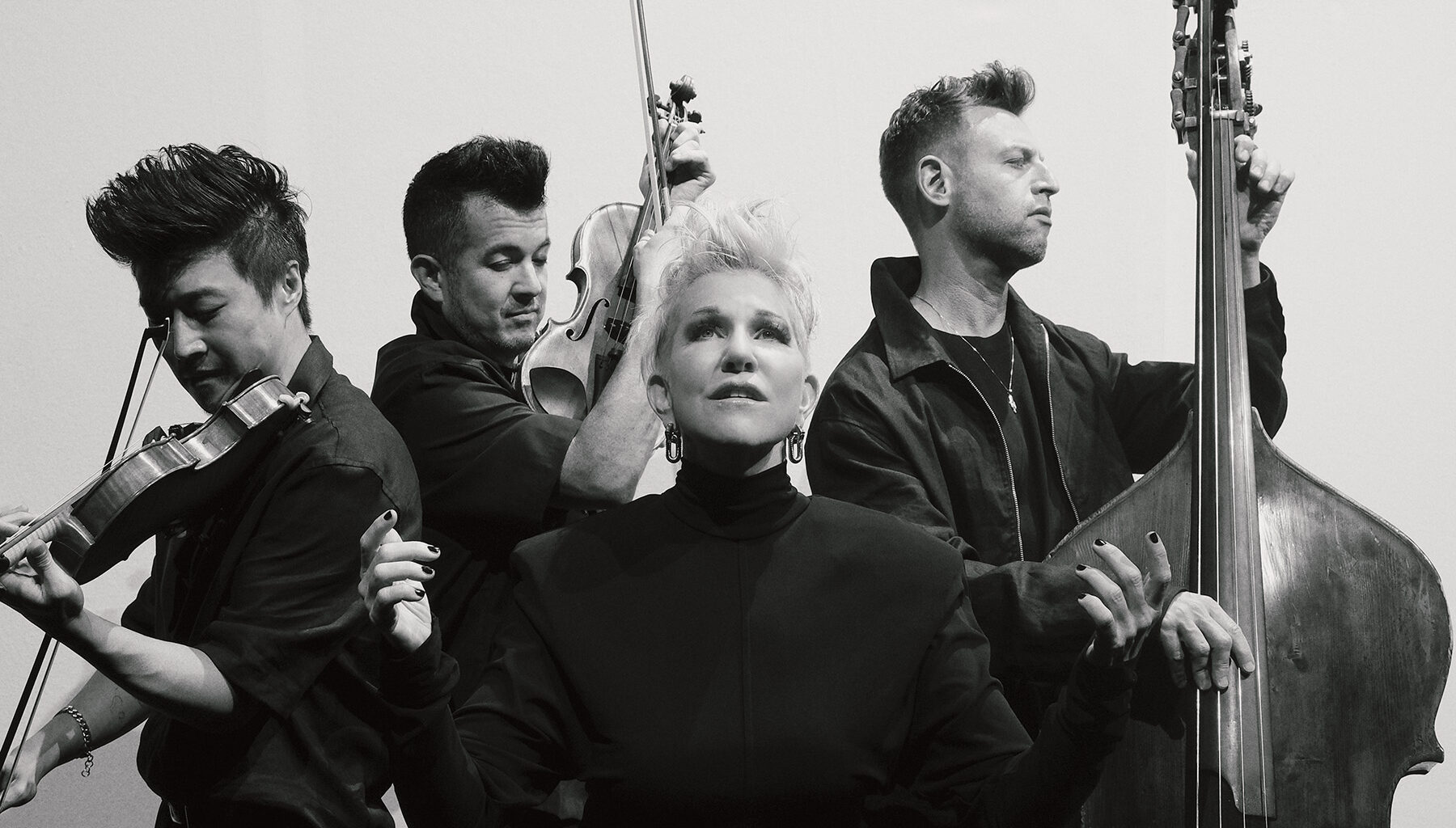
Over the years, scores of musicians have transformed Dickinson’s verse into song, from composer Aaron Copland’s 1950 song cycle to Phoebe Bridgers’ recent spectral reimagining of her poems. And on Saturday, Feb. 7, Cal Performances is presenting a new co-commissioned work, Emily — No Prisoner Be, composed by Pulitzer Prize-winning composer Kevin Puts and performed by mezzo-soprano Joyce DiDonato and the string trio Time for Three. In a series of 24 intimate songs, the performers traverse selected poetry of Dickinson, bringing her voice to audiences in the campus’s Zellerbach Hall. Following the performance, Shoptaw will join the members of Time for Three and DiDonato for a post-performance talk, free to all ticket holders.
“The wonderful thing about her poetry is that, at times, it absolutely feels explosive, outward and expanding,” says DiDonato, “and at other times, it implodes inward, but with just as much veracity. She can go to the ends of the universe and into the smallest inner workings of the heart or soul.”
A voice meant to be heard
Dickinson was born in 1830 to a prominent family in Amherst, Massachusetts. Though she was a prolific writer, she famously retreated to her family home in her 30s, living a largely reclusive life during the Civil War. Because her work was so unconventional, Dickinson never truly pursued publication; of her nearly 1,800 poems, fewer than a dozen were published during her lifetime, and even those were heavily edited to fit the era’s standard rules of grammar.
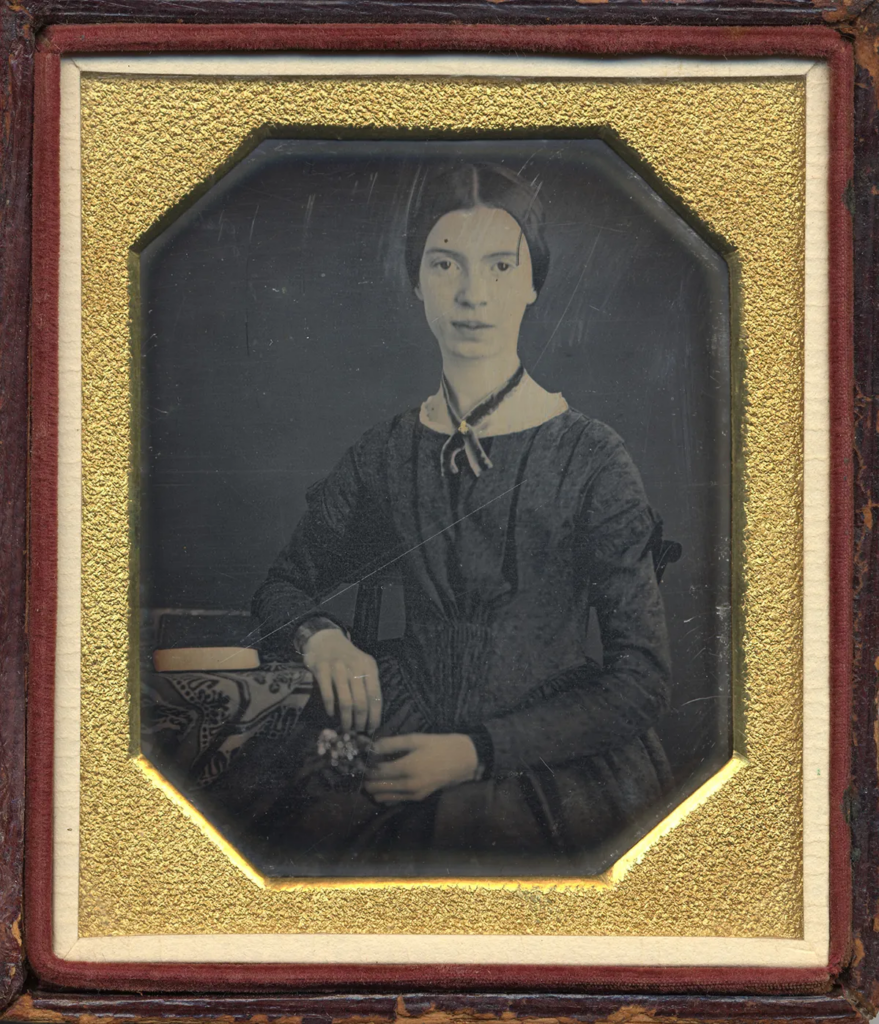 Emily Dickinson in 1847, at age 17.
Amherst College Archives & Special Collections, gift of Millicent Todd Bingham, 1956
Although the public might not have understood her poetry, Dickinson continued writing in her own style, channeling her vast interiority through her verse right up until her death in 1886. Only decades later did artists begin to bring her unconventional lines to the stage, proving that her private voice was meant to be heard.
The poems in Emily — No Prisoner Be are wide-ranging, from the irregular “Wild Nights! Wild Nights!”, a breathless incantation of longing with endless interpretations, to “I tie my Hat – I crease my Shawl,” about the daily tasks one does to keep it together and not explode. Another in the repertoire, “I felt a Funeral, in my Brain,” is a leaden, inexorable thrum that explores the suffocating internal grief of the Civil War years. Shoptaw deems it Dickinson’s most ambitious poem. “There’s no poem more dramatic or emotionally intense than this poem,” he says.
I felt a Funeral, in my Brain,
And Mourners to and fro
Kept treading – treading – till it seemed
That Sense was breaking through –
And when they all were seated,
A Service, like a Drum –
Kept beating – beating – till I thought
My mind was going numb –
And then I heard them lift a Box
And creak across my Soul
With those same Boots of Lead, again,
Then Space – began to toll,
As all the Heavens were a Bell,
And Being, but an Ear,
And I, and Silence, some strange Race,
Wrecked, solitary, here –
And then a Plank in Reason, broke,
And I dropped down, and down –
And hit a World, at every plunge,
And Finished knowing – then –
In Amherst, Dickinson lived next to a cemetery and would see funeral processions go by her window, the drum beating as the mourners trod on. But in this poem — which Shoptaw links to the shattering death of her brother’s dear friend, Frazar Stearns, during the war — she’s not watching from her room. Rather, she’s in the casket with him, being plunged into the earth, buried by grief.
It’s this expansiveness of place and time that DiDonato says the artists aim to capture in their performance Emily — No Prisoner Be.
Channelling 19th-century voices
The upcoming Dickinson performance has a familiar resonance for Shoptaw, whose own creative work once echoed through the very same hall. Back in 2007, the balcony rang with the choruses of Our American Cousin, an opera by Eric Sawyer reimagining the night of Abraham Lincoln’s assassination for which Shoptaw wrote the libretto.
“We aren’t trying to recreate her room; we are showing the vastness of her imagination and creativity,” says DiDonato. “So the space is open, abstract and can become anything the listener cares to invent. We absolutely followed the mystical and infinite world of her poetry and not the limitations of her physical world.”
This semester, Shoptaw is teaching a research seminar on Dickinson’s poetry. Like the musicians, he encourages his students to “find your own Dickinson — the Dickinson that especially speaks to you.” Maybe it’s a poem about love and death. Or maybe it’s her way of using metaphor or dashes or irregular meter.
For Shoptaw, the beauty of Dickinson’s verse lies in its embodied nature that invites every reader — and every musician — to become a part of the performance. “For Dickinson, the experience always transcends reality,” he says. “Whatever it is, “you have to be responsive.”
An antidote to our endless digital scroll
When Shoptaw teaches Dickinson, he always asks his students to read the poems out loud. They go around the room, performing stanza by stanza. Often their stanzas will be syntactically linked, so one person will end in the middle of the sentence and another will pick it up with the next. They have to work in sync, piecing together the poems in an imperfect way.
It’s a far cry from — or a rebuff of — the smooth, polished transactions of digital technology, especially generative AI, says Shoptaw.
 Dickinson’s poems, like the one pictured here — “He preached upon ‘Breadth’ till it argued him narrow” — were filled with cross-outs and alternate words, among other markups.
Amherst College Archives & Special Collections
Like Dickinson, whose papers were full of coffee and tea stains, blots, cross-outs, and alternate words scrawled in the margins, students in his class don’t use computers, but instead mark up their course readers as they go. It’s this physical and emotional work that her poetry requires — this struggle to understand — that Shoptaw says makes Dickinson’s poetry still resonate with audiences 150 years later.
“The poems are constantly changing,” Shoptaw says. “You can’t get lulled into the smoothness, because it’s just surprise after surprise. You constantly hit that roughness.”
“Her poems are immortal — they’ve outlived her — but they’re not timeless,” he continues. “They’re transhistorical, because as they go through time, their meanings, their settings, change. We respond to them in different ways for different reasons.”
DiDonato says that in a world of hyper-connectivity, where YouTube influencers and TikTok’s neverending scroll abound, Dickinson’s poetry offers us a different way of being.
“It was her way of navigating a complicated world within a very complex self,” says DiDonato. “What a great example to us in 2026 to just sit with ourselves, with our thoughts, with our imagination and creative souls, and just put pen to paper — not simply digesting continuous, vapid content and calling it a life.”
Learn more about Emily — No Prisoner Be, and buy tickets to the show, on Cal Performances’ website. Tickets are also available at the ticket office at Zellerbach Hall.
Listen to the full album, Emily — No Prisoner Be, released on Jan. 30.
Read Shoptaw’s 2024 book of poetry, Near-Earth Object, which explores the interactions, sometimes dark and sometimes joyful, between humans and the non-human natural world.