
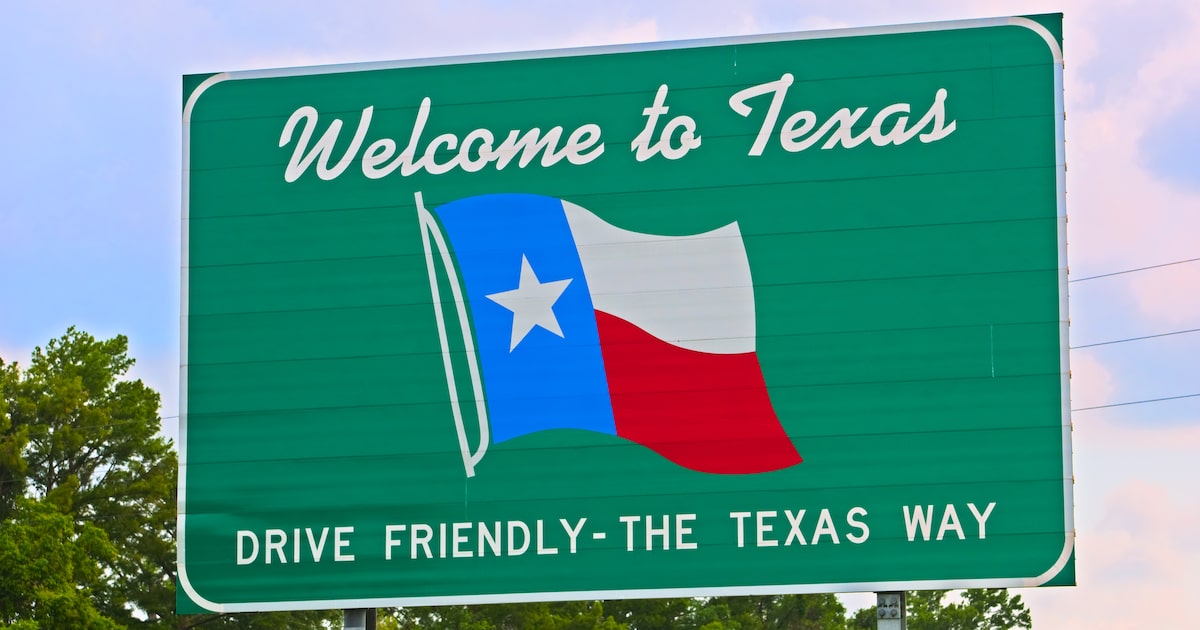
U-Haul recently published its new annual growth index, which analyzes one-way customer transactions in 2025. In announcing the release of U-Haul’s new index, the moving company noted in a statement that “Texas reclaims the title of No. 1 U-Haul growth state for the seventh time in 10 years.”
Meanwhile, U-Haul pointed out that “California ranks last with the greatest out-migration number for the sixth consecutive year.” According to newly released census estimates, California continued to lose more residents to net domestic migration than any other state between July 1, 2024, and July 1, 2025. In contrast, Texas gained more new residents last year due to net domestic migration than every other state except North Carolina.
The proposed 5% state wealth tax that could appear on California’s ballot this November, officially titled the 2026 Billionaire Tax Act, will help ensure California continues to have high rates of out-migration, likely spurring further migration of ex-Californians to Texas.
California’s proposed wealth tax is great news for Texas, as well as Tennessee, Arizona, North Carolina, Florida and other states that are popular destinations for former Californians. In fact, high net worth Californians comprising an estimated one-third of all billionaire wealth in the state took steps in the final weeks of 2025 to establish residency outside of the Golden State.
Opinion
The San Francisco Chronicle recently reported Google founder Larry Page and Oracle founder Larry Ellison, “have taken concrete steps to move key business entities out of California as labor groups race to qualify — but have not yet secured — a proposed wealth tax on billionaires for the ballot.” So too has tech entrepreneur David Sacks, who announced his relocation to Austin on the last day of 2025. Page’s family office “was converted out of the state and incorporated in Delaware in late December, along with other entities tied to research, aviation and real estate ventures,” the Chronicle added, noting that some of the relocated entities “now list principal addresses in Florida, Texas or Nevada.”
The beginning of signature collection for the proposed California wealth tax and other recent developments in the largest blue and red states underscore how Democratic and Republican-led states continue to take divergent paths, particularly when it comes to tax and regulatory policy. Consider the fact that union backers of the proposed wealth tax filed their initiative petition with the California attorney general’s office in November 2026, less than four weeks after Texas voters enacted a constitutional amendment prohibiting state taxation of capital gains.
The Lone Star State already had the advantage of being one of nine states with no personal income tax. Thanks to other constitutional amendments approved by Texas voters in 2025, capital allocators and site selectors have even greater assurance that their investments are safeguarded from onerous state taxation when they choose to locate a new manufacturing plant, laboratory, or office building in Texas. Meanwhile, such investment in California is already exposed to some of the most onerous tax rates in the nation.
Wealth tax proponents who want to argue their proposal is workable face a major challenge in that the levy targets wealth that exists only on paper and cannot be liquidated. But, as All In podcast co-host David Friedberg explained in rebutting a defense of the proposed wealth tax by U.S. Rep. Ro Khanna, D-Calif., such a levy is still objectionable even in cases where assets are tangible or easily liquidated.
Friedberg warned Khanna that no matter what the tax is called, “at the end of the day, it’s the seizure of private property from citizens by the government.” Friedberg lamented that “citizens that earned money, paid their fair taxes on those earnings (over 53% if they live in California) and are now being told they need to hand over after-tax assets because the government has failed to provide promised services with the revenue it’s collected.”
California Gov. Gavin Newsom, who has opposed wealth tax bills filed in the California Assembly in recent years, has come out against the 2026 wealth tax initiative. Even if unions collect enough signatures to qualify the wealth tax for the ballot, that doesn’t necessarily mean it will be put to voters.
“The union backing the Billionaire Tax Act initiative can collect signatures to put it on the ballot, then negotiate with the legislature/governor for a different tax and pass that with a 2/3 vote in exchange for taking the Billionaire Tax Act off the ballot,” Susan Shelly, editorial board member for the Southern California News Group, recently explained. This peculiarity of California law was on display during the 2024 election cycle, when an anti-tax ballot measure received enough signatures to qualify for the ballot, only to have state lawmakers swoop in and prevent it from going before voters.
Even if the proposed wealth tax doesn’t pass, or even if it never makes it to the ballot, it has already resulted in capital flight. That’s because the proposed wealth tax, even though it can’t be enacted until November, has a retroactive effectiveness date of Jan. 1, 2026.
“One upshot of this is that you might have some billionaires change their legal residency anticipatorily and keep it that way, even if the measure never makes the ballot, let alone passes,” Jared Walczak, senior fellow at the Tax Foundation, recently pointed out. “That would be a pure revenue and economic loss for the state.”
Unions championing the wealth tax proposition must collect 874,641 valid signatures by the end of June for the initiative to be certified to appear on the ballot and, even then, lawmakers might still block it from going before voters in November.
In an era of heightened mobility, the mere proposal of a retroactive wealth tax comes with real economic consequences for California, from which Texas and other competing states are poised to benefit. Whether or not California voters see the Billionaire Tax Act on their ballot next year, the push for it underscores the growing divide between states making their tax climates more attractive to investment and states that are willing to risk capital flight in pursuit of higher tax collections.
Patrick Gleason is vice president of state affairs at Americans for Tax Reform, an organization founded in 1985 at the request of President Ronald Reagan, and a senior fellow at the Beacon Center of Tennessee.
We welcome your thoughts in a letter to the editor. See the guidelines and submit your letter here.
If you have problems with the form, you can submit via email at letters@dallasnews.com