
San Diego faces a new, nearly $17 million budget hole that will likely prompt city officials to more quickly implement service cuts that weren’t supposed to take effect until summer, a 73-page analysis says.
The key drivers of the new deficit for the ongoing fiscal year include lower hotel tax projections of $7.5 million, along with delays and changes to implementing paid parking in Balboa Park that are now projected to cost the city nearly $9 million.
The analysis, called a mid-year budget report, does not specify which emergency cuts are likely to be immediate. Those cuts may be discussed Wednesday when the analysis is presented to the City Council’s budget committee.
The new $16.8 million budget hole is separate from a roughly $110 million projected deficit the city faces in the upcoming fiscal year, which begins July 1. Making cuts quickly could help shrink both projected gaps.
The new hole comes with the city in arguably its worst position to deal with such a deficit in more than a decade. The city, which has a $2.2 billion annual budget, has no excess cash on hand, and its reserves are at a relatively low $207.1 million.
Mayor Todd Gloria and the council have canceled a series of scheduled reserve contributions in recent years, which has left the reserves $56 million short of the $263 million required under the city’s reserve policy.
City finance officials say in the report that the local economy doesn’t offer much reason for optimism that city revenues will start to grow more quickly.
“Local economic indicators are supportive of the overall projection for restrained revenue growth, highlighting a continued softening local economy and suggesting that economic conditions may continue to weigh on revenue sources,” the report says.
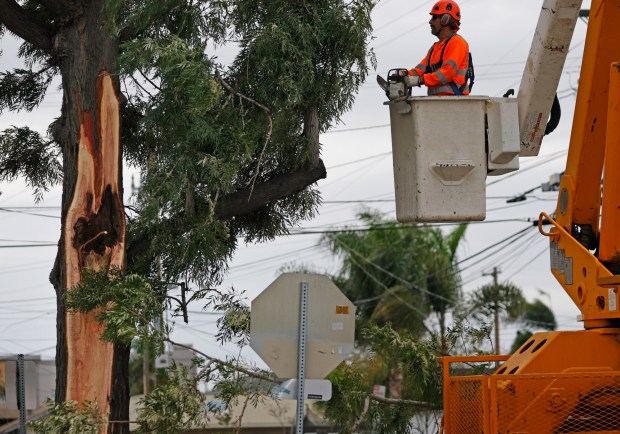 A tree trimmer prepares to cut branches on a tree at the corner of Marlborough Avenue and Wightman Street in City Heights where earlier branches fell and killed a man on Dec. 24, 2025, in San Diego. (K.C. Alfred / The San Diego Union-Tribune)
Other key drivers of the new deficit are a $13.4 million increase in expenses for overtime and $3.4 million to cover salaries and benefits for some newly hired employees.
In addition, revenues from the city’s cannabis tax will be $2.1 million lower than was projected at the beginning of the fiscal year last July, and revenue from ads on downtown wayfinding kiosks will be $1.4 million less than expected.
But the lowered projections for parking revenue are hitting the city particularly hard.
The $8.9 million drop from what Balboa Park was originally expected to bring in includes a number of factors: It’s $4.4 million lower because the start date was delayed from October to January, $3.3 million lower because of resident discounts and free three-hour parking at Inspiration Point and $1.1 million lower because of discounts for frequent users.
Paid parking in Balboa Park was initially projected to generate $12.5 million in the ongoing fiscal year.
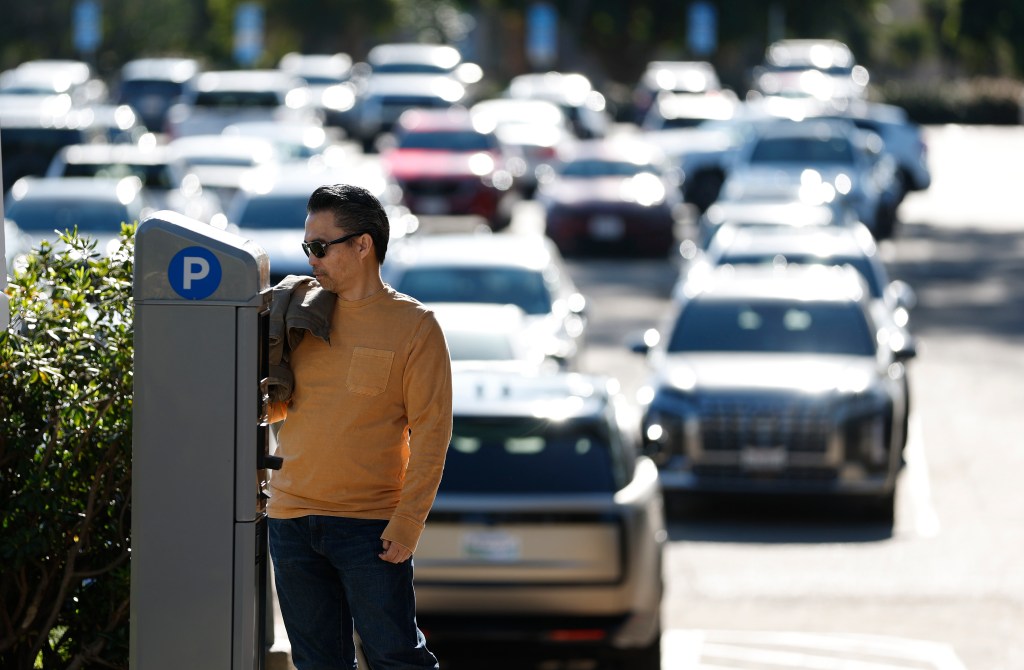
The city is also facing an unexpected $5 million drop in projected parking meter revenue, which is due largely to drivers reacting to fee increases and curbing their use of metered parking.
The analysis says $3.3 million of that drop is the result of an “unanticipated change in human behavior,” where drivers are staying at meters for shorter periods since hourly rates doubled from $1.25 to $2.50 a year ago.
Another $1.7 million drop is attributed to the city delaying the start of Sunday parking enforcement from January to April, and then deciding last week to cancel Sunday enforcement altogether.
On hotel taxes — which are projected to be $162.8 million, instead of the previous estimate of $170.3 million — the analysis said things could start to look up after a flat period.
While international, business and leisure travel are expected to remain below pre-pandemic levels through 2026, the analysis says soft rebounds are likely later this year.
The new gap would be much larger than $17 million if not for projected increases of $2 million each in sales and property tax, along with some other unexpected revenue and previous mitigation actions.
In late November, the mayor barred city departments from doing any hiring without his permission, suspended most overtime and asked department heads to limit training expenses and explore canceling or curtailing outside contracts.
The analysis says the next step will likely be near-immediate implementation of proposed spending cuts department heads had submitted for July 1 — the first day of fiscal year 2027.
“Opportunities for early implementation will be evaluated based on feasibility, timing and alignment with intended FY 2027 operations,” the analysis says.
The City Council will be made aware of those cuts if they significantly impact programs or services, like cuts to library hours.
“If any reductions are anticipated to be implemented in the current fiscal year that would result in a significant reduction in programs or services, the mayor will notify the City Council,” the analysis says.
Wednesday’s budget committee meeting is scheduled to begin at 9 a.m. at City Hall, 202 C St.