
Partygoers gathered to celebrate Diwali, the Hindu festival of lights, in a Jack London Square event hall in October, watching dance performances, listening to music, and eating heaps of catered food.
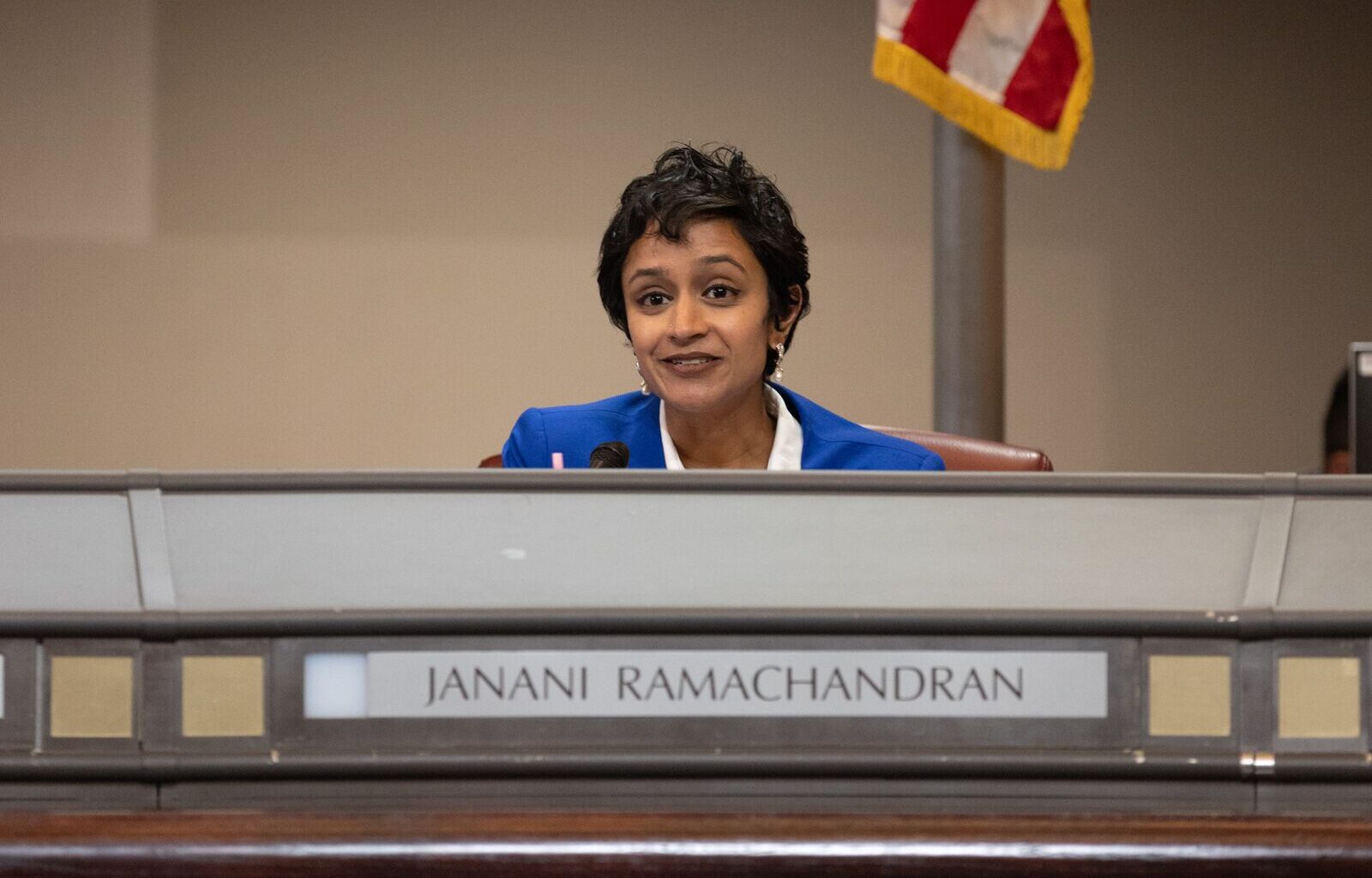
The free bash, attended by hundreds according to its organizers, was put on by Tiger Arts, a nonprofit created last February by Oakland Councilmember Janani Ramachandran, who is currently the group’s president. On Facebook, Ramachandran said, “Oakland Diwali 2025 was a NIGHT to remember!”
Diwali is like many other cultural celebrations in the city, showcasing the East Bay’s incredible diversity.
But government ethics experts say the way the event was paid for raises complicated questions about elected officials’ fundraising activities, specifically around behested payments in which public officials are allowed to act as the middlemen soliciting unlimited amounts of money from companies and foundations for other organizations.
To foot the bill for last year’s Diwali festival, Ramachandran solicited money from at least one company with business before the city, Waste Management’s Alameda County subsidiary. Ramachandran’s organization also asked for and received support from a lobbying firm that represents Waste Management and multiple clients who have come before city leaders in recent years, asking for contracts and other official city decisions affecting their businesses.
Ramachandran’s role as a decision maker on the City Council gives her direct authority over some city contracts. Ethics experts said this makes it ethically tricky for Ramachandran, in her capacity as board president of a nonprofit, to ask companies with business before the city to give money to her organization.
“That’s kind of ticking all of the wrong boxes,” said Delaney Marsco, an ethics director at the Campaign Legal Center.
Behested payments can complicate relationships between elected officials and contractors
Ramachandran’s fundraising activity most immediately raises questions about how she might handle city business that involves Waste Management.
The company sued Oakland last year over a complex contract dispute, which is still pending in state court. Oakland recently responded by filing a cross-complaint. The council has been briefed on this case, and one day Ramachandran and her colleagues may be tasked with approving a settlement or pushing for a trial.
Ramachandran did not respond to interview requests for this story. In an email, she provided some details about the Diwali event and noted that Tiger Arts’ sponsors were listed in a newsletter and on social media. Ramachandran also didn’t respond to several written questions, including whether she would recuse herself from any future vote to settle the Waste Management case. She has not been accused of violating any laws or ethics rules with respect to her nonprofit’s fundraising activities.
Waste Management officials did not respond to interview requests.
There are similar questions around the money Ramachandran’s organization received from the Kos-Read Group, a lobbying firm that represents Waste Management and several other companies that had business before the city last year. In a disclosure report, Isaac Kos-Read, the founder and president of the firm, reported that he had an informational meeting with Ramachandran in 2025 to discuss “how [Waste Management] can best serve Oakland, addressing illegal dumping and ensuring affordable rates.”
In an email, Kos-Read confirmed that Ramachandran’s nonprofit asked him for financial support. He said his firm provided a “modest sponsorship” consistent with other events they’ve sponsored, but couldn’t recall the exact amount or when he was contacted. State law only requires elected officials to report a behested payment if it exceeds $5,000 from a source in a single year.
Ramachandran voted multiple times last year on legislation that benefited some of Kos-Read’s clients.
In June, the City Council approved a deal to give Becker Boards, an advertising company, the right to set up new billboards around town in exchange for up to roughly $2.3 million upfront and free ads for some local organizations, plus millions of dollars over the lifetime of the agreement. Ramachandran co-sponsored the legislation. She was also part of a team of councilmembers who recommended that the revenue from this agreement be included in the city’s new budget before the deal had been finalized. Kos-Read co-hosted a reelection campaign launch for Ramachandran a month before this vote, according to an event flier.
In December, Ramachandran and the rest of the council voted to authorize the city administrator to negotiate with Costco and a developer called Deca Companies for a potential big box store on the former Oakland Army Base. Deca is a Kos-Read client.
That same month, Ramachandran joined her colleagues in approving legislation to forgive $8 million in outstanding loans for two properties owned by affiliates of the East Bay Asian Local Development Corporation, or EBALDC. EBALDC is a client of Kos-Read, and last year, he reported contacting Ramachandran and several other councilmembers to support “policies, projects, and legislative initiatives to help EBALDC” to preserve and maintain community developments.
Kos-Read told The Oaklandside he did not pay Ramachandran’s nonprofit to influence her decisions around his clients.
He said his lobbying firm “celebrates every community that makes Oakland so beautiful – Vietnamese, Latino, Chinese, Native American, African American, and more. So this was a natural complement.”
Elected officials are allowed to ask lobbyists and contractors for donations, but ethics experts say the practice is fraught
Under California law, public officials can ask companies, including lobbying firms and foundations, to donate money to organizations, usually local nonprofits and civic groups performing some kind of service. This kind of fundraising, where the elected official plays a middleman role, is known as a behested payment.
The rules for behested payments are different from those that apply to politicians’ campaign activities. Unlike campaign fundraising, there’s no limit on how much money officials can solicit through a behested payment. But they need to report any money they raise that exceeds $5,000 from a single source in a year. There are few restrictions on what kinds of groups elected officials can steer the money to.
This has made behested payments popular among California officials. In Oakland, former Mayor Libby Schaaf solicited millions of dollars from foundations and major companies for local educational programs. Mayor Barbara Lee has asked for hundreds of thousands of dollars to support civic causes and even pay for staff for her office.
By comparison, Ramachandran hasn’t solicited much money. In reports filed with the Public Ethics Commission, which tracks behested payments in Oakland, the councilmember reported soliciting $5,000 each from Waste Management and Kaiser Permanente to support Tiger Arts.
But Waste Management’s contribution appears to mark the first time an Oakland elected official has reported soliciting money from a city contractor to fund a nonprofit that the official also leads as a board president. The Oaklandside was unable to find an equivalent example in the city’s database of payment reports, which goes back to 2017.
State law doesn’t prohibit elected officials from using behested payments to fund nonprofits they run. But ethics experts say Ramachandran may have created the perception of a conflict of interest.
“Even if everything is all above board, there’s always now going to be a question in the minds of the public about whether that arrangement was corrupt or not,” said Delaney Marsco, an ethics director at the Campaign Legal Center who previously issued recommendations to San Francisco on how to create stricter anti-corruption rules around behested payments.
Ramachandran confirmed in an email to us that she is the founder and board president of Tiger Arts. (Ramachandran also uses an image of a tiger as her campaign logo on her website.)
“I do not receive compensation of any kind from Tiger Arts or the Oakland Diwali festival,” Ramachandran wrote.
Marsco said it’s immaterial whether a politician in Ramachandran’s situation personally received any money through her nonprofit.
“They have a very serious personal interest in the success of the nonprofit,” Marsco said. “The willingness to engage financially in this way with something that is important to the lawmaker on a personal level creates these conditions for a conflict of interest.”
Behested payments have been a vehicle for corruption in other cities
Behested payments have been the focus of reform in other cities because of the real and perceived conflicts they create.
One of the most notorious cases involved Mohammed Nuru, head of San Francisco’s Public Works Department. In 2020, federal agents arrested Nuru and charged him with accepting bribes from city contractors and developers. A detail that emerged in the case was that Nuru had used behested payments to solicit hundreds of thousands of dollars from the city’s curbside trash company, whose rates he regulated, to go to a local nonprofit that he controlled. Nuru then used the money to pay for meals and events for himself and his staff. He and a city contractor also discussed the possibility of using behested payments to bribe an airport commissioner.
In a subsequent report, staff at the San Francisco Ethics Commission documented how behested payments had become a workaround for officials to solicit favors from lobbyists and contractors.
Former Supervisor Mark Farrell, according to the report, steered hundreds of thousands of dollars in behested payments to a nonprofit organization he favored. Some of these payments were made by contractors who were seeking business with the city. Under city laws at the time, Farrell was barred from soliciting or accepting gifts from the contractors and lobbyists. But he was legally allowed to ask them to give money to a third party.
“If officials or employees request payments from people seeking to influence, it can create a perception by those people and by the public that the payments are solicited in exchange for the official’s or employee’s support,” San Francisco’s ethics commission staff wrote in the report.
In 2022, San Francisco voters approved a ballot measure barring members of the Board of Supervisors from seeking behested payments from contractors if the board had approved their contract. San Francisco’s ethics rules also currently prohibit public officials from asking “interested parties” to make behested payments, with some limited exceptions. An interested party is basically anyone who wants to influence a specific city official. That applies to anyone seeking a license or permit from the city, city contractors, people trying to do business with the city, and lobbyists.
Oakland follows state law and has no such restrictions. Elected officials here appear to be free to solicit behested payments from city contractors and lobbyists, so long as the payment doesn’t qualify as a gift or an election-related contribution. The California Fair Political Practices Commission, which regulates behested payments at the state level, says officials who solicit money for an organization they’re involved in must disclose that fact in their reports.
Oakland does have rules that limit city contractors from giving money to politicians. But behested payments aren’t considered campaign contributions, so they aren’t subject to these guardrails, said Suzanne Doran, executive director of Oakland’s Public Ethics Commission.
“Additionally, since they are not considered gifts to the official, they are not subject to the City’s $50 gift limit for those doing or seeking to do business with the City,” Doran told The Oaklandside.
Davina Hurt, the director of government ethics at the Markkula Center for Applied Ethics, said it’s relatively common for elected officials to sit on the boards of nonprofit organizations and that they’re entitled to support causes in their communities.
But this can create problems when an elected official takes on a fundraising role in a nonprofit, she said, especially if it involves soliciting money from businesses the official has some authority over.
“A business owner might think if I don’t donate, then things may be getting more troubling for me, or I may not get the role I want in the city,” Hurt said. “Even if it’s not the official’s intent, the power imbalance is real.”
For his part, Kos-Read said his firm has given money to other nonprofits run by elected officials, but didn’t say whether any of them worked in Oakland. When we asked if his firm had ever contributed money to support events organized by Oakland elected officials, Kos-Read said, “Many.”
Asked if he plans to contribute money to Tiger Arts again in 2026, Kos-Read wrote, “Yes!”
“*” indicates required fields