
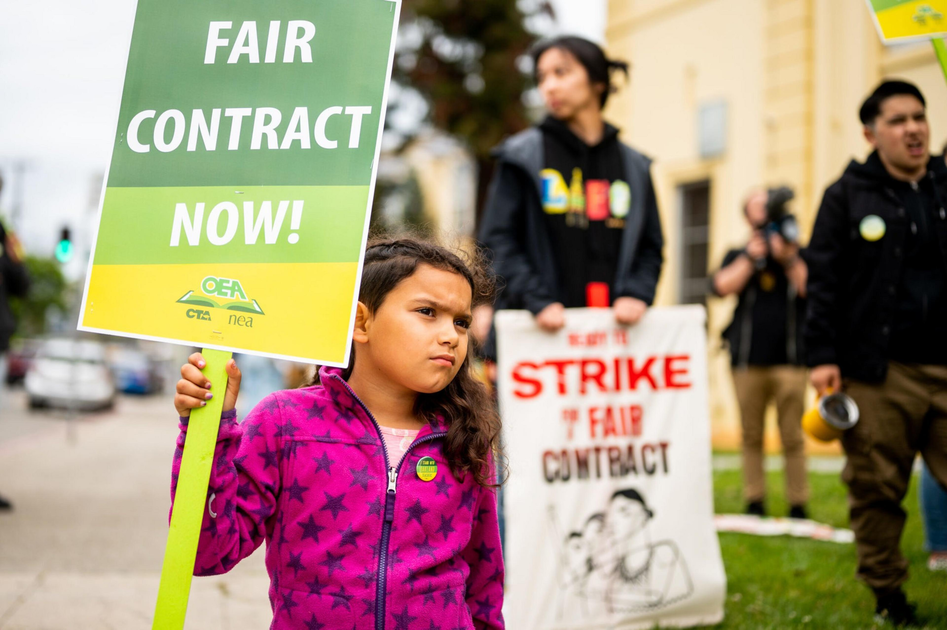
As I write this, San Francisco’s public schools are on the brink of a teachers strike — the first in 47 years. A neutral, third-party, fact-finding report is expected to be released Wednesday, summarizing the financial health of the San Francisco Unified School District and its ability to meet the demands of the 6,000-member United Educators of San Francisco.
But let’s face it: The findings won’t be surprising. The SFUSD will not be able to meet the union’s demands for substantial pay raises and increased benefits. The UESF will likely go on strike.
Fortunately, none of this is a foregone conclusion. There are solutions staring us right in the face — if both parties are willing to lock arms, set aside impossible demands, and lobby the state to reform how it allocates funding to public schools.
For more than a year, the SFUSD’s Board of Education has been engaged in the difficult but necessary work of stabilizing the district’s finances. This work is rooted in the twin goals of exiting state oversight and ensuring that the district has a durable foundation to serve students for decades to come. As a parent of three children in public education and the PTA president of McKinley Elementary School, I have observed in recent board meetings how district leaders approached that work with discipline and pragmatism — characteristics that haven’t always been associated with San Francisco public schools.
One example was the board’s action in December to establish a rainy-day reserve fund equal to 8% of the district’s budget, approximately $111 million. This was a concrete step rooted in sound public-sector financial management, adopted under state recommendations, and designed with a clear intention to protect classrooms for the years ahead.
Now, with the ink still wet from adopting this policy, UESF leaders are calling for the district to use these emergency funds to pay for ongoing teacher salary increases. Like so many of my fellow public school parents, I deeply respect our educators and recognize the importance of competitive compensation. I have often (opens in new tab) advocated (opens in new tab) to ensure we have the necessary resources at our schools. But the notion of using one-time reserves for permanent costs is a recipe for failure.
First, the math simply does not work. Even if the district were to exhaust the entire $111 million reserve, those funds would not cover all three years of the wage increases and benefits our educators are requesting. That is not a sustainable, long-term plan. Draining these one-time funds would eventually create an unwarranted financial cliff that would trigger deeper cuts and layoffs.
Second, draining the reserve would leave the district dangerously exposed. We have seen, very recently, why reserves matter. Late last year, the city and county of San Francisco drew on $9 million in emergency funds to backfill SNAP benefits — food vouchers for low-income residents — when there was a lapse in federal benefits due to the government shutdown. In light of the current national climate, we need to protect our education system by having a buffer from unexpected external factors.
I would like to suggest an alternative for the sake of our students, teachers, and the future of public education. Let’s agree on a shorter-term contract — say, two years instead of three, with the district granting the UESF 65% of what it’s asking for — with one condition: SFUSD and the union will pour their collective energy and advocacy into convincing Gov. Gavin Newsom and state Superintendent of Public Instruction Tony Thurmond to fix the dysfunctional way California allocates education funding. Seventy percent of SFUSD’s funding comes from the state’s Local Control Funding Formula, which has major flaws that are hurting the biggest cities, especially San Francisco.
We can fix this in three principle ways.
• The state must shift to enrollment-based funding. The current model of average daily attendance disproportionately impacts minorities and those who are socioeconomically disadvantaged. Without the shift, you continue to restrict the funding for those who need it the most.
• We must adjust how “low-income” is defined when calculating funding for people in need. Currently, a family of four needs a household income of $80,600 or less to be qualified as low-income. The reality is that in the Bay Area, you can make almost double that — $156,500 or less — and be hobbled by the local cost of living.
• We must shift how the state allocates cost-of-living adjustments to school districts, decoupling from federal standards and better reflecting the inflationary realities of California and the Bay Area. Teachers can’t survive with a 2.4% annual salary adjustment when local inflation was recorded to be at least 4.3% on average in 2025.
I conservatively estimate that these three adjustments alone would equitably reallocate at least $25 million annually to San Francisco to support education and our teachers.
Of course, these changes — while dramatically improving urban districts’ financial health — would not be a panacea. SFUSD must join forces (opens in new tab) with other major districts that are facing the same funding inequities from the state. Imagine school districts and unions going hand in hand to Sacramento, fighting for what is right, fixing a funding model that has been broken for decades.
We have a chance to build a school system that is strong enough to weather uncertainty and focused enough to deliver for every student. But it only happens when we work together, not tear ourselves apart.
Rasheq Zarif is a commercial real estate partner. He volunteers as president of the McKinley Elementary School PTA and the Buena Vista Neighborhood Association and co-led a 2025 initiative that raised millions for community groups affected by mismanagement at the San Francisco Parks Alliance.